115195
论文已发表
注册即可获取德孚的最新动态
IF 收录期刊
- 3.6 Breast Cancer (Dove Med Press)
- 4.3 Clin Epidemiol
- 2.6 Cancer Manag Res
- 3.2 Infect Drug Resist
- 4.1 Clin Interv Aging
- 6.1 Drug Des Dev Ther
- 4.1 Int J Chronic Obstr
- 8.7 Int J Nanomed
- 2.5 Int J Women's Health
- 3.2 Neuropsych Dis Treat
- 2.4 OncoTargets Ther
- 2.6 Patient Prefer Adher
- 2.6 Ther Clin Risk Manag
- 3.1 J Pain Res
- 3.5 Diabet Metab Synd Ob
- 4.5 Psychol Res Behav Ma
- 3.4 Nat Sci Sleep
- 2.4 Pharmgenomics Pers Med
- 2.6 Risk Manag Healthc Policy
- 4.6 J Inflamm Res
- 2.3 Int J Gen Med
- 3.9 J Hepatocell Carcinoma
- 3.3 J Asthma Allergy
- 2.5 Clin Cosmet Investig Dermatol
- 3.0 J Multidiscip Healthc

全基因组分析揭示了中国艰难梭菌 NAP1/BI/027/ST1 临床分离株的分子特征的新见解
Authors Lv T, Chen Y, Guo L, Xu Q, Gu S, Shen P, Quan J, Fang Y, Chen L, Gui Q, Ye G, Li L
Received 28 January 2019
Accepted for publication 8 May 2019
Published 1 July 2019 Volume 2019:12 Pages 1783—1794
DOI https://doi.org/10.2147/IDR.S203238
Checked for plagiarism Yes
Review by Single-blind
Peer reviewers approved by Dr Cristina Weinberg
Peer reviewer comments 2
Editor who approved publication: Professor Suresh Antony
Background: The epidemic new strain NAP1/BI/027/ST-1 of Clostridioides difficile (C. difficile ) causes more severe coliti and a higher mortality rate than historical strains. However, C. difficile NAP1/BI/027/ST-1 (C. difficile RT027) infections have been rarely reported in Asia, particularly in China.
Purpose: The objective of this study was to strengthen the understanding of the molecular characterizations of C. difficile RT027 in China.
Patients and methods: Two C. difficile NAP1/BI/027/ST-1 were detected from two patients, and no additional isolates were found. Whole genome sequencing (WGS) was used to characterize two C. difficile RT027 isolates and control strain CD6 (from Hong Kong), and comparative genomic analysis was performed to compare genomic differences between seven isolates from Mainland China, CD6, and 10 isolates from North America and Europe.
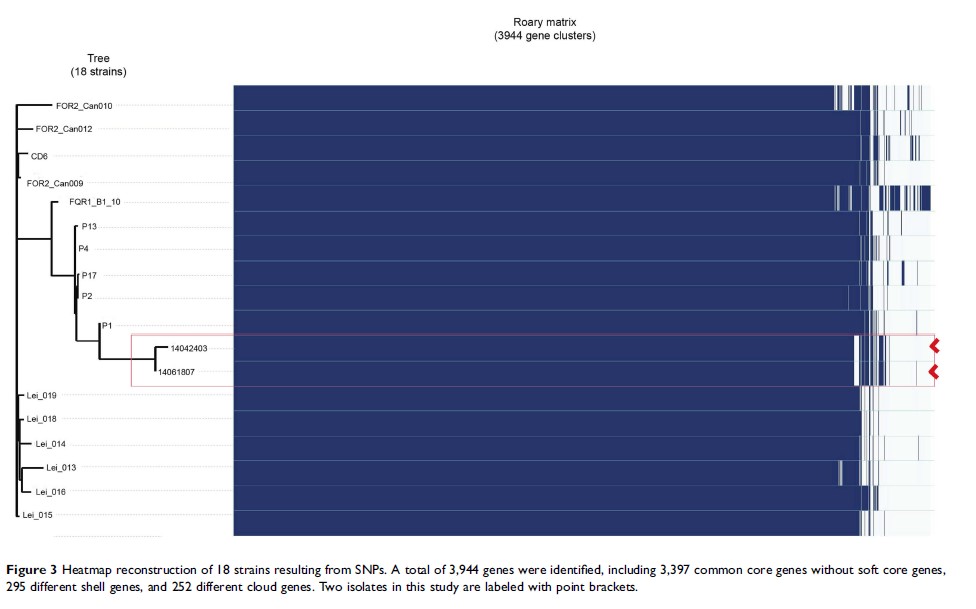
Results: The comparative genomic analysis revealed that isolates obtained from Mainlan China were outside of the two epidemic lineages, FQR1 and FQR2, and might have decreased virulence and transmissibility for outbreak. Furthermore, unique SNP mutations were detected in isolates obtained from Mainland China, which may affect the biological function of C. difficile .
Conclusion: We speculate that C. difficile RT027 isolates in Mainland China may have different features, compared to those in North America and Europe.
Keywords: People’s Republic of China, multilocus sequence typing, Clostridioides difficile infection, whole genome sequencing