115195
论文已发表
注册即可获取德孚的最新动态
IF 收录期刊
- 3.6 Breast Cancer (Dove Med Press)
- 4.3 Clin Epidemiol
- 2.6 Cancer Manag Res
- 3.2 Infect Drug Resist
- 4.1 Clin Interv Aging
- 6.1 Drug Des Dev Ther
- 4.1 Int J Chronic Obstr
- 8.7 Int J Nanomed
- 2.5 Int J Women's Health
- 3.2 Neuropsych Dis Treat
- 2.4 OncoTargets Ther
- 2.6 Patient Prefer Adher
- 2.6 Ther Clin Risk Manag
- 3.1 J Pain Res
- 3.5 Diabet Metab Synd Ob
- 4.5 Psychol Res Behav Ma
- 3.4 Nat Sci Sleep
- 2.4 Pharmgenomics Pers Med
- 2.6 Risk Manag Healthc Policy
- 4.6 J Inflamm Res
- 2.3 Int J Gen Med
- 3.9 J Hepatocell Carcinoma
- 3.3 J Asthma Allergy
- 2.5 Clin Cosmet Investig Dermatol
- 3.0 J Multidiscip Healthc

诊断时的白蛋白与碱性磷酸酶比率可预测转移性非小细胞肺癌患者的生存率
Authors Li D, Yu H, Li W
Received 29 January 2019
Accepted for publication 7 May 2019
Published 2 July 2019 Volume 2019:12 Pages 5241—5249
DOI https://doi.org/10.2147/OTT.S203321
Checked for plagiarism Yes
Review by Single-blind
Peer reviewers approved by Ms Shreya Arora
Peer reviewer comments 2
Editor who approved publication: Dr Takuya Aoki
Background: Previous studies have reported that the albumin-to-alkaline phosphatase ratio (AAPR), a novel blood biomarker-based index, is associated with clinical outcome in several cancers. However, data relating to lung cancer are rare. This study was performed to clarify the clinical significance of AAPR in patients with metastatic non-small-cell lung cancer (NSCLC).
Methods: In total, 290 stage IV NSCLC patients were enrolled in this retrospective study. Associations between serum enzyme levels and clinical characteristics were analyzed using the Mann–Whitney U-test or chi-squared test. Kaplan–Meier survival analysis and Cox’s proportional hazard regression model were adopted to assess the prognostic value of AAPR for overall survival (OS).
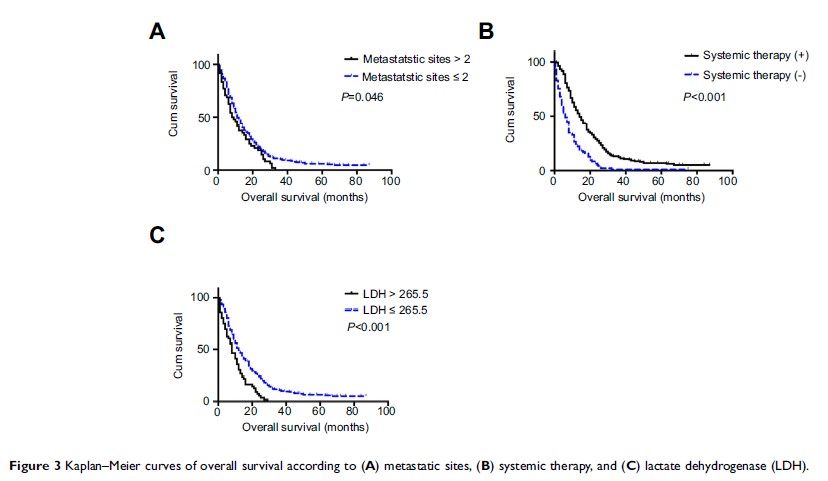
Results: The optimal cut-off points for AAPR and lactate dehydrogenase (LDH) were 0.36 and 265.5 U/L, respectively. Patients with AAPR ≤0.36 had apparently longer survival than those with AAPR >0.36 (13 vs 7 months, P <0.001). Furthermore, AAPR was an independent predictor of OS in metastatic NSCLC in multivariate analysis (HR=0.657, 95% CI=0.504–0.856, P <0.01). The prognostic impact of LDH for survival of NSCLC populations was also validated in this study (HR=1.462, 95% CI=1.070–1.999, P <0.05).
Conclusion: Elevated AAPR can be an independent favorable prognostic indicator in metastatic NSCLC.
Keywords: AAPR, LDH, NSCLC, prognosis