117518
论文已发表
注册即可获取德孚的最新动态
IF 收录期刊
- 3.6 Breast Cancer (Dove Med Press)
- 4.3 Clin Epidemiol
- 2.6 Cancer Manag Res
- 3.2 Infect Drug Resist
- 4.1 Clin Interv Aging
- 6.1 Drug Des Dev Ther
- 4.1 Int J Chronic Obstr
- 8.7 Int J Nanomed
- 2.5 Int J Women's Health
- 3.2 Neuropsych Dis Treat
- 2.4 OncoTargets Ther
- 2.6 Patient Prefer Adher
- 2.6 Ther Clin Risk Manag
- 3.1 J Pain Res
- 3.5 Diabet Metab Synd Ob
- 4.5 Psychol Res Behav Ma
- 3.4 Nat Sci Sleep
- 2.4 Pharmgenomics Pers Med
- 2.6 Risk Manag Healthc Policy
- 4.6 J Inflamm Res
- 2.3 Int J Gen Med
- 3.9 J Hepatocell Carcinoma
- 3.3 J Asthma Allergy
- 2.5 Clin Cosmet Investig Dermatol
- 3.0 J Multidiscip Healthc

本文章已被撤回:二氢丹参酮I通过 Wnt/β-连环蛋白信号通路抑制骨肉瘤的生长
Authors Tan T, Chen J, Hu Y, Wang N, Chen Y, Yu T, Lin D, Yang S, Luo J, Luo X
Received 9 February 2019
Accepted for publication 28 May 2019
Published 2 July 2019 Volume 2019:12 Pages 5111—5122
DOI https://doi.org/10.2147/OTT.S204574
Checked for plagiarism Yes
Review by Single-blind
Peer reviewers approved by Ms Rachel Predeepa
Peer reviewer comments 3
Editor who approved publication: Prof. Dr. Geoffrey Pietersz
***本文章已被撤回***
Background: Osteosarcoma is a common malignant tumor, with relatively lower survival rates in adolescents. Dihydrotanshinone I (DHI) was extracted from the traditional Chinese medicine Salvia miltiorrhiza and was shown to inhibit several types of cancer.
Purpose: To explore the effect of DHI on the proliferation, migration, invasion, and apoptosis of osteosarcoma cells, as well as the possible molecular mechanism.
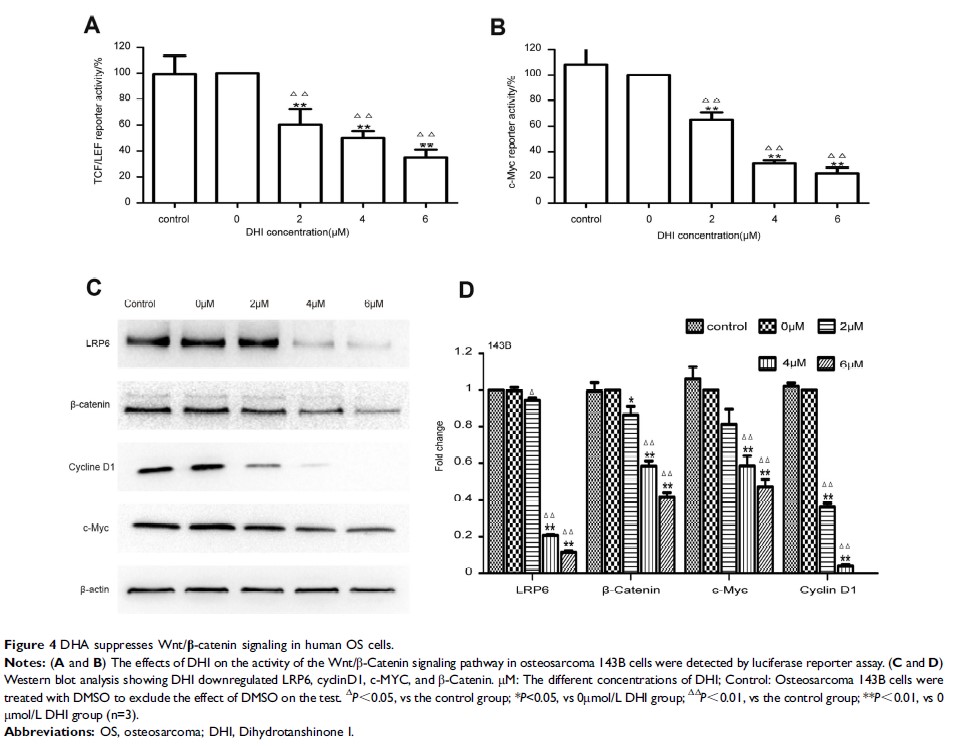
Methods: The effect of DHI on the proliferation of osteosarcoma was detected by crystal violet assay, MTT assay, colony formation assay. The effects of DHI on the migration and invasion of osteosarcoma were detected by wound healing assays, cell migration and invasion assays. The effect of DHI on apoptosis of osteosarcoma was detected by cell apoptosis assay and Hoechst apoptosis staining. The protein expression levels were detected by Western blotting assay. The activity of Wnt/β-Catenin signaling pathway was detected by luciferase reporter assay and Western blot. The inhibitory effect of DHI on osteosarcoma in vivo was analyzed by an orthotopic OS tumor animal model and immunohistochemistry.
Result: DHI may inhibit the proliferation, decrease the migration, reduce the invasion, and promote the apoptosis of osteosarcoma cells. In vivo mouse model, DHI can inhibit the formation of osteosarcoma. In terms of mechanism, DHI may inhibit both the transcriptional activity and the total protein level of β-catenin.
Conclusion: DHI may inhibit the proliferation, migration, and invasion as well as induce the apoptosis of osteosarcoma cells, possibly through suppressing the Wnt/β-catenin signaling pathway.
Keywords: dihydrotanshinone I, osteosarcoma, Wnt/β-catenin signalling pathway, proliferation, migration, invasion