117518
论文已发表
注册即可获取德孚的最新动态
IF 收录期刊
- 3.6 Breast Cancer (Dove Med Press)
- 4.3 Clin Epidemiol
- 2.6 Cancer Manag Res
- 3.2 Infect Drug Resist
- 4.1 Clin Interv Aging
- 6.1 Drug Des Dev Ther
- 4.1 Int J Chronic Obstr
- 8.7 Int J Nanomed
- 2.5 Int J Women's Health
- 3.2 Neuropsych Dis Treat
- 2.4 OncoTargets Ther
- 2.6 Patient Prefer Adher
- 2.6 Ther Clin Risk Manag
- 3.1 J Pain Res
- 3.5 Diabet Metab Synd Ob
- 4.5 Psychol Res Behav Ma
- 3.4 Nat Sci Sleep
- 2.4 Pharmgenomics Pers Med
- 2.6 Risk Manag Healthc Policy
- 4.6 J Inflamm Res
- 2.3 Int J Gen Med
- 3.9 J Hepatocell Carcinoma
- 3.3 J Asthma Allergy
- 2.5 Clin Cosmet Investig Dermatol
- 3.0 J Multidiscip Healthc

新辅助化疗与局部晚期胃癌前期手术后的术后发病率和死亡率:倾向评分匹配分析
Authors Wu L, Ge L, Qin Y, Huang M, Chen J, Yang Y, Zhong J
Received 1 February 2019
Accepted for publication 31 May 2019
Published 3 July 2019 Volume 2019:11 Pages 6011—6018
DOI https://doi.org/10.2147/CMAR.S203880
Checked for plagiarism Yes
Review by Single-blind
Peer reviewers approved by Dr Colin Mak
Peer reviewer comments 2
Editor who approved publication: Dr Eileen O'Reilly
Background: Cohort studies have shown that neoadjuvant chemotherapy (NAC) is not associated with increased risk of postoperative complications and mortality as compared to upfront surgery (SURG).
Objective: The aim of this study was to compare postoperative morbidity and mortality after NAC with SURG.
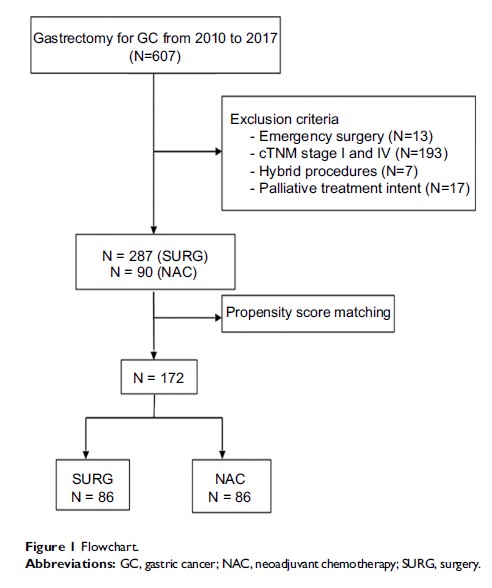
Patients and methods: Patients who underwent gastrectomy with D2 lymphadenectomy for advanced gastric cancer (GC) between 2010 and 2017 were selected. The impact of neoadjuvant chemotherapy on surgical safety was investigated by using propensity score matching.
Results: Three hundred and seventy-seven patients were included. After propensity score matching, 86 patients in each group were matched. The percentage of patients with one or more complications was 10.5% in NAC group and 15.1% in SURG group (P =0.361), there was no mortality developed in either group. The total blood loss was significantly more in the NAC group than that in the SURG group (320.79 vs 243.37 ml, P <0.04). In univariate and multivariate of the matched cohort, sex, age (<70), BMI (<24), ASA grade, surgical procedure (open vs laparoscopy), gastrectomy extent, cTNM and Charlson index comorbidity were not associated with postoperative complications (all P >0.05).
Conclusion: This study showed that postoperative morbidity and mortality were similar for NAC group and SURG group.
Keywords: gastric cancer, surgery, postoperative morbidity, propensity score, neoadjuvant chemotherapy