117518
论文已发表
注册即可获取德孚的最新动态
IF 收录期刊
- 3.6 Breast Cancer (Dove Med Press)
- 4.3 Clin Epidemiol
- 2.6 Cancer Manag Res
- 3.2 Infect Drug Resist
- 4.1 Clin Interv Aging
- 6.1 Drug Des Dev Ther
- 4.1 Int J Chronic Obstr
- 8.7 Int J Nanomed
- 2.5 Int J Women's Health
- 3.2 Neuropsych Dis Treat
- 2.4 OncoTargets Ther
- 2.6 Patient Prefer Adher
- 2.6 Ther Clin Risk Manag
- 3.1 J Pain Res
- 3.5 Diabet Metab Synd Ob
- 4.5 Psychol Res Behav Ma
- 3.4 Nat Sci Sleep
- 2.4 Pharmgenomics Pers Med
- 2.6 Risk Manag Healthc Policy
- 4.6 J Inflamm Res
- 2.3 Int J Gen Med
- 3.9 J Hepatocell Carcinoma
- 3.3 J Asthma Allergy
- 2.5 Clin Cosmet Investig Dermatol
- 3.0 J Multidiscip Healthc

LINC01116 沉默通过上调 microRNA-136 抑制口腔鳞状细胞癌的发展,从而遏制 FN1
Authors Chen Z, Tao Q, Qiao B, Zhang L
Received 9 December 2018
Accepted for publication 25 May 2019
Published 3 July 2019 Volume 2019:11 Pages 6043—6059
DOI https://doi.org/10.2147/CMAR.S197583
Checked for plagiarism Yes
Review by Single-blind
Peer reviewers approved by Dr Cristina Weinberg
Peer reviewer comments 3
Editor who approved publication: Dr Ahmet Emre Eskazan
Background: Oral squamous cell carcinoma (OSCC), one of the most common cancers worldwide with a high mortality rate, is accompanied by poor prognosis, highlighting the significance of early diagnosis and effective treatment. Long non-coding RNAs (lncRNAs) have been linked with the development and progression of various cancers. In this study, aberrantly expressed lncRNA LINC01116, microRNA-136 (miR-136), and fibronectin1 (FN1) were identified in OSCC using a microarray analysis. Therefore, this study aimed to investigate the role of LINC01116/miR-136/FN1 regulatory axis in OSCC.
Methods: The gain-of-function and loss-of-function experiments in vitro were performed to alter the expression of LINC01116 and miR-136 in OSCC cells to elucidate their effects on cellular processes, including epithelial–mesenchymal transition (EMT), viability, invasion, and migration. In addition, the interaction among LINC01116, miR-136, and FN1 was identified. Additionally, the tumorigenicity and lymph node metastasis (LNM) affected by LINC01116 were observed through xenograft tumor in nude mice.
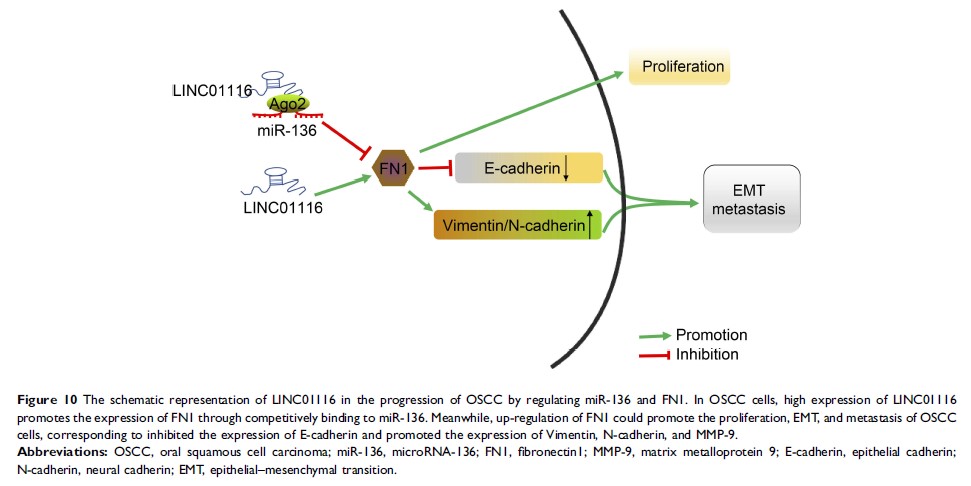
Results: LINC01116 and FN1 were abundant in both OSCC tissues and cells, while miR-136 was poorly expressed. LINC01116 could competitively bind to miR-136, which targets and negatively regulates FN1. Moreover, in response to LINC01116 silencing or miR-136 over-expression, OSCC cells exhibited diminished EMT process and inhibited cell viability, invasion, and migration in vitro, coupling with impaired tumorigenicity and LNM in vivo.
Conclusion: The fundamental findings in this study collectively demonstrate that LINC01116 silencing may inhibit the progression of OSCC via the miR-136-mediated FN1 inhibition, highlighting a promising therapeutic strategy for OSCC treatment.
Keywords: long non-coding RNA LINC01116, fibronectin 1, microRNA-136, oral squamous cell carcinoma, epithelial–mesenchymal transition, lymph node metastasis