117518
论文已发表
注册即可获取德孚的最新动态
IF 收录期刊
- 3.6 Breast Cancer (Dove Med Press)
- 4.3 Clin Epidemiol
- 2.6 Cancer Manag Res
- 3.2 Infect Drug Resist
- 4.1 Clin Interv Aging
- 6.1 Drug Des Dev Ther
- 4.1 Int J Chronic Obstr
- 8.7 Int J Nanomed
- 2.5 Int J Women's Health
- 3.2 Neuropsych Dis Treat
- 2.4 OncoTargets Ther
- 2.6 Patient Prefer Adher
- 2.6 Ther Clin Risk Manag
- 3.1 J Pain Res
- 3.5 Diabet Metab Synd Ob
- 4.5 Psychol Res Behav Ma
- 3.4 Nat Sci Sleep
- 2.4 Pharmgenomics Pers Med
- 2.6 Risk Manag Healthc Policy
- 4.6 J Inflamm Res
- 2.3 Int J Gen Med
- 3.9 J Hepatocell Carcinoma
- 3.3 J Asthma Allergy
- 2.5 Clin Cosmet Investig Dermatol
- 3.0 J Multidiscip Healthc

幽门螺杆菌通过 Wnt/β-catenin 信号通路上调 TRPC6,促进胃癌迁移和侵袭
Authors Song Y, Liu G, Liu S, Chen R, Wang N, Liu Z, Zhang X, Xiao Z, Liu L
Received 10 January 2019
Accepted for publication 20 May 2019
Published 3 July 2019 Volume 2019:12 Pages 5269—5279
DOI https://doi.org/10.2147/OTT.S201025
Checked for plagiarism Yes
Review by Single-blind
Peer reviewers approved by Ms Aruna Narula
Peer reviewer comments 2
Editor who approved publication: Dr William Cho
Background: Helicobacter pylori infection is recognized as a major risk factor for gastric cancer (GC) progression; however, the underlying molecular mechanisms have remained to be fully elucidated.
Methods: qPCR and Western blot were used to detect mRNA level and relative protein expression. Wound healing assay and transwell were used to determine migration and invasion of cells. Calcium imaging was used to determine calcium signaling in cells. Luciferase reporter assay and immunohistochemistry were performed.
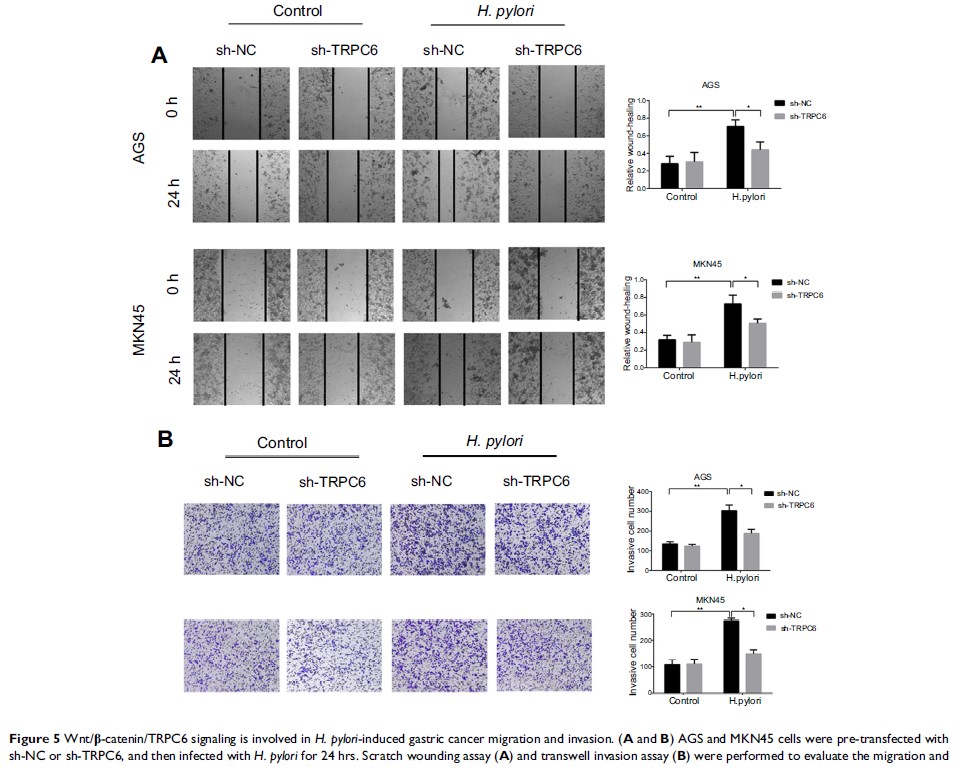
Results: In the present study, it was demonstrated that H. pylori infection in GC is closely associated with the depth of tumor invasion, lymph node metastasis, tumor-nodes-metastasis stage, and distant metastasis. Migration and invasion assays indicated that H. pylori infection enhanced the migration and invasion of GC cells in a Ca2+-dependent manner. Calcium imaging was applied to detect intracellular Ca2+ and revealed that H. pylori induced an increase of intracellular Ca2+ in GC cells through release from Ca2+ stores and extracellular Ca2+ influx. Further study indicated that H. pylori infection led to an upregulation of the expression of transient receptor potential cation channel subfamily C member 6 (TRPC6) and induced an increase of Ca2+ through the TRPC6 channel. Furthermore, H. pylori increased TRPC6 transcription through the Wnt/β-catenin pathway, and Wnt/β-catenin/TRPC6 signaling was identified to be at least in part responsible for H. pylori -induced GC migration and invasion. Finally, it was observed that TRPC6 expression was significantly associated with the H. pylori infection status in GC tissues, and H. pylori infection was associated with metastasis and poor prognosis for GC patients.
Conclusion: The present results indicate that H. pylori causes an upregulation of TRPC6 expression through the Wnt/β-catenin pathway to promote GC progression, and this interaction may serve as a promising target for GC therapy.
Keywords: helicobacter pylori, TRPC6, Wnt/β-catenin, calcium signaling, gastric cancer