117518
论文已发表
注册即可获取德孚的最新动态
IF 收录期刊
- 3.6 Breast Cancer (Dove Med Press)
- 4.3 Clin Epidemiol
- 2.6 Cancer Manag Res
- 3.2 Infect Drug Resist
- 4.1 Clin Interv Aging
- 6.1 Drug Des Dev Ther
- 4.1 Int J Chronic Obstr
- 8.7 Int J Nanomed
- 2.5 Int J Women's Health
- 3.2 Neuropsych Dis Treat
- 2.4 OncoTargets Ther
- 2.6 Patient Prefer Adher
- 2.6 Ther Clin Risk Manag
- 3.1 J Pain Res
- 3.5 Diabet Metab Synd Ob
- 4.5 Psychol Res Behav Ma
- 3.4 Nat Sci Sleep
- 2.4 Pharmgenomics Pers Med
- 2.6 Risk Manag Healthc Policy
- 4.6 J Inflamm Res
- 2.3 Int J Gen Med
- 3.9 J Hepatocell Carcinoma
- 3.3 J Asthma Allergy
- 2.5 Clin Cosmet Investig Dermatol
- 3.0 J Multidiscip Healthc

YAP/TAZ:鳞状细胞癌治疗的有希望的靶点
Authors Dong X, Meng L, Liu P, Ji R, Su X, Xin Y, Jiang X
Received 12 December 2018
Accepted for publication 4 June 2019
Published 8 July 2019 Volume 2019:11 Pages 6245—6252
DOI https://doi.org/10.2147/CMAR.S197921
Checked for plagiarism Yes
Review by Single-blind
Peer reviewers approved by Dr Colin Mak
Peer reviewer comments 2
Editor who approved publication: Dr Beicheng Sun
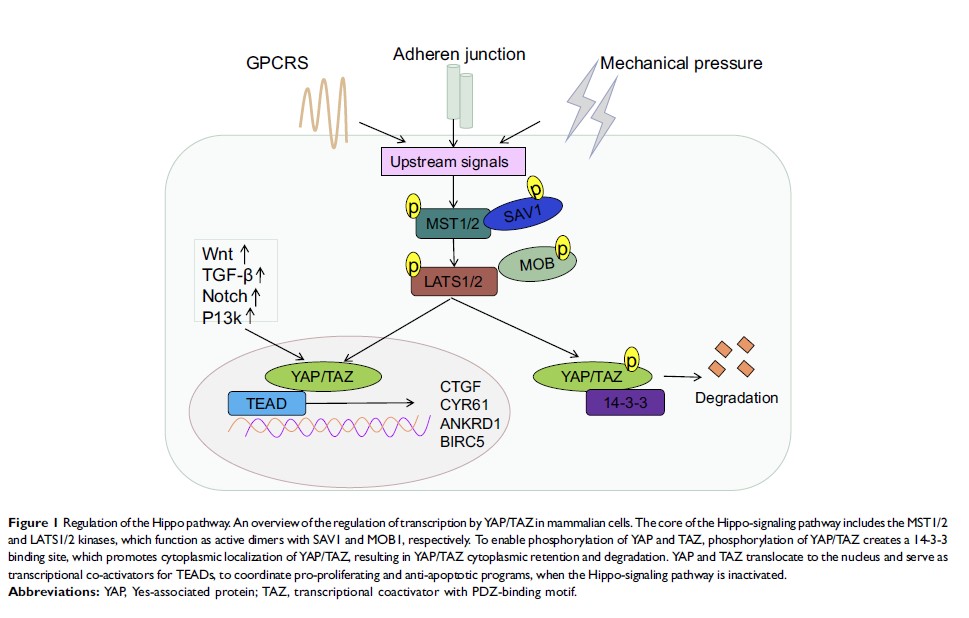
Abstract: Yes-associated protein (YAP) and transcriptional coactivator with PDZ-binding motif (TAZ) are two homologous transcriptional coactivators and the final effectors of the Hippo signaling transduction pathway. The transcriptional activity of YAP/TAZ is dependent on their recruitment to the nucleus, which promotes binding to the transcription factor of TEA domain family members 1–4 (TEAD1-4). In Hippo-signaling pathway, YAP/TAZ is inactivated and its translocation to the nucleus is blocked via a core kinase cascade stimulated by a variety of upstream signals, such as G-protein-coupled receptor signaling, mechanical pressure, and adherens junction signaling. This pathway plays a very important role in regulating organ size, tissue homeostasis, and tumor development. In recent years, many studies have reported upregulation or nuclear localization of YAP/TAZ in a number of human malignancies, such as breast cancer, melanoma, lung cancer, especially squamous cell carcinoma in different organs. A large number of experiments demonstrate that YAP/TAZ activation promotes cancer formation, progression, and metastasis. Therefore, in this review, we summarize the evidence of regulation and function of YAP/TAZ and discuss its role in squamous cell carcinoma. Collectively, this summary strongly suggests that targeting aberrant YAP/TAZ activation is a promising strategy for the suppression of squamous cell carcinoma.
Keywords: Hippo pathway, YAP/TAZ, squamous cell carcinoma