117518
论文已发表
注册即可获取德孚的最新动态
IF 收录期刊
- 3.6 Breast Cancer (Dove Med Press)
- 4.3 Clin Epidemiol
- 2.6 Cancer Manag Res
- 3.2 Infect Drug Resist
- 4.1 Clin Interv Aging
- 6.1 Drug Des Dev Ther
- 4.1 Int J Chronic Obstr
- 8.7 Int J Nanomed
- 2.5 Int J Women's Health
- 3.2 Neuropsych Dis Treat
- 2.4 OncoTargets Ther
- 2.6 Patient Prefer Adher
- 2.6 Ther Clin Risk Manag
- 3.1 J Pain Res
- 3.5 Diabet Metab Synd Ob
- 4.5 Psychol Res Behav Ma
- 3.4 Nat Sci Sleep
- 2.4 Pharmgenomics Pers Med
- 2.6 Risk Manag Healthc Policy
- 4.6 J Inflamm Res
- 2.3 Int J Gen Med
- 3.9 J Hepatocell Carcinoma
- 3.3 J Asthma Allergy
- 2.5 Clin Cosmet Investig Dermatol
- 3.0 J Multidiscip Healthc

分析药物受益方案对中国城市老年人抗高血压药物依从性的影响
Authors Ma X, Zhang Y, Zhang M, Li X, Yin H, Li K, Jing M
Received 15 January 2019
Accepted for publication 19 June 2019
Published 11 July 2019 Volume 2019:13 Pages 1111—1123
DOI https://doi.org/10.2147/PPA.S201707
Checked for plagiarism Yes
Review by Single-blind
Peer reviewers approved by Ms Justinn Cochran
Peer reviewer comments 3
Editor who approved publication: Dr Naifeng Liu
Purpose: Hypertension is a rapidly growing epidemic in People’s Republic of China, yet it remains inadequately controlled. This study aimed to identify the relative contributions of program effects and patients’ characteristics to the differences in antihypertensive medication nonadherence between drug benefit program enrollees and non-enrollees.
Patients and methods: Data were from a cross-sectional survey of 1,969 community-dwelling elderly adults with hypertension. Self-reported adherence was measured following previous studies in People’s Republic of China. The Blinder-Oaxaca nonlinear decomposition method was used to identify the relative contributions of program effects and patients’ individual characteristics.
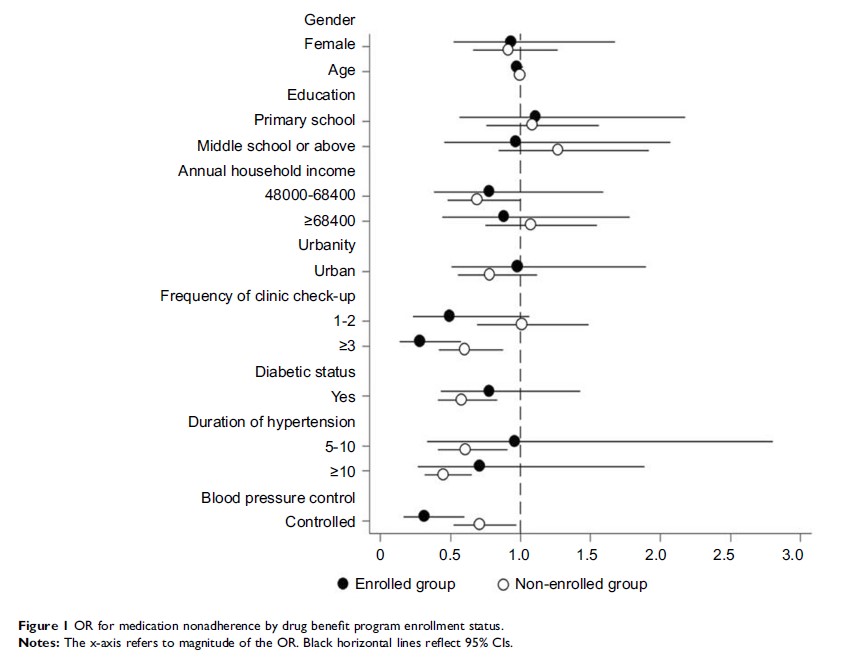
Results: Eleven percent of the drug benefit program enrollees were nonadherent to their medication, while 17% of non-enrollees were. Blinder-Oaxaca decomposition identified that over 60% of the gap between the two groups was due to the program effects (P =0.024). The rest could be explained by differences in observable characteristics (P <0.001), such as diabetic status, duration of hypertension, and blood pressure control.
Conclusion: The study confirmed that drug benefit program enrollees were more likely to be adherent to their antihypertensive medication than non-enrollees in the context of People’s Republic of China.
Keywords: medication adherence, drug benefit program, decomposition, hypertension