117518
论文已发表
注册即可获取德孚的最新动态
IF 收录期刊
- 3.6 Breast Cancer (Dove Med Press)
- 4.3 Clin Epidemiol
- 2.6 Cancer Manag Res
- 3.2 Infect Drug Resist
- 4.1 Clin Interv Aging
- 6.1 Drug Des Dev Ther
- 4.1 Int J Chronic Obstr
- 8.7 Int J Nanomed
- 2.5 Int J Women's Health
- 3.2 Neuropsych Dis Treat
- 2.4 OncoTargets Ther
- 2.6 Patient Prefer Adher
- 2.6 Ther Clin Risk Manag
- 3.1 J Pain Res
- 3.5 Diabet Metab Synd Ob
- 4.5 Psychol Res Behav Ma
- 3.4 Nat Sci Sleep
- 2.4 Pharmgenomics Pers Med
- 2.6 Risk Manag Healthc Policy
- 4.6 J Inflamm Res
- 2.3 Int J Gen Med
- 3.9 J Hepatocell Carcinoma
- 3.3 J Asthma Allergy
- 2.5 Clin Cosmet Investig Dermatol
- 3.0 J Multidiscip Healthc

杜仲的全部黄酮含量通过 HIF-α/MMP-2 通路使人胶质母细胞瘤细胞对放射治疗敏感,并激活内源性凋亡途径
Authors Wang Y, Tan X, Li S, Yang S
Received 29 March 2019
Accepted for publication 21 May 2019
Published 11 July 2019 Volume 2019:12 Pages 5515—5524
DOI https://doi.org/10.2147/OTT.S210497
Checked for plagiarism Yes
Review by Single-blind
Peer reviewers approved by Ms Rachel Predeepa
Peer reviewer comments 2
Editor who approved publication: Dr Yao Dai
Background: As one of the most common and lethal malignant primary brain tumors, glioblastomas (GBMs) are identified as grade IV neoplasms, the most severe grade, according to WHO classification systems. The outcome of surgery against GBMs is limited since its frequent relapse. Radiotherapy is a crucial and widely used treatment after surgery, while the strong radioresistance of GBM cells still becomes a severe problem of radiotherapy. Eucommia ulmoides Oliv . is used for the treatment of various diseases, such as lower blood pressure and inflammation.
Purpose: To explore the anti-tumor effect of Eucommia ulmoides Oliv . against GBMs.
Methods: Dose-viability assays were performed to examine the anti-tumor effect. Would-healing and transwell assays were carried out to evaluate the migration and invasion ability of GBMs. Cell apoptosis was detected by 33, 258 staining, and the expressions of key proteins were examined by western blot.
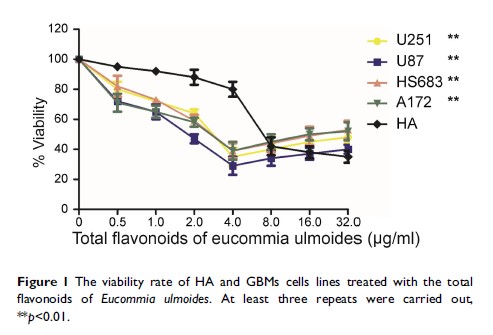
Results: In this study, we confirmed that the inhibitory effect of the total flavonoid of Eucommia ulmoides on proliferation, migration and invasion of human GBM cells. Its favorable effects inspired us to explore the potential ability in enhancing radiosensitivity of GBM cells. The results demonstrated that it could further induce apoptosis during radiotherapy via intrinsic apoptosis pathway. Besides, it could significantly reduce the malondialdehyde level after radiotherapy, which suggested it inhibited tumor cell and protected normal neuronal cells. By examining the expression of important genes of radioresistant pathway, we found a significant decrease of HIF-α/MMP-2 when using the total flavonoid of Eucommia ulmoides during radiotherapy.
Conclusion: This result suggests that the enhancement of radiotherapy may be mediated by modulating glucose metabolism of GBMs in HIF-α/MMP-2 pathway.
Keywords: Eucommia ulmoides , glioblastoma, radiotherapy, apoptosis, HIF-α/MMP-2 pathway