117333
论文已发表
注册即可获取德孚的最新动态
IF 收录期刊
- 3.6 Breast Cancer (Dove Med Press)
- 4.3 Clin Epidemiol
- 2.6 Cancer Manag Res
- 3.2 Infect Drug Resist
- 4.1 Clin Interv Aging
- 6.1 Drug Des Dev Ther
- 4.1 Int J Chronic Obstr
- 8.7 Int J Nanomed
- 2.5 Int J Women's Health
- 3.2 Neuropsych Dis Treat
- 2.4 OncoTargets Ther
- 2.6 Patient Prefer Adher
- 2.6 Ther Clin Risk Manag
- 3.1 J Pain Res
- 3.5 Diabet Metab Synd Ob
- 4.5 Psychol Res Behav Ma
- 3.4 Nat Sci Sleep
- 2.4 Pharmgenomics Pers Med
- 2.6 Risk Manag Healthc Policy
- 4.6 J Inflamm Res
- 2.3 Int J Gen Med
- 3.9 J Hepatocell Carcinoma
- 3.3 J Asthma Allergy
- 2.5 Clin Cosmet Investig Dermatol
- 3.0 J Multidiscip Healthc

南非农村地区患有多发慢性病且日常生活活动能力困难的老年人的主观健康状况和生活质量
Authors Wang C, Pu R, Li Z, Ji L, Li X, Ghose B, Huang R, Tang S
Received 17 February 2019
Accepted for publication 3 June 2019
Published 17 July 2019 Volume 2019:14 Pages 1285—1296
DOI https://doi.org/10.2147/CIA.S205734
Checked for plagiarism Yes
Review by Single-blind
Peer reviewers approved by Dr Bik-Wai Bilvick Tai
Peer reviewer comments 2
Editor who approved publication: Dr Zhi-Ying Wu
Background: South Africa has been experiencing a growing proportion of elderly population with rapid increases in the burden of non-communicable diseases (NCDs) characteristic of population aging. Rural areas in South Africa represent a far smaller fraction of the population, however, share a relatively higher burden of NCDs. In the current literature, there is limited evidence on rural studies in the context of chronic diseases and activities of daily living (ADLs) among the elderly population (60 years and above) in South Africa.
Purpose: In this regard, we undertook the present study with the objective of examining the demographic, behavioral, and socioeconomic predictors of subjective health, depression, and quality of life among elderly men and women living in the rural areas (n=2,627).
Methods: Data for this study were collected from the Health and Aging in Africa: A Longitudinal Study of an INDEPTH Community in South Africa (HAALSI). Main explanatory variables were self-reported NCDs and difficulties in ADLs. The predictors of subjective health, depression, and quality of life were assessed using multivariable regression methods.
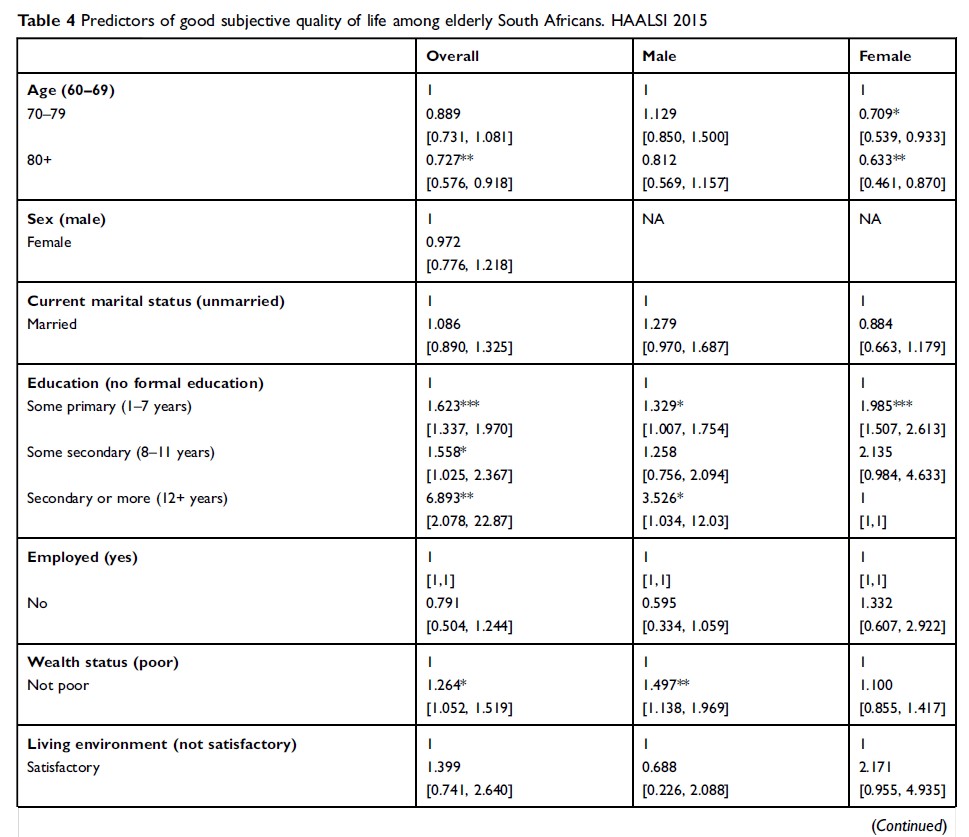
Results: We found that the proportion of participants who reported good health, not having depression, and good quality of life was respectively 44.7%, 81.3%, and 63%. Women in the oldest age group (80+ years) were significantly less likely to report good health (OR=0.577, 95% CI=0.420, 0.793) and quality of life (OR=0.709, 95% CI=0.539, 0.933) compared with those in the youngest group. Having more than one chronic condition and ADL difficulties significantly lowered the odds of good health, having no depression, and quality of life among men and women.
Conclusion: The present findings suggest the involvement of sociodemographic factors in health and quality of life outcomes among elderly South Africans, and call for enhanced efforts to address these health limiting conditions such as ADLs and chronic multimorbidity.
Keywords: activities of daily, elderly population, non-communicable diseases, rural health, South Africa