119661
论文已发表
注册即可获取德孚的最新动态
IF 收录期刊
- 3.6 Breast Cancer (Dove Med Press)
- 4.3 Clin Epidemiol
- 2.6 Cancer Manag Res
- 3.2 Infect Drug Resist
- 4.1 Clin Interv Aging
- 6.1 Drug Des Dev Ther
- 4.1 Int J Chronic Obstr
- 8.7 Int J Nanomed
- 2.5 Int J Women's Health
- 3.2 Neuropsych Dis Treat
- 2.4 OncoTargets Ther
- 2.6 Patient Prefer Adher
- 2.6 Ther Clin Risk Manag
- 3.1 J Pain Res
- 3.5 Diabet Metab Synd Ob
- 4.5 Psychol Res Behav Ma
- 3.4 Nat Sci Sleep
- 2.4 Pharmgenomics Pers Med
- 2.6 Risk Manag Healthc Policy
- 4.6 J Inflamm Res
- 2.3 Int J Gen Med
- 3.9 J Hepatocell Carcinoma
- 3.3 J Asthma Allergy
- 2.5 Clin Cosmet Investig Dermatol
- 3.0 J Multidiscip Healthc

MAPT 启动子 CpG 岛高甲基化与 II 期结直肠癌患者预后不良有关
Authors Wang C, Liu Y, Guo W, Zhu X, Ahuja N, Fu T
Received 25 February 2019
Accepted for publication 1 July 2019
Published 5 August 2019 Volume 2019:11 Pages 7337—7343
DOI https://doi.org/10.2147/CMAR.S206731
Checked for plagiarism Yes
Review by Single-blind
Peer reviewers approved by Dr Cristina Weinberg
Peer reviewer comments 2
Editor who approved publication: Dr Antonella D'Anneo
Background: The methylation of microtubule-associated protein tau (MAPT ) was first described in patients with Alzheimer’s disease. In this study, we aim to determine if MAPT promoter CpG island is hypermethylated and whether this signature could work as a prognostic marker for patients with stage II colorectal cancer (CRC).
Methods: MAPT methylation level and CpG island methylator phenotype (CIMP) status were examined. The prognostic value of MAPT methylation was analyzed using Cox regression analysis.
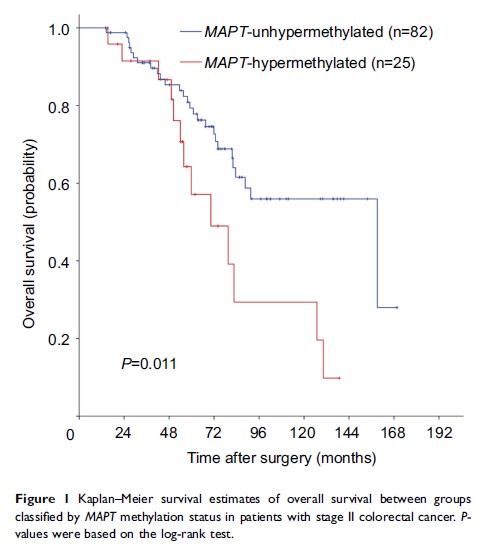
Results: Amongst stage II CRC patients (n=107), hypermethylation of MAPT promoter CpG island was seen in 23.4% of them. MAPT methylation was much more frequent in patients with age ≥60 compared to age <60 (P <0.001). MAPT were preferentially methylated among proximal colon tumors or CIMP high tumors (both P <0.001). Five-year overall survival (OS) rates were 57.1% and 79.4% for patients with and without MAPT hypermethylation, respectively, HR=2.33 (95% CI, 1.19–4.57; P =0.014). MAPT hypermethylation remained an important prognostic variable for OS in multivariate analysis with a HR of 2.29 (95% CI, 1.01–5.18; P =0.047).
Conclusion: Our findings suggest that MAPT is frequently methylated and hypermethylation is associated with worse prognosis in patients with stage II CRC.
Keywords: colorectal cancer, methylation, MAPT , prognosis