113173
论文已发表
注册即可获取德孚的最新动态
IF 收录期刊
- 3.4 Breast Cancer (Dove Med Press)
- 3.2 Clin Epidemiol
- 2.6 Cancer Manag Res
- 2.9 Infect Drug Resist
- 3.7 Clin Interv Aging
- 5.1 Drug Des Dev Ther
- 3.1 Int J Chronic Obstr
- 6.6 Int J Nanomed
- 2.6 Int J Women's Health
- 2.9 Neuropsych Dis Treat
- 2.8 OncoTargets Ther
- 2.0 Patient Prefer Adher
- 2.2 Ther Clin Risk Manag
- 2.5 J Pain Res
- 3.0 Diabet Metab Synd Ob
- 3.2 Psychol Res Behav Ma
- 3.4 Nat Sci Sleep
- 1.8 Pharmgenomics Pers Med
- 2.0 Risk Manag Healthc Policy
- 4.1 J Inflamm Res
- 2.0 Int J Gen Med
- 3.4 J Hepatocell Carcinoma
- 3.0 J Asthma Allergy
- 2.2 Clin Cosmet Investig Dermatol
- 2.4 J Multidiscip Healthc

白术多糖通过调节 TLR4 信号通路来调整大肠癌细胞的先天免疫
Authors Feng Z, Yang R, Wu L, Tang S, Wei B, Guo L, He L, Feng Y
Received 15 June 2019
Accepted for publication 1 August 2019
Published 4 September 2019 Volume 2019:12 Pages 7111—7121
DOI https://doi.org/10.2147/OTT.S219623
Checked for plagiarism Yes
Review by Single-blind
Peer reviewers approved by Ms Shreya Arora
Peer reviewer comments 2
Editor who approved publication: Dr Takuya Aoki
Background: It has been well-recognized that the polysaccharides from Atractylodes macrocephala (PAM) are immune system enhancers, which can facilitate the proliferation of lymphocytes and stimulate immune cells. Nevertheless, the antitumor effects of PAM and their molecular mechanisms remain unclear.
Aim: Our research aimed to evaluate the anti-cancer effects of PAM on colorectal cancer (CRC).
Methods: We tested the effects of PAM on the growth and proliferation of CRC cells and macrophages by MTT (3-(4,5-Dimethylthiazol-2-yl)-2,5-diphenyltetrazolium bromide) assay. The pro-inflammatory cytokines expression and secretion was analyzed by real-time RT-PCR and ELISA assay. We also used MC38 cells xenograft model to test the anti-cancer effects of PAM in vivo.
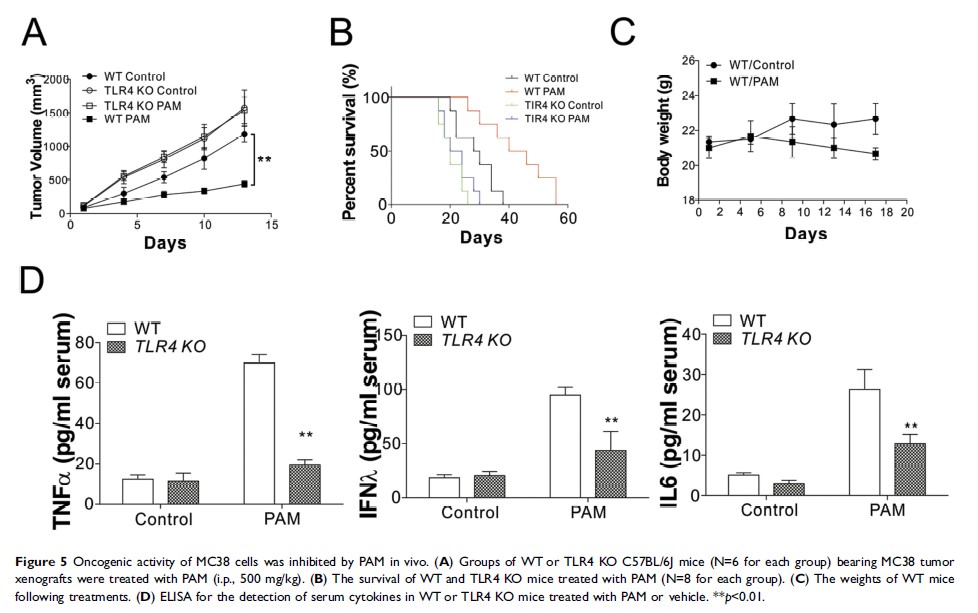
Results: We found that although PAM treatment did not significantly affect the growth of CRC cells or enhance the proliferation of bone marrow-derived macrophages (BMDMs), it could enhance the phagocytosis of BMDMs by CRC cells. Biochemical tests and immunoblotting assays revealed that exposing BMDMs to PAM promoted the production of interleukin-6 (IL-6), interferon λ (IFN λ), tumor necrosis factor α (TNF-α), and nitric oxide (NO) through the MyD88/TLR4-dependent signaling pathway. One noteworthy observation is that PAM treatment could significantly prevent tumorigenesis of MC38 cells in C57BL/6J mice and increase the survival duration of mice with tumors, without influence on the weight of those mice. However, the anti-cancer effects of PAM were compromised in TLR4 KO mice, further suggesting that TLR4 signaling plays a vital role in the anti-cancer effects of PAM.
Conclusion: Therefore, PAM may prove to be a potential candidate in cancer immunotherapy.
Keywords: polysaccharides from Atractylodes macrocephala , colorectal cancer, macrophages, TLR4, cancer immunotherapy