115195
论文已发表
注册即可获取德孚的最新动态
IF 收录期刊
- 3.6 Breast Cancer (Dove Med Press)
- 4.3 Clin Epidemiol
- 2.6 Cancer Manag Res
- 3.2 Infect Drug Resist
- 4.1 Clin Interv Aging
- 6.1 Drug Des Dev Ther
- 4.1 Int J Chronic Obstr
- 8.7 Int J Nanomed
- 2.5 Int J Women's Health
- 3.2 Neuropsych Dis Treat
- 2.4 OncoTargets Ther
- 2.6 Patient Prefer Adher
- 2.6 Ther Clin Risk Manag
- 3.1 J Pain Res
- 3.5 Diabet Metab Synd Ob
- 4.5 Psychol Res Behav Ma
- 3.4 Nat Sci Sleep
- 2.4 Pharmgenomics Pers Med
- 2.6 Risk Manag Healthc Policy
- 4.6 J Inflamm Res
- 2.3 Int J Gen Med
- 3.9 J Hepatocell Carcinoma
- 3.3 J Asthma Allergy
- 2.5 Clin Cosmet Investig Dermatol
- 3.0 J Multidiscip Healthc

对用于预测不良的高级别肾脏小肿块的 CT 成像术前列线图的开发和验证
Authors Xie H, Li G, Liu K, Wang Z, Shang Z, Liu Z, Xiong Z, Quan C, Niu Y
Received 8 September 2018
Accepted for publication 7 December 2018
Published 25 September 2019 Volume 2019:11 Pages 8731—8741
DOI https://doi.org/10.2147/CMAR.S186914
Checked for plagiarism Yes
Review by Single-blind
Peer reviewers approved by Dr Colin Mak
Peer reviewer comments 2
Editor who approved publication: Professor Lu-Zhe Sun
Purpose: In recent years, there has been an increase in the incidence of small renal masses (SRMs) and nephrectomy was the standard management of this disease in the past. Currently, the use of active surveillance has been recommended as an alternative option in the case of some patients with SRMs due to its heterogenicity. However, limited studies focused on the regarding risk stratification. Therefore, in the current study, we developed a nomogram for the purpose of predicting the presence of high-grade SRMs on the basis of the patient information provided (clinical information, hematological indicators, and CT imaging data).
Patients and methods: A total of 329 patients (consisting of development and validation cohort) who had undergone nephrectomy for SRMs between January 2013 and May 2016 retrospectively were recruited for the present study. All preoperative information, including clinical predictors, hematological indicators, and CT predictors, were obtained. Lasso regression model was used for data dimension reduction and feature selection. Multivariable logistic regression analysis was applied for the establishment of the predicting model. The performance of the nomogram was assessed with respect to its calibration and discrimination properties and externally validated.
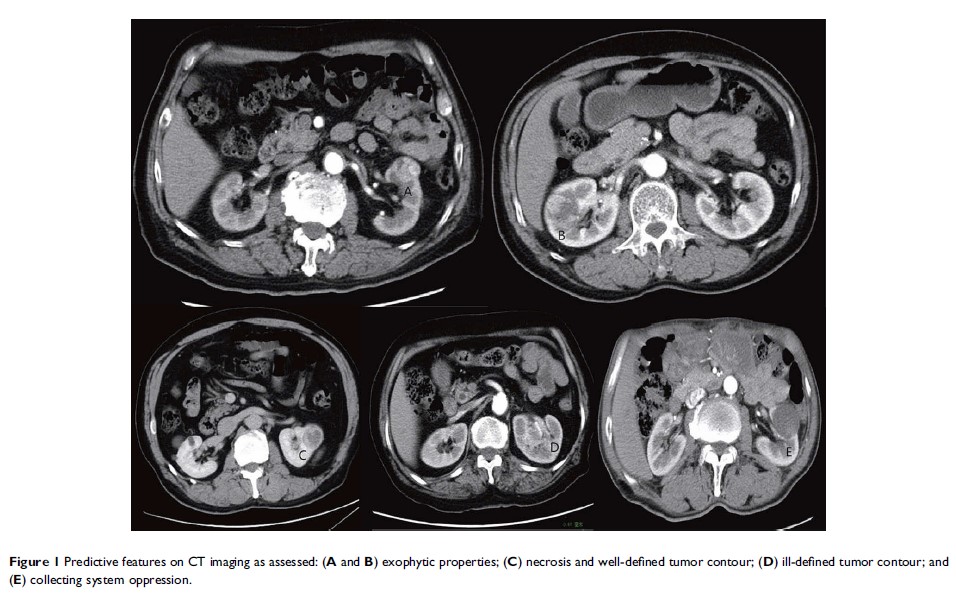
Results: The predictors used in the assessment of the nomogram included tumor size, CT tumor contour, CT necrosis, CT tumor exophytic properties, and CT collecting system oppression. Based on these parameters, the nomogram was evaluated to have an effective discrimination and calibration ability, and the C-index was found to be 0.883 after internal validation and 0.887 following external validation.
Conclusion: Based on the aforementioned findings, it can be concluded that CT imaging–based preoperative nomogram is an effective predictor of SRMs and hence can be used in the preoperative evaluation of SRMs, due to its calibration and discrimination abilities.
Keywords: renal cell carcinoma, small renal masses, SRMs, nomogram, tumor histology, CT