115195
论文已发表
注册即可获取德孚的最新动态
IF 收录期刊
- 3.6 Breast Cancer (Dove Med Press)
- 4.3 Clin Epidemiol
- 2.6 Cancer Manag Res
- 3.2 Infect Drug Resist
- 4.1 Clin Interv Aging
- 6.1 Drug Des Dev Ther
- 4.1 Int J Chronic Obstr
- 8.7 Int J Nanomed
- 2.5 Int J Women's Health
- 3.2 Neuropsych Dis Treat
- 2.4 OncoTargets Ther
- 2.6 Patient Prefer Adher
- 2.6 Ther Clin Risk Manag
- 3.1 J Pain Res
- 3.5 Diabet Metab Synd Ob
- 4.5 Psychol Res Behav Ma
- 3.4 Nat Sci Sleep
- 2.4 Pharmgenomics Pers Med
- 2.6 Risk Manag Healthc Policy
- 4.6 J Inflamm Res
- 2.3 Int J Gen Med
- 3.9 J Hepatocell Carcinoma
- 3.3 J Asthma Allergy
- 2.5 Clin Cosmet Investig Dermatol
- 3.0 J Multidiscip Healthc

贵州省多药耐药性结核病患者的药物非依从性及其原因:一项跨领域研究
Authors Wang Y, Chen H, Huang Z, McNeil EB, Lu X, Chongsuvivatwong V
Received 18 June 2019
Accepted for publication 12 September 2019
Published 30 September 2019 Volume 2019:13 Pages 1641—1653
DOI https://doi.org/10.2147/PPA.S219920
Checked for plagiarism Yes
Review by Single-blind
Peer reviewers approved by Dr Justinn Cochran
Peer reviewer comments 2
Editor who approved publication: Dr Naifeng Liu
Purpose: Treatment interruption and incorrect dosage for measuring drug non-adherence have seldom been studied in multidrug-resistant tuberculosis (MDR-TB) treatment. This study aimed to 1) estimate the overall and drug-specific incidence of short (≤14 days) and serious (>14 days) treatment interruption among MDR-TB patients, 2) identify main reasons and predictors for serious interruption, and 3) document the level of agreement of classification for incorrect drug dosage between self-report and pill count.
Patients and methods: A cross-sectional study combining hospital-based interviews and home-based pill count was conducted from January to June 2018. Treatment interruption was determined from patient’s medical records and interviews using a structured questionnaire among 202 patients treated at one designated hospital for MDR-TB treatment. Concordance of pills counted with self-reports for each drug use within one month was assessed for a subgroup of patients at their homes using kappa statistics.
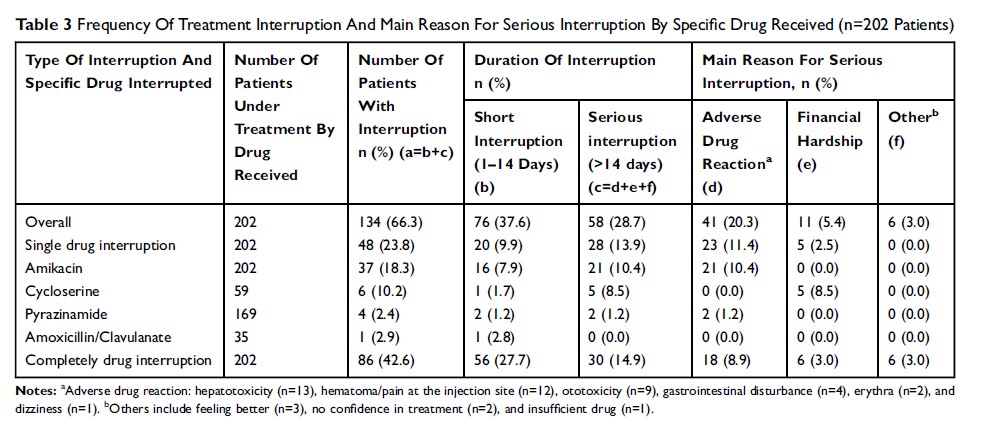
Results: Of 202 patients, the incidence of short and serious treatment interruption was 37.6% and 28.7%, respectively. Adverse drug reactions (ADRs) and financial hardship were the top two reasons for serious interruption. Amikacin and cycloserine had the highest rate of specific drug interruption (18.3% and 10.2%, respectively). ADRs (ORadj: 2.82, 95% CI: 1.41–5.61), monthly out-of-pocket expenses exceeding 250 US dollars (ORadj: 2.27, 95% CI: 1.14–4.50), and baseline co-morbidities (ORadj: 2.53, 95% CI: 1.19–5.38) were significantly associated with serious treatment interruption. Of 111 patients assessed for pill count at home, 5.4% had perfect drug adherence, 54.1% had drug under-use, 6.3% had drug over-use, and 34.2% had both problems. The respective number from self-reports was 7.2%, 56.8%, 5.4% and 30.6%. The two methods gave an acceptable level of agreement for most of the drugs (kappa: 0.52–0.95).
Conclusion: Close monitoring of ADRs, revision of drug regimens, and financial support for MDR-TB in this study population are needed. Self-report on drug under-use and over-use should be monitored monthly in clinical settings.
Keywords: multidrug-resistant tuberculosis, adherence, treatment interruption, Guizhou