115195
论文已发表
注册即可获取德孚的最新动态
IF 收录期刊
- 3.6 Breast Cancer (Dove Med Press)
- 4.3 Clin Epidemiol
- 2.6 Cancer Manag Res
- 3.2 Infect Drug Resist
- 4.1 Clin Interv Aging
- 6.1 Drug Des Dev Ther
- 4.1 Int J Chronic Obstr
- 8.7 Int J Nanomed
- 2.5 Int J Women's Health
- 3.2 Neuropsych Dis Treat
- 2.4 OncoTargets Ther
- 2.6 Patient Prefer Adher
- 2.6 Ther Clin Risk Manag
- 3.1 J Pain Res
- 3.5 Diabet Metab Synd Ob
- 4.5 Psychol Res Behav Ma
- 3.4 Nat Sci Sleep
- 2.4 Pharmgenomics Pers Med
- 2.6 Risk Manag Healthc Policy
- 4.6 J Inflamm Res
- 2.3 Int J Gen Med
- 3.9 J Hepatocell Carcinoma
- 3.3 J Asthma Allergy
- 2.5 Clin Cosmet Investig Dermatol
- 3.0 J Multidiscip Healthc

各种新型口服抗凝剂在胃肠道安全性方面的差异:来自网络荟萃分析的证据
Authors Guo WQ, Chen XH, Tian XY, Li L
Received 13 June 2019
Accepted for publication 3 August 2019
Published 1 October 2019 Volume 2019:11 Pages 911—921
DOI https://doi.org/10.2147/CLEP.S219335
Checked for plagiarism Yes
Review by Single-blind
Peer reviewers approved by Dr Cristina Weinberg
Peer reviewer comments 2
Editor who approved publication: Professor Eyal Cohen
Background: There is no consensus at present regarding the differences in the risk of GI bleeding across various NOAC regimens. Therefore, we performed a network meta-analysis to compare the risk of gastrointestinal bleeding after different NOAC regimens.
Methods: PubMed, Cochrane, Web of Science, Clinicaltrial.gov and Clinicaltrialresults.org were searched for randomized controlled trials (RCTs) assessing gastrointestinal bleeding of all NOAC regimens from inception to January 2018. The primary endpoint was major gastrointestinal (MGI) bleeding. The meta-regression was performed to access the association between the MGI bleeding events and mortality. The network meta-analysis was carried out with the Bayesian random-effect model.
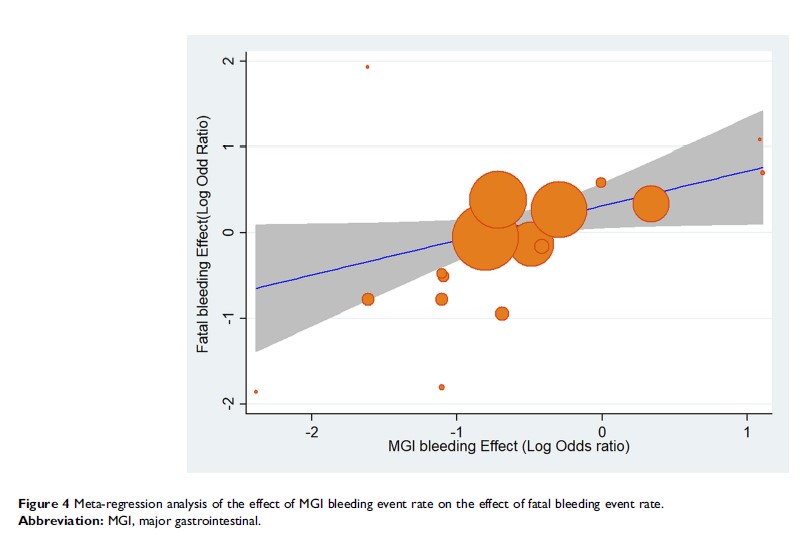
Results: A total of 25 RCTs, including 139,392 patients, were identified. Meta-regression analysis showed that MGI bleeding was correlated with fatal bleeding events (odds ratios [OR], 1.76; 95% confidence interval [CI], 1.13–2.77], P=0.015). The network meta-analysis results showed that compared to the conventional regimens, rivaroxaban was associated with increased risk of MGI bleeding (OR, 1.37; 95% credible interval [CrI], 1.00–1.85), but not the apixaban (OR, 0.77; 95% CrI, 0.53–1.07]), edoxaban (OR, 0.86; 95%CrI, 0.52–1.18) and dabigatran etexilate (OR, 1.22; 95% CrI, 0.82–1.69). Compared to rivaroxaban, apixaban (OR, 0.56; 95% CrI, 0.35–0.88) and edoxaban (OR, 0.62; 95% CrI, 0.35–0.96) showed a significantly lower risk of MGI bleeding. Apixaban had the highest probability of being the safest option with regard to the risk of MGI bleeding (89.1%), followed by edoxaban (77.4%), conventional therapy (51.4%), dabigatran etexilate (23.8%) and rivaroxaban (8.3%).
Conclusion: The risk of GI bleeding significantly varies among different NOAC regimens, and evidence shows that apixaban and edoxaban had the most favorable MGI bleeding safety profile, while rivaroxaban and dabigatran etexilate were the least safe.
Keywords: new oral anticoagulant, gastrointestinal bleeding, network meta-analysis