115195
论文已发表
注册即可获取德孚的最新动态
IF 收录期刊
- 3.6 Breast Cancer (Dove Med Press)
- 4.3 Clin Epidemiol
- 2.6 Cancer Manag Res
- 3.2 Infect Drug Resist
- 4.1 Clin Interv Aging
- 6.1 Drug Des Dev Ther
- 4.1 Int J Chronic Obstr
- 8.7 Int J Nanomed
- 2.5 Int J Women's Health
- 3.2 Neuropsych Dis Treat
- 2.4 OncoTargets Ther
- 2.6 Patient Prefer Adher
- 2.6 Ther Clin Risk Manag
- 3.1 J Pain Res
- 3.5 Diabet Metab Synd Ob
- 4.5 Psychol Res Behav Ma
- 3.4 Nat Sci Sleep
- 2.4 Pharmgenomics Pers Med
- 2.6 Risk Manag Healthc Policy
- 4.6 J Inflamm Res
- 2.3 Int J Gen Med
- 3.9 J Hepatocell Carcinoma
- 3.3 J Asthma Allergy
- 2.5 Clin Cosmet Investig Dermatol
- 3.0 J Multidiscip Healthc

右美托咪定通过上调 miR-340 减轻 LPS 刺激的 BV2 小胶质细胞活化产生的炎症反应
Authors Bao Y, Zhu Y, He G, Ni H, Liu C, Ma L, Zhang L, Shi D
Received 29 March 2019
Accepted for publication 30 August 2019
Published 3 October 2019 Volume 2019:13 Pages 3465—3475
DOI https://doi.org/10.2147/DDDT.S210511
Checked for plagiarism Yes
Review by Single-blind
Peer reviewers approved by Dr Amy Norman
Peer reviewer comments 2
Editor who approved publication: Dr Qiongyu Guo
Background: Dexmedetomidine (Dex) was reported to exhibit anti-inflammatory effect in the nervous system. However, the mechanism by which Dex exhibits anti-inflammation effects on LPS-stimulated BV2 microglia cells remains unclear. Thus, this study aimed to investigate the role of Dex in LPS-stimulated BV2 cells.
Methods: The BV2 cells were stimulated by lipopolysaccharides (LPS). BV2 cells were infected with short-hairpin RNAs targeting NF-κB (NF-κB-shRNAs) and NF-κB overexpression lentivirus, respectively. In addition, miR-340 mimics or miR-340 inhibitor was transfected into BV2 cells, respectively. Meanwhile, the dual-luciferase reporter system assay was used to explore the interaction of miR-340 and NF-κB in BV2 cells. CCK-8 was used to detect the viability of BV2 cells. In addition, Western blotting was used to detect the level of NF-κB in LPS-stimulated BV2 cells. The levels of TNF-α, IL-6, IL-1β, IL-2, IL-12, IL-10 and MCP-1 in LPS-stimulated BV2 cells were measured with ELISA.
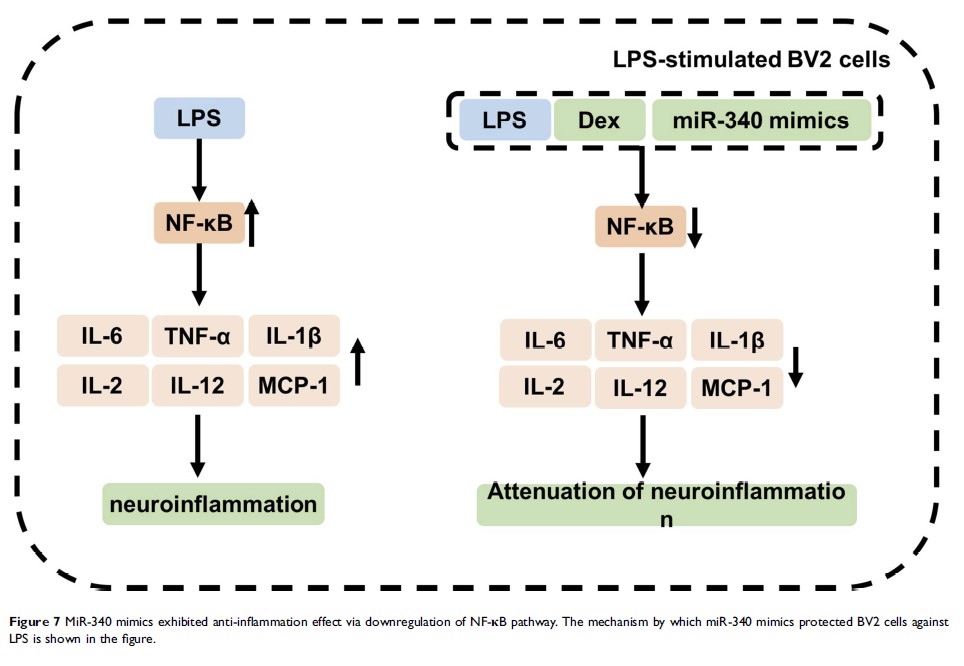
Results: The level of miR-340 was significantly upregulated in Dex-treated BV2 cells. Meanwhile, the level of NF-κB was significantly increased in BV2 cells following infection with lenti-NF-κB, which was markedly reversed by Dex. LPS markedly increased the expression of NF-κB and proinflammatory cytokines in BV2 cells, which were reversed in the presence of Dex. Moreover, miR-340 mimics enhanced the anti-inflammatory effects of Dex in LPS-stimulated BV2 cells via inhibiting NF-κB and proinflammatory cytokines. Furthermore, Dex obviously inhibited LPS-induced phagocytosis in BV2 cells.
Conclusion: Taken together, our results suggested that Dex might exert anti-inflammatory effects in LPS-stimulated BV2 cells via upregulation of miR-340. Therefore, Dex might serve as a potential agent for the treatment of neuroinflammation.
Keywords: NF-κB, dexmedetomidine, BV2 microglia cells, postoperative cognitive dysfunction