115195
论文已发表
注册即可获取德孚的最新动态
IF 收录期刊
- 3.6 Breast Cancer (Dove Med Press)
- 4.3 Clin Epidemiol
- 2.6 Cancer Manag Res
- 3.2 Infect Drug Resist
- 4.1 Clin Interv Aging
- 6.1 Drug Des Dev Ther
- 4.1 Int J Chronic Obstr
- 8.7 Int J Nanomed
- 2.5 Int J Women's Health
- 3.2 Neuropsych Dis Treat
- 2.4 OncoTargets Ther
- 2.6 Patient Prefer Adher
- 2.6 Ther Clin Risk Manag
- 3.1 J Pain Res
- 3.5 Diabet Metab Synd Ob
- 4.5 Psychol Res Behav Ma
- 3.4 Nat Sci Sleep
- 2.4 Pharmgenomics Pers Med
- 2.6 Risk Manag Healthc Policy
- 4.6 J Inflamm Res
- 2.3 Int J Gen Med
- 3.9 J Hepatocell Carcinoma
- 3.3 J Asthma Allergy
- 2.5 Clin Cosmet Investig Dermatol
- 3.0 J Multidiscip Healthc

人非小细胞肺癌组织中 IFIT2 表达降低与患者的癌症进展和不良生存率相关
Authors Su W, Xiao W, Chen L, Zhou Q, Zheng X, Ju J, Jiang J, Wang Z
Received 25 June 2019
Accepted for publication 18 September 2019
Published 3 October 2019 Volume 2019:12 Pages 8139—8149
DOI https://doi.org/10.2147/OTT.S220698
Checked for plagiarism Yes
Review by Single-blind
Peer reviewers approved by Ms Rachel Predeepa
Peer reviewer comments 2
Editor who approved publication: Dr Federico Perche
Background: IFIT2 (interferon-induced proteins with tetratricopeptide repeats 2), also known as ISG54, is an important interferon-stimulated gene family protein, which has been confirmed to play a crucial role in anti-cancer as well as anti-virus process. In the present study, we aimed to investigate the IFIT2 expression in human non-small-cell cancer (NSCLC) tissues and its clinical implications.
Methods: The immunohistochemistry assay was used to identify the clinical significance and prognostic value of IFIT2 expression in NSCLC tissues. The depletion of IFIT2 was achieved using RNAi approach to assess the role of IFIT2 in the regulation of biological behaviors in human lung cancer cell lines.
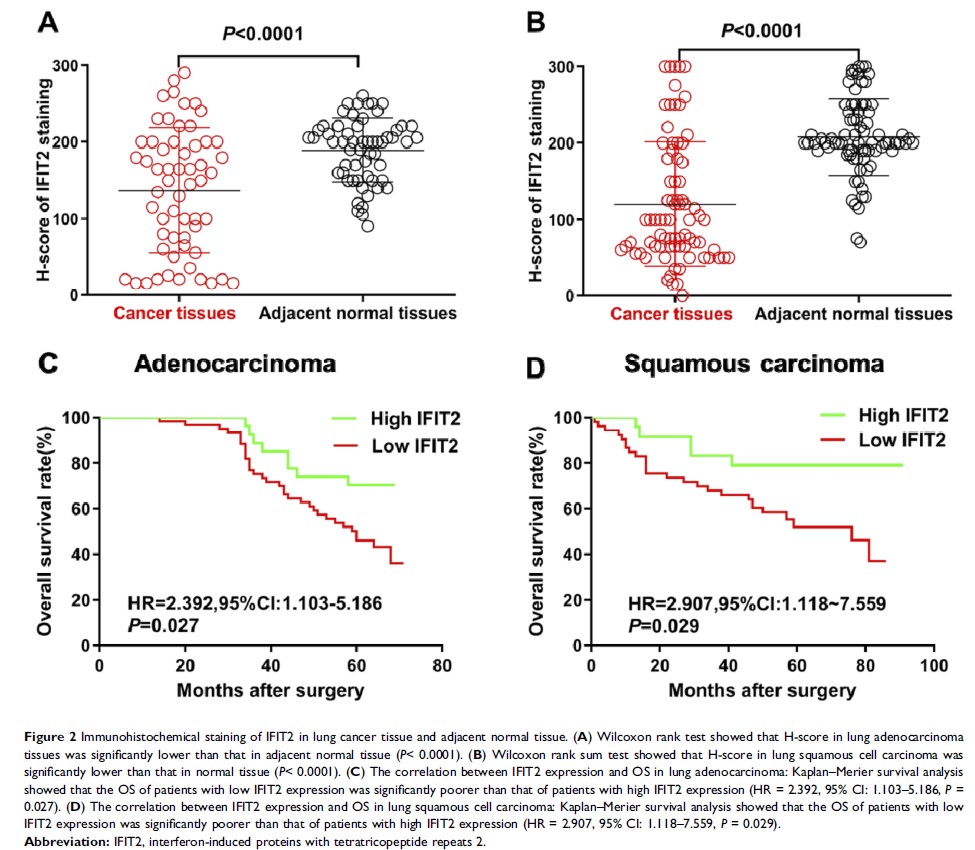
Results: Decreased IFIT2 expression was found in human NSCLC tissues (both in lung adenocarcinoma and lung squamous cell carcinoma) in contrast to the adjacent normal tissues (both P <0.0001, respectively). We did not find any significant correlations between the IFIT2 expression and patient’s clinicopathological features. The survival analysis showed that the overall survival (OS) of patients in IFIT2 low expression group was significantly poorer than that in IFIT2 high expression group (in lung adenocarcinoma: P =0.027; and in lung squamous cell carcinoma: P =0.029). The Cox model analysis also indicated that the distant metastasis (P =0.043) could be used as an independent prognostic factor for lung adenocarcinoma patients, and the lymph node metastasis (P =0.045) and IFIT2 low expression (P =0.020) could be used as independent prognostic factors for lung squamous cell carcinoma patients. Moreover, the depletion of IFIT2 in human lung cancer cell lines A549, H1975 and SK-MES-1 significantly increased the cellular abilities, such as viability, migration and invasion.
Conclusion: Decreased IFIT2 was involved in the initiation and the progression of human NSCLC, and its underlying mechanisms still needs further investigation.
Keywords: lung cancer, IFIT2, RNAi, prognosis