115195
论文已发表
注册即可获取德孚的最新动态
IF 收录期刊
- 3.6 Breast Cancer (Dove Med Press)
- 4.3 Clin Epidemiol
- 2.6 Cancer Manag Res
- 3.2 Infect Drug Resist
- 4.1 Clin Interv Aging
- 6.1 Drug Des Dev Ther
- 4.1 Int J Chronic Obstr
- 8.7 Int J Nanomed
- 2.5 Int J Women's Health
- 3.2 Neuropsych Dis Treat
- 2.4 OncoTargets Ther
- 2.6 Patient Prefer Adher
- 2.6 Ther Clin Risk Manag
- 3.1 J Pain Res
- 3.5 Diabet Metab Synd Ob
- 4.5 Psychol Res Behav Ma
- 3.4 Nat Sci Sleep
- 2.4 Pharmgenomics Pers Med
- 2.6 Risk Manag Healthc Policy
- 4.6 J Inflamm Res
- 2.3 Int J Gen Med
- 3.9 J Hepatocell Carcinoma
- 3.3 J Asthma Allergy
- 2.5 Clin Cosmet Investig Dermatol
- 3.0 J Multidiscip Healthc

Akt/mTOR 介导的自噬在卵巢癌中给予针对 BET 抑制剂 JQ1 的耐药性
Authors Luan W, Pang Y, Li R, Wei X, Jiao X, Shi J, Yu J, Mao H, Liu P
Received 21 June 2019
Accepted for publication 18 September 2019
Published 3 October 2019 Volume 2019:12 Pages 8063—8074
DOI https://doi.org/10.2147/OTT.S220267
Checked for plagiarism Yes
Review by Single-blind
Peer reviewers approved by Ms Shreya Arora
Peer reviewer comments 2
Editor who approved publication: Dr Carlos E Vigil
Background: Bromodomain and extra-terminal domain inhibitors like JQ1 have proved to be promising epigenetic agents for the treatment of malignant ovarian carcinoma. However, the resistance of ovarian cancer cells to BET inhibitors has not been elucidated. In this study, we investigated the potential mechanisms underlying the resistance of ovarian cancer cell lines to the BET inhibitor JQ1.
Materials and methods: We evaluated the apoptotic and proliferative response of four ovarian cancer cell lines to JQ1. The cell lines were designated as resistant (A2780 and HO-8910) and sensitive groups (SKOV-3 and HEY). Further experiments detected the different levels of JQ1-induced autophagy. Anti-tumour effect of the combination of JQ1 and autophagy inhibitors was tested both in vitro and in vivo.
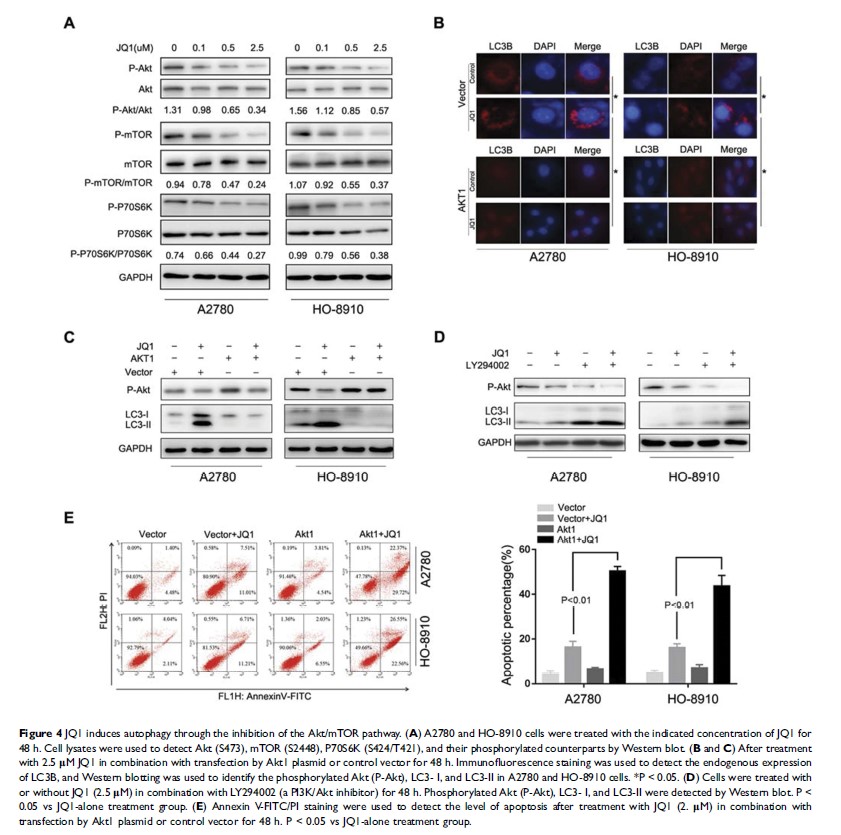
Results: In the JQ1-sensitive group, JQ1 effectively inhibited proliferation and apoptosis in a concentration-dependent manner. Conversely, JQ1 showed modest inhibition of proliferation and negligible apoptosis in the resistant group. We detected increased LC3-II lipidation, autophagosome formation, upregulation of Beclin-1 and ATG5, and downregulation of P62/SQSTM1 in the resistant group. Inhibition of JQ1-induced autophagy by pharmacologic inhibitors 3-MA and CQ enhanced the inhibition of proliferation and significantly increased the apoptosis in the JQ1-resistant group, which was also verified by in vivo experiments, indicating that JQ1-induced autophagy played a cytoprotective role. Inactivation of Akt (Ser473)/mTOR(Ser2448) pathway was associated with JQ1-induced autophagy in the resistant group. Overexpression of Akt1 suppressed autophagy and increased the anti-tumour effect of JQ1.
Conclusion: These findings revealed that JQ1-induced pro-survival autophagy might be a potential mechanism in the resistance of ovarian cancer cells to BET inhibition by JQ1. Combination of JQ1 and autophagy inhibitors could be an effective therapeutic strategy for overcoming BET inhibitor resistance in ovarian cancer.
Keywords: BET inhibitor, ovarian cancer, drug resistance, autophagy, Akt/mTOR pathway