115195
论文已发表
注册即可获取德孚的最新动态
IF 收录期刊
- 3.6 Breast Cancer (Dove Med Press)
- 4.3 Clin Epidemiol
- 2.6 Cancer Manag Res
- 3.2 Infect Drug Resist
- 4.1 Clin Interv Aging
- 6.1 Drug Des Dev Ther
- 4.1 Int J Chronic Obstr
- 8.7 Int J Nanomed
- 2.5 Int J Women's Health
- 3.2 Neuropsych Dis Treat
- 2.4 OncoTargets Ther
- 2.6 Patient Prefer Adher
- 2.6 Ther Clin Risk Manag
- 3.1 J Pain Res
- 3.5 Diabet Metab Synd Ob
- 4.5 Psychol Res Behav Ma
- 3.4 Nat Sci Sleep
- 2.4 Pharmgenomics Pers Med
- 2.6 Risk Manag Healthc Policy
- 4.6 J Inflamm Res
- 2.3 Int J Gen Med
- 3.9 J Hepatocell Carcinoma
- 3.3 J Asthma Allergy
- 2.5 Clin Cosmet Investig Dermatol
- 3.0 J Multidiscip Healthc

EGFR-TKIs 联合颅脑放疗对 EGFR 激活突变和脑转移的 NSCLC 患者的一线治疗效果:一项回顾性研究
Authors An N, Wang H, Li J, Zhai X, Jing W, Jia W, Kong L, Zhu H, Yu J
Received 15 July 2019
Accepted for publication 20 September 2019
Published 8 October 2019 Volume 2019:12 Pages 8311—8318
DOI https://doi.org/10.2147/OTT.S223216
Checked for plagiarism Yes
Review by Single-blind
Peer reviewers approved by Dr Shashank Kaushik (PT)
Peer reviewer comments 2
Editor who approved publication: Dr Sanjay Singh
Purpose: Non-small cell lung cancer (NSCLC) patients with EGFR mutation are suffering from a high incidence of brain metastasis (BM). It is still controversial whether cranial radiotherapy could be delayed when the EGFR-tyrosine kinase inhibitors (TKIs) used as first-line therapy for EGFR-positive patients with BM. This study aims to investigate the therapeutic effect of TKIs combined with concurrent cranial radiotherapy on BM.
Patients and methods: NSCLC patients with EGFR mutation and BM were retrospectively analyzed from January 2013 to December 2016 in Shandong Cancer Hospital. Identified cases were treated with first-line EGFR-TKIs with or without concurrent cranial radiation.
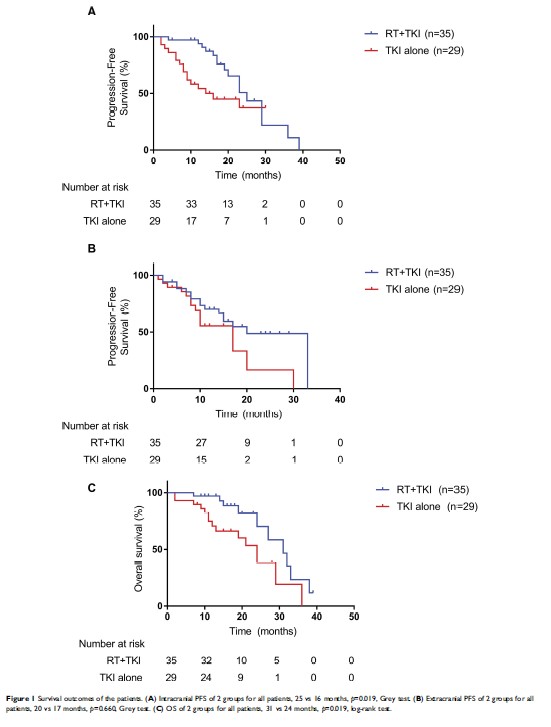
Results: A total of 64 eligible patients were enrolled in this study, while 35 patients received first-line EGFR-TKIs plus cranial radiotherapy (RT+TKI group) and 29 patients received first-line EGFR-TKIs only (TKI alone group). The intracranial progression-free survival (PFS) of the RT+TKI group was significantly longer than the TKI alone group (25 vs 16 months; p =0.019), but no significant differences were observed between the two groups on extracranial PFS (20 vs 17 months, p =0.660). The median overall survival was also longer in the RT+TKI group (31 vs 24 months, p =0.019).
Conclusion: Our retrospective data suggest that first-line TKIs plus concurrent cranial radiotherapy is a promising therapeutic strategy that led to remarkable intracranial PFS improvement and survival benefits for EGFR-mutant NSCLC with BM. Hence, it should be considered as a crucial treatment method during clinical management.
Keywords: non-small cell lung cancer, EGFR mutation, brain metastasis, radiotherapy, tyrosine kinase inhibitor