115195
论文已发表
注册即可获取德孚的最新动态
IF 收录期刊
- 3.6 Breast Cancer (Dove Med Press)
- 4.3 Clin Epidemiol
- 2.6 Cancer Manag Res
- 3.2 Infect Drug Resist
- 4.1 Clin Interv Aging
- 6.1 Drug Des Dev Ther
- 4.1 Int J Chronic Obstr
- 8.7 Int J Nanomed
- 2.5 Int J Women's Health
- 3.2 Neuropsych Dis Treat
- 2.4 OncoTargets Ther
- 2.6 Patient Prefer Adher
- 2.6 Ther Clin Risk Manag
- 3.1 J Pain Res
- 3.5 Diabet Metab Synd Ob
- 4.5 Psychol Res Behav Ma
- 3.4 Nat Sci Sleep
- 2.4 Pharmgenomics Pers Med
- 2.6 Risk Manag Healthc Policy
- 4.6 J Inflamm Res
- 2.3 Int J Gen Med
- 3.9 J Hepatocell Carcinoma
- 3.3 J Asthma Allergy
- 2.5 Clin Cosmet Investig Dermatol
- 3.0 J Multidiscip Healthc

父亲移民/母亲照顾家庭的留守青少年的同伴侵害、母亲控制方式和适应问题
Authors Xiong Y, Wang H, Wang Q, Liu X
Received 12 June 2019
Accepted for publication 30 August 2019
Published 9 October 2019 Volume 2019:12 Pages 961—971
DOI https://doi.org/10.2147/PRBM.S219249
Checked for plagiarism Yes
Review by Single-blind
Peer reviewers approved by Dr Justinn Cochran
Peer reviewer comments 3
Editor who approved publication: Dr Einar Thorsteinsson
Background: Left-behind adolescents who are from father-migrant/mother caregiver families have become the main type of left-behind children in China. The migratory of fathers not only makes left-behind adolescents suffer more difficulties but also causes left-behind women to face the challenge of raising the child alone. This study examined the association among peer victimization, maternal psychological control, and adjustment problems among Chinese rural left-behind adolescents. Furthermore, we first explored the moderating role of maternal behavioral control in this relationship.
Methods: Using cross-sectional design, we recruited 194 left-behind adolescents (49% girls; mean age = 13.51, SD = 1.03) from four junior schools in the Guizhou province of China. Left-behind adolescents completed a battery of self-report questionnaires regarding peer victimization, maternal control, self-injury behaviors, depression, and loneliness.
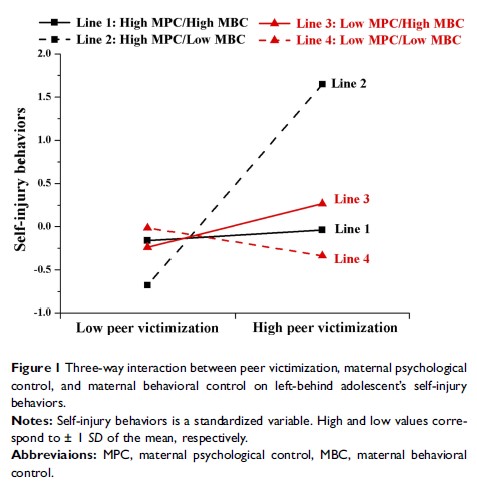
Results: The hierarchical multiple regressions indicated that both peer victimization and maternal psychological control were positively associated with self-injury behaviors, depression, and loneliness. Moreover, maternal behavioral control played a dual role in the impact of peer victimization on self-injury behaviors depending on the levels of maternal psychological control. When left-behind women exerted high psychological control on their children, maternal behavioral control buffered the negative effect of peer victimization on self-injury behaviors. However, when left-behind women exerted low psychological control on their children, maternal behavioral control exacerbated the negative effect of peer victimization on self-injury behaviors.
Conclusion: These findings suggest that the effectiveness of behavioral control may depend on different situations, left-behind women should be cautious in exerting behavioral control over their children.
Keywords: left-behind adolescents, peer victimization, psychological control, behavioral control, psychological adjustment