115195
论文已发表
注册即可获取德孚的最新动态
IF 收录期刊
- 3.6 Breast Cancer (Dove Med Press)
- 4.3 Clin Epidemiol
- 2.6 Cancer Manag Res
- 3.2 Infect Drug Resist
- 4.1 Clin Interv Aging
- 6.1 Drug Des Dev Ther
- 4.1 Int J Chronic Obstr
- 8.7 Int J Nanomed
- 2.5 Int J Women's Health
- 3.2 Neuropsych Dis Treat
- 2.4 OncoTargets Ther
- 2.6 Patient Prefer Adher
- 2.6 Ther Clin Risk Manag
- 3.1 J Pain Res
- 3.5 Diabet Metab Synd Ob
- 4.5 Psychol Res Behav Ma
- 3.4 Nat Sci Sleep
- 2.4 Pharmgenomics Pers Med
- 2.6 Risk Manag Healthc Policy
- 4.6 J Inflamm Res
- 2.3 Int J Gen Med
- 3.9 J Hepatocell Carcinoma
- 3.3 J Asthma Allergy
- 2.5 Clin Cosmet Investig Dermatol
- 3.0 J Multidiscip Healthc

与中国儿童和青少年代谢综合征相关的脂质积累产物的新型指示物
Authors Zhang Y, Hu J, Li Z, Li T, Chen M, Wu L, Liu W, Han H, Yao R, Fu L
Received 3 July 2019
Accepted for publication 3 September 2019
Published 10 October 2019 Volume 2019:12 Pages 2075—2083
DOI https://doi.org/10.2147/DMSO.S221786
Checked for plagiarism Yes
Review by Single-blind
Peer reviewers approved by Dr Melinda Thomas
Peer reviewer comments 2
Editor who approved publication: Dr Antonio Brunetti
Background: The lipid accumulation product (LAP) is a powerful marker for predicting metabolic syndrome (MS) in adults. The present study aimed to propose a novel indicator, the children’s lipid accumulation product (CLAP), and to assess its association with MS among Chinese children and adolescents.
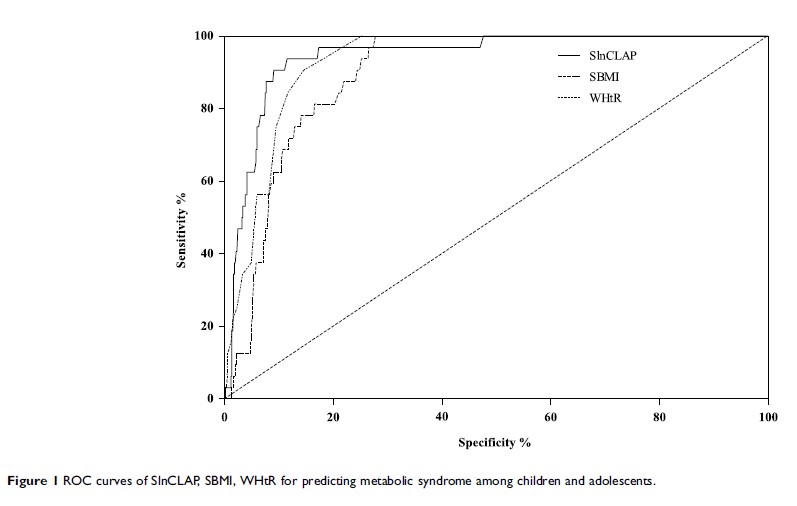
Methods: A total of 683 Chinese children aged 8–15 years were recruited using a stratified cluster sampling method in this cross-sectional study. The presence of MS was defined according to the NCEP-ATP III criteria. The effects of BMI, WHtR and the CLAP for predicting MS were compared using logistic regression models and receiver operating characteristic (ROC) curves.
Results: The prevalence of MS was 5.1% (6.6% and 3.5% among boys and girls, respectively). Overall obesity (based on BMI), abdominal obesity (based on WHtR) and CLAP≥P75 were significantly associated with an increased risk of MS (ORs (95% CIs) were 143.79 (18.78–1101.22), 86.83 (27.19–277.27), 150.75 (20.11–1130.19), respectively). The area under the ROC curve (AUC) for the CLAP was higher than that for BMI and WHtR for predicting MS, with AUC (95% CI) values of 0.944 (0.913–0.975), 0.895 (0.864–0.927), and 0.928 (0.903–0.953), respectively.
Conclusion: The children’s lipid accumulation product (CLAP) was an effective indicator associated with MS in Chinese children and adolescents and was better than BMI and WHtR for predicting MS.
Keywords: childhood obesity, lipid metabolism, metabolic syndrome