115195
论文已发表
注册即可获取德孚的最新动态
IF 收录期刊
- 3.6 Breast Cancer (Dove Med Press)
- 4.3 Clin Epidemiol
- 2.6 Cancer Manag Res
- 3.2 Infect Drug Resist
- 4.1 Clin Interv Aging
- 6.1 Drug Des Dev Ther
- 4.1 Int J Chronic Obstr
- 8.7 Int J Nanomed
- 2.5 Int J Women's Health
- 3.2 Neuropsych Dis Treat
- 2.4 OncoTargets Ther
- 2.6 Patient Prefer Adher
- 2.6 Ther Clin Risk Manag
- 3.1 J Pain Res
- 3.5 Diabet Metab Synd Ob
- 4.5 Psychol Res Behav Ma
- 3.4 Nat Sci Sleep
- 2.4 Pharmgenomics Pers Med
- 2.6 Risk Manag Healthc Policy
- 4.6 J Inflamm Res
- 2.3 Int J Gen Med
- 3.9 J Hepatocell Carcinoma
- 3.3 J Asthma Allergy
- 2.5 Clin Cosmet Investig Dermatol
- 3.0 J Multidiscip Healthc

CXCL13 是抗富亮氨酸胶质瘤失活 1 蛋白(LGI1)抗体脑炎患者的生物标志物
Authors Lin Y, Yang X, Lv J, Liu X, Wang S
Received 7 July 2019
Accepted for publication 17 September 2019
Published 11 October 2019 Volume 2019:15 Pages 2909—2915
DOI https://doi.org/10.2147/NDT.S222258
Checked for plagiarism Yes
Review by Single-blind
Peer reviewers approved by Prof. Dr. Roumen Kirov
Peer reviewer comments 3
Editor who approved publication: Dr Yu-Ping Ning
Background: Although antibody-mediated immune responses are considered pathogenic and responsible for neural injury in anti-leucine-rich glioma-inactivated protein 1 (anti-LGI1) encephalitis, previous studies have indicated that cytokines and chemokines might play roles in the pathogenic process by serving as B cell enhancers. In this study, we detected the profiles of cytokines and chemokines in the cerebral fluid (CSF) and serum of patients with anti-LGI1 encephalitis to identify potential biomarkers.
Methods: Sixteen patients diagnosed with anti-LGI1 encephalitis and nine patients diagnosed with noninflammatory neurologic disorders were included in the study. Cytokines and chemokines including IL-6, IL-10, IL-17, CXCL12, CXCL13, BAFF and HMGB1 in serum and CSF were measured.
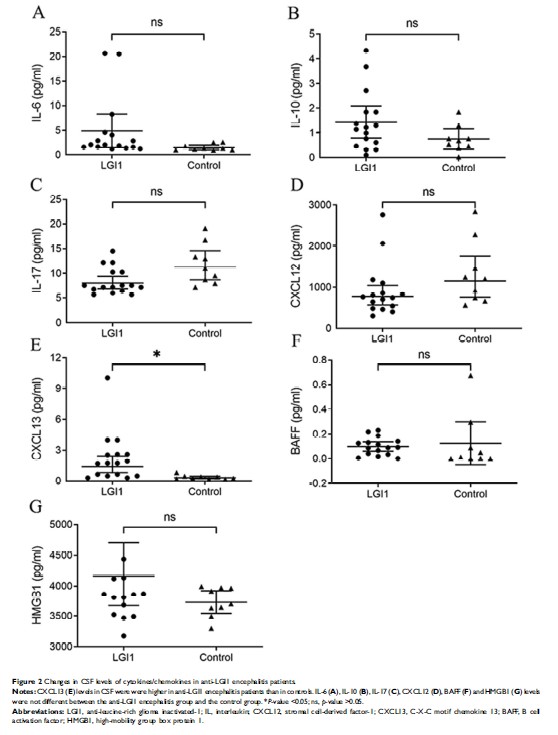
Results: The serum and CSF levels of CXCL13 were significantly higher in patients with anti-LGI1 encephalitis (36.32±34.71 pg/mL and 2.23±2.41 pg/mL, respectively) than in controls (10.84±5.02 pg/mL and 0.34±0.21 pg/mL, respectively). There was no significant difference in serum or CSF levels of IL-6, IL-10, IL-17, CXCL12, BAFF and HMGB1 between the two groups.
Conclusion: CXCL13 is a potential biomarker of active inflammation in anti-LGI1 encephalitis. The distinctive response of cytokines and chemokines might be closely linked to the mechanisms underlying this condition.
Keywords: leucine-rich glioma-inactivated protein 1, CXCL13, cytokine, encephalitis, biomarker