115195
论文已发表
注册即可获取德孚的最新动态
IF 收录期刊
- 3.6 Breast Cancer (Dove Med Press)
- 4.3 Clin Epidemiol
- 2.6 Cancer Manag Res
- 3.2 Infect Drug Resist
- 4.1 Clin Interv Aging
- 6.1 Drug Des Dev Ther
- 4.1 Int J Chronic Obstr
- 8.7 Int J Nanomed
- 2.5 Int J Women's Health
- 3.2 Neuropsych Dis Treat
- 2.4 OncoTargets Ther
- 2.6 Patient Prefer Adher
- 2.6 Ther Clin Risk Manag
- 3.1 J Pain Res
- 3.5 Diabet Metab Synd Ob
- 4.5 Psychol Res Behav Ma
- 3.4 Nat Sci Sleep
- 2.4 Pharmgenomics Pers Med
- 2.6 Risk Manag Healthc Policy
- 4.6 J Inflamm Res
- 2.3 Int J Gen Med
- 3.9 J Hepatocell Carcinoma
- 3.3 J Asthma Allergy
- 2.5 Clin Cosmet Investig Dermatol
- 3.0 J Multidiscip Healthc

MicroRNA-761 靶向 FGFR1,通过使 PI3K/Akt 通路失活来以抑制骨肉瘤的恶性肿瘤
Authors Lv Z, Ma J, Wang J, Lu J
Received 11 March 2019
Accepted for publication 15 August 2019
Published 15 October 2019 Volume 2019:12 Pages 8501—8513
DOI https://doi.org/10.2147/OTT.S208263
Checked for plagiarism Yes
Review by Single-blind
Peer reviewers approved by Ms Aruna Narula
Peer reviewer comments 2
Editor who approved publication: Prof. Dr. Geoffrey Pietersz
Purpose: MicroRNA-761 (miR-761) has been reported to be deregulated in many types of human cancers and play important roles in cancer genesis and progression. However, the biological roles of miR-761 in osteosarcoma (OS) and the underlying mechanisms remain largely unknown.
Methods: The expression of miR-761 in OS tissues and cell lines was analyzed using RT-qPCR. A series of gain-of-function tests were performed, and status of malignancy was evaluated on basis of proliferation, migration, invasion, and apoptosis using different assays to determine the regulatory roles of miR-761 in OS cells in vivo and in vitro. Notably, the mechanisms underlying the action of miR-761 in the pathogenesis of OS were investigated using bioinformatic analysis, luciferase reporter assay, RT-qPCR and Western blotting.
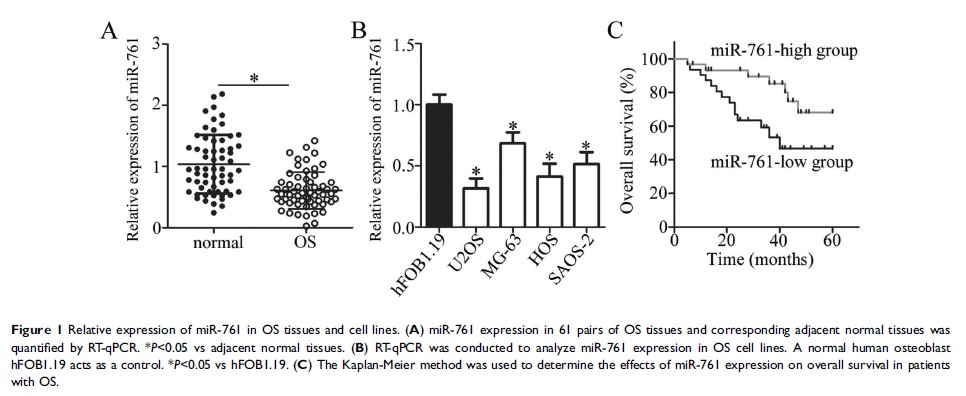
Results: The results showed that miR-761 expression was decreased in OS tissues and cell lines and is closely correlated with clinical stage and distant metastasis in OS patients. Patients with OS having low miR-761 expression showed worse prognosis compared to OS patients with high miR-761 expression. Restoring the miR-761 expression level decreased OS cell proliferation, migration, and invasion in vitro; promoted cell apoptosis in vitro; and impaired tumor growth in vivo. In addition, fibroblast growth factor receptor 1 (FGFR1) was found as a direct target gene of miR-761 in OS cells. Furthermore, silencing FGFR1 expression stimulated the tumor-suppressing roles of miR-761 upregulation in OS cells, whereas the activity of miR-761 overexpression in OS cells was abolished by the restoration of FGFR1 expression. Moreover, restoration of miR-761 expression deactivated the PI3K/Akt pathway in vitro and in vivo.
Conclusion: These results suggest that miR-761 plays anti-cancer roles in OS by directly targeting FGFR1 and deactivating the PI3K/Akt pathway. The newly identified miR-761/FGFR1/PI3K/Akt pathway partially illustrates the mechanism of OS pathogenesis and presents a novel candidate therapeutic target for antitumor therapy.
Keywords: microRNA-761, osteosarcoma, fibroblast growth factor receptor 1, PI3K/Akt pathway, pathogenesis