115195
论文已发表
注册即可获取德孚的最新动态
IF 收录期刊
- 3.6 Breast Cancer (Dove Med Press)
- 4.3 Clin Epidemiol
- 2.6 Cancer Manag Res
- 3.2 Infect Drug Resist
- 4.1 Clin Interv Aging
- 6.1 Drug Des Dev Ther
- 4.1 Int J Chronic Obstr
- 8.7 Int J Nanomed
- 2.5 Int J Women's Health
- 3.2 Neuropsych Dis Treat
- 2.4 OncoTargets Ther
- 2.6 Patient Prefer Adher
- 2.6 Ther Clin Risk Manag
- 3.1 J Pain Res
- 3.5 Diabet Metab Synd Ob
- 4.5 Psychol Res Behav Ma
- 3.4 Nat Sci Sleep
- 2.4 Pharmgenomics Pers Med
- 2.6 Risk Manag Healthc Policy
- 4.6 J Inflamm Res
- 2.3 Int J Gen Med
- 3.9 J Hepatocell Carcinoma
- 3.3 J Asthma Allergy
- 2.5 Clin Cosmet Investig Dermatol
- 3.0 J Multidiscip Healthc

电针可减轻脊髓神经损伤引起的神经痛,并调节脊髓中的 HMGB1/NF-κB 信号通路
Authors Xia Y, Xue M, Wang Y, Huang Z, Huang C
Received 20 June 2019
Accepted for publication 12 September 2019
Published 16 October 2019 Volume 2019:12 Pages 2851—2863
DOI https://doi.org/10.2147/JPR.S220201
Checked for plagiarism Yes
Review by Single-blind
Peer reviewers approved by Dr Melinda Thomas
Peer reviewer comments 2
Editor who approved publication: Dr Michael Ueberall
Background: Neuropathic pain with complications greatly affects patients worldwide. High mobility group box 1 (HMGB1) has been shown to contribute to the pathogenesis of neuropathic pain; thus, suppression of HMGB1 may provide a novel therapeutic option for neuropathic pain. Electroacupuncture (EA) has been indicated to be effective in attenuating neuropathic pain, but the underlying mechanism remains to be fully clarified. We aim to explore whether 2Hz EA stimulation regulates the spinal HMGB1/NF-κB signaling in neuropathic pain induced by spared nerve injury (SNI).
Materials and methods: Paw withdrawal threshold and CatWalk gait analysis were used to assess the effect of 2Hz EA on pain-related behaviors in SNI rats. Administration of 2Hz EA to SNI rats once every other day lasting for 21 days. Expression of spinal protein molecules were detected using Western blot and immunofluorescence staining.
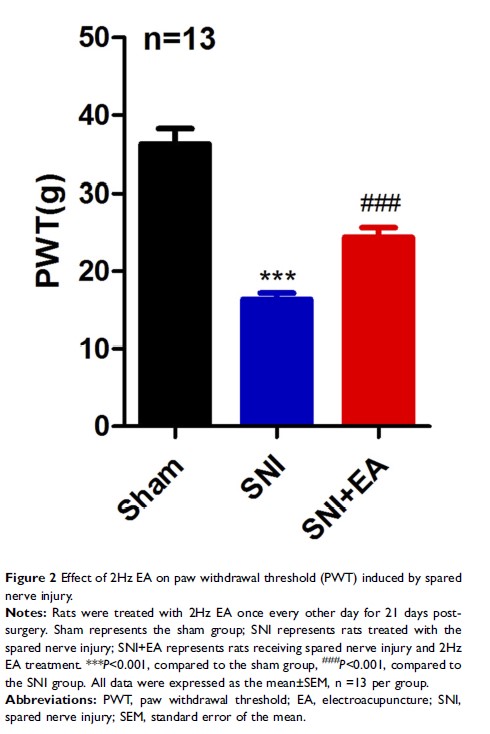
Results: It was found that SNI significantly induced mechanical hypersensitivity and decrease of gait parameters, and subsequently increased the levels of HMGB1, TLR4, MyD88, and NF-κB p65 protein expression. 2Hz EA stimulation led to remarkable attenuation of mechanical hypersensitivity, upregulation of spinal HMGB1, TLR4, MyD88, and NF-κB p65 protein expressions induced by SNI, and significant improvement in gait parameters. Furthermore, immunofluorescence staining also confirmed that 2Hz EA obviously suppressed the co-expression of microglia activation marker CD11b and TLR4 or MyD88, as well as the activation of NF-κB p65 in SNI rats.
Conclusion: This study suggested that blockade of HMGB1/NF-κB signaling in the spinal cord may be a promising therapeutic approach for 2Hz EA management of SNI-induced neuropathic pain.
Keywords: electroacupuncture, neuropathic pain, spared nerve injury, HMGB1/NF-κB signaling, TLR4