115195
论文已发表
注册即可获取德孚的最新动态
IF 收录期刊
- 3.6 Breast Cancer (Dove Med Press)
- 4.3 Clin Epidemiol
- 2.6 Cancer Manag Res
- 3.2 Infect Drug Resist
- 4.1 Clin Interv Aging
- 6.1 Drug Des Dev Ther
- 4.1 Int J Chronic Obstr
- 8.7 Int J Nanomed
- 2.5 Int J Women's Health
- 3.2 Neuropsych Dis Treat
- 2.4 OncoTargets Ther
- 2.6 Patient Prefer Adher
- 2.6 Ther Clin Risk Manag
- 3.1 J Pain Res
- 3.5 Diabet Metab Synd Ob
- 4.5 Psychol Res Behav Ma
- 3.4 Nat Sci Sleep
- 2.4 Pharmgenomics Pers Med
- 2.6 Risk Manag Healthc Policy
- 4.6 J Inflamm Res
- 2.3 Int J Gen Med
- 3.9 J Hepatocell Carcinoma
- 3.3 J Asthma Allergy
- 2.5 Clin Cosmet Investig Dermatol
- 3.0 J Multidiscip Healthc

表没食子儿茶素没食子酸酯通过 PI3K/Akt 通路抑制自噬而对抗心肌缺血再灌注损伤,MicroRNA-384-5p/Beclin-1 可作为其潜在指标
Authors Zhang C, Liang R, Gan X, Yang X, Chen L, Jian J
Received 11 June 2019
Accepted for publication 2 October 2019
Published 17 October 2019 Volume 2019:13 Pages 3607—3623
DOI https://doi.org/10.2147/DDDT.S219074
Checked for plagiarism Yes
Review by Single-blind
Peer reviewers approved by Dr Cristina Weinberg
Peer reviewer comments 2
Editor who approved publication: Professor Manfred Ogris
Background/Aims: Epigallocatechin gallate (EGCG) has established protective actions against myocardial ischemia/reperfusion (I/R) injury by regulating autophagy. However, little is known about the mechanisms of EGCG in posttranscriptional regulation in the process of cardioprotection. Here we studied whether microRNAs play a role in EGCG-induced cardioprotection.
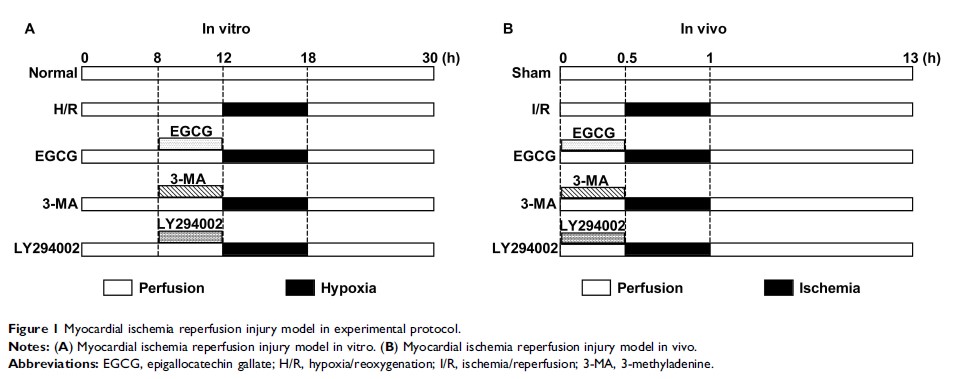
Methods: The myocardial I/R injury in vitro and in vivo model were made, with or without EGCG pretreatment. The upregulation and silencing of microRNA-384-5p (miR-384) and Beclin-1 in H9c2 cell lines were established. Rats were transfected with miR-384 specific shRNA. Dual-luciferase reporter gene assay was conducted to verify the relationship between miR-384 and Beclin-1. TTC staining was performed to analyze the area of myocardial infarct size. Cell viability was monitored by cell counting kit-8 (CCK-8). The release of cardiac troponin-I (cTnI) was examined by ELISA. The levels of autophagy-related genes or proteins expression were evaluated by qRT-PCR or Western blotting. Autophagosomes of myocardial cells were detected by transmission electron microscopy and laser scanning confocal microscope.
Results: I/R increased both autophagosomes and autolysosomes, thereby increasing autophagic flux both in vitro and in vivo. Pretreatment with EGCG attenuated I/R-induced autophagic flux expression, accompanied by an increase in cell viability and a decrease in the size of myocardial infarction. MiR-384 expression was down-regulated in H9c2 cell lines when subjected to I/R, while this suppression could be reversed by EGCG pretreatment. The dual-luciferase assay verified that Beclin-1 was a target of miR-384. Both overexpression of miR-384 and knocking down of Beclin-1 significantly inhibited I/R-induced autophagy, accompanied by the activation of PI3K/Akt pathway, thus enhanced the protective effect of EGCG. However, these functions were abrogated by the PI3K inhibitor, LY294002.
Conclusion: We confirmed that EGCG has a protective role in microRNA-384-mediated autophagy by targeting Beclin-1 via activating the PI3K/Akt signaling pathway. Our results unveiled a novel role of EGCG in myocardial protection, involving posttranscriptional regulation with miRNA-384.
Keywords: epigallocatechin gallate, ischemia/reperfusion, autophagy, microRNA-384-5p, Beclin-1, PI3K/Akt pathway