115195
论文已发表
注册即可获取德孚的最新动态
IF 收录期刊
- 3.6 Breast Cancer (Dove Med Press)
- 4.3 Clin Epidemiol
- 2.6 Cancer Manag Res
- 3.2 Infect Drug Resist
- 4.1 Clin Interv Aging
- 6.1 Drug Des Dev Ther
- 4.1 Int J Chronic Obstr
- 8.7 Int J Nanomed
- 2.5 Int J Women's Health
- 3.2 Neuropsych Dis Treat
- 2.4 OncoTargets Ther
- 2.6 Patient Prefer Adher
- 2.6 Ther Clin Risk Manag
- 3.1 J Pain Res
- 3.5 Diabet Metab Synd Ob
- 4.5 Psychol Res Behav Ma
- 3.4 Nat Sci Sleep
- 2.4 Pharmgenomics Pers Med
- 2.6 Risk Manag Healthc Policy
- 4.6 J Inflamm Res
- 2.3 Int J Gen Med
- 3.9 J Hepatocell Carcinoma
- 3.3 J Asthma Allergy
- 2.5 Clin Cosmet Investig Dermatol
- 3.0 J Multidiscip Healthc

心理授权对中国大学的教职工工作投入的影响
Authors Meng Q, Sun F
Received 20 May 2019
Accepted for publication 25 September 2019
Published 18 October 2019 Volume 2019:12 Pages 983—990
DOI https://doi.org/10.2147/PRBM.S215912
Checked for plagiarism Yes
Review by Single-blind
Peer reviewers approved by Dr Colin Mak
Peer reviewer comments 2
Editor who approved publication: Professor Igor Elman
Background: The primary aim of this research was to examine the role of psychological empowerment on the work engagement of university faculty members in China and the implications for both faculty members and university administrators. The questions of the study focus on the level of psychological empowerment and work engagement of university faculty members and the correlation between psychological empowerment and work engagement.
Materials and methods: Data were collected from a sample of 162 faculty members working at a China university. They were asked to complete two self-reported scales with good reliability and validity: the psychological empowerment scale (PES) and the Utrecht work engagement scale (UWES). The responses from the sample were analyzed using SPSS software. The descriptive statistics showed the participants’ statistical characteristics, while independent sample t-tests and one-way analysis of variance (ANOVA) revealed group differences among university faculty members. Correlation analysis and multidimensional regression analysis demonstrated how psychological empowerment affected work engagement.
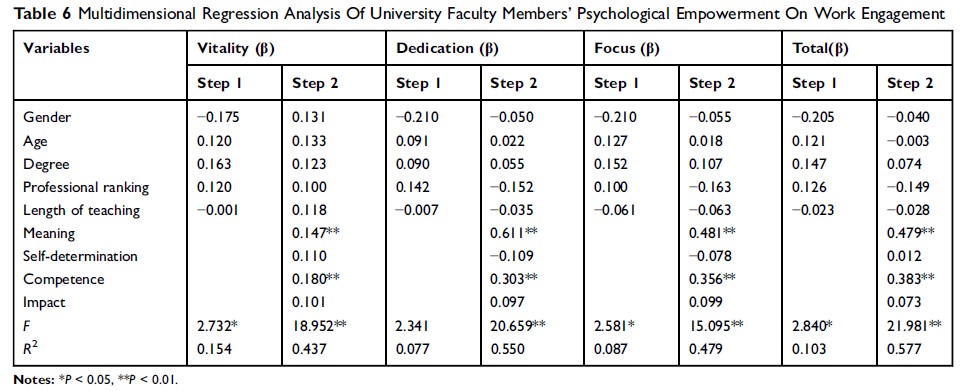
Results: The total scores for the PES and UWES were both moderately high. Gender, age, degree attained, and professional ranking were associated with differences in levels of psychological empowerment and work engagement. The results confirmed that psychological empowerment was positively correlated with all the dimensions of work engagement. The regression analysis results showed that the positive role of psychological empowerment in work engagement was mainly realized through two dimensions: meaning and competence.
Conclusion: The study results revealed significant group differences in the PES and UWES scores among university faculty members. Universities should give more support to younger and junior faculty. There is highly positive correlation between psychological empowerment and work engagement. University should recognize the role of psychological empowerment and create a supportive environment to promote faculty members’ professional development, which, in turn, can increase universities’ productivity.
Keywords: psychological empowerment, work engagement, faculty members, case study