115195
论文已发表
注册即可获取德孚的最新动态
IF 收录期刊
- 3.6 Breast Cancer (Dove Med Press)
- 4.3 Clin Epidemiol
- 2.6 Cancer Manag Res
- 3.2 Infect Drug Resist
- 4.1 Clin Interv Aging
- 6.1 Drug Des Dev Ther
- 4.1 Int J Chronic Obstr
- 8.7 Int J Nanomed
- 2.5 Int J Women's Health
- 3.2 Neuropsych Dis Treat
- 2.4 OncoTargets Ther
- 2.6 Patient Prefer Adher
- 2.6 Ther Clin Risk Manag
- 3.1 J Pain Res
- 3.5 Diabet Metab Synd Ob
- 4.5 Psychol Res Behav Ma
- 3.4 Nat Sci Sleep
- 2.4 Pharmgenomics Pers Med
- 2.6 Risk Manag Healthc Policy
- 4.6 J Inflamm Res
- 2.3 Int J Gen Med
- 3.9 J Hepatocell Carcinoma
- 3.3 J Asthma Allergy
- 2.5 Clin Cosmet Investig Dermatol
- 3.0 J Multidiscip Healthc

氮透膜调节剂类似物 2 具有抗肿瘤作用,并可增强大肠癌细胞对奥沙利铂和 5-氟尿嘧啶的敏感性
Authors Liu A, Qiao J, He L, Liu Z, Chen J, Pei F, Du Y
Received 14 June 2019
Accepted for publication 10 September 2019
Published 18 October 2019 Volume 2019:12 Pages 8637—8644
DOI https://doi.org/10.2147/OTT.S219562
Checked for plagiarism Yes
Review by Single-blind
Peer reviewers approved by Dr Shashank Kaushik (PT)
Peer reviewer comments 2
Editor who approved publication: Prof. Dr. Geoffrey Pietersz
Background: Colorectal cancer (CRC) is one of the most common malignant tumors in the world. Our previous study revealed that nitrogen permease regulator-like-2 (NPRL2), a promising anti-tumor gene, was downregulated at both the blood and tissue levels in CRC patients compared with that in healthy individuals.
Purpose: This study aims to explore the role of NPRL2 in CRC.
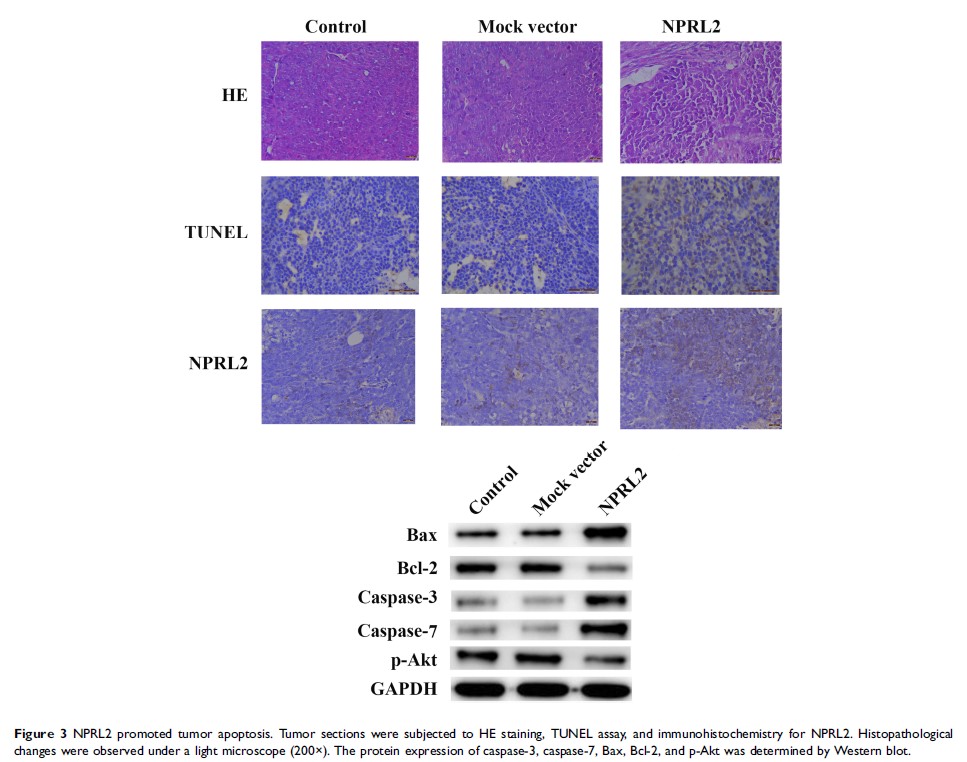
Methods: Herein, we constructed NPRL2 overexpression lentivirus vectors and transfected them into HT29 cells. The transfected cells were inoculated subcutaneously into nude mice. Tumor growth, pathology, apoptosis, and the protein expression of caspase-3, caspase-7, Bax, Bcl-2, and phosphorylated protein kinase B (p-Akt) were evaluated. To further explore whether NPRL2 could reduce drug resistance of CRC cells against oxaliplatin (L-OHP) and 5-fluorouracil (5-FU), we constructed a tumor model using HT29 cells. The tumor model was treated with lentiviral particles assembled with vectors encoding NPRL2 and exposed to L-OHP and 5-FU. Tumor growth, pathology, apoptosis, and the protein expression of caspase-3, caspase-7, Bax, Bcl-2, p-Akt, P-glycoprotein (P-gp), and multidrug resistance protein 1 (MRP1) were evaluated.
Results: The results indicated that in the in vivo CRC xenograft model, NPRL2 reduced the tumor volume and weight and enhanced apoptosis. Our results also confirmed that NPRL2 enhanced the sensitivity of CRC cells to L-OHP and 5-FU. Our studies further demonstrated that NPRL2 exerted anti-tumor and anti-drug resistance effects through the caspase-3, caspase-7, Bax, Bcl-2, Akt, P-gp, and MRP1 pathways.
Conclusion: Our present work demonstrated that NPRL2 exhibited anti-tumor effects and enhanced the sensitivities of CRC cells to L-OHP and 5-FU through the P-gp and MRP1 pathways.
Keywords: NPRL2, colorectal cancer, drug resistance, apoptosis, P-gp, MRP1