115195
论文已发表
注册即可获取德孚的最新动态
IF 收录期刊
- 3.6 Breast Cancer (Dove Med Press)
- 4.3 Clin Epidemiol
- 2.6 Cancer Manag Res
- 3.2 Infect Drug Resist
- 4.1 Clin Interv Aging
- 6.1 Drug Des Dev Ther
- 4.1 Int J Chronic Obstr
- 8.7 Int J Nanomed
- 2.5 Int J Women's Health
- 3.2 Neuropsych Dis Treat
- 2.4 OncoTargets Ther
- 2.6 Patient Prefer Adher
- 2.6 Ther Clin Risk Manag
- 3.1 J Pain Res
- 3.5 Diabet Metab Synd Ob
- 4.5 Psychol Res Behav Ma
- 3.4 Nat Sci Sleep
- 2.4 Pharmgenomics Pers Med
- 2.6 Risk Manag Healthc Policy
- 4.6 J Inflamm Res
- 2.3 Int J Gen Med
- 3.9 J Hepatocell Carcinoma
- 3.3 J Asthma Allergy
- 2.5 Clin Cosmet Investig Dermatol
- 3.0 J Multidiscip Healthc

EGFR 突变的肺鳞状细胞癌的临床和影像学特征
Authors Gao X, Zhu J, Chen L, Jiang Y, Zhou X, Shuai J, Zhao Y
Received 12 July 2019
Accepted for publication 18 September 2019
Published 21 October 2019 Volume 2019:11 Pages 9017—9024
DOI https://doi.org/10.2147/CMAR.S223021
Checked for plagiarism Yes
Review by Single-blind
Peer reviewers approved by Dr Cristina Weinberg
Peer reviewer comments 2
Editor who approved publication: Professor Lu-Zhe Sun
Purpose: To analyze the distribution of epidermal growth factor receptor (EGFR ) mutations; characterize the clinical and imageological features of lung squamous cell carcinoma (LSCC) in a large population of patients; and assess correlations between clinical and imageological characteristics and clinical outcomes of LSCC patients harboring EGFR mutations.
Patients and methods: Three pathologists retrospectively evaluated the morphological and immunohistochemical data of 2,322 patients with LSCC resected between February 2013 and December 2017. Data on the distribution of EGFR mutations and the clinical and imageological characteristics of the patients were retrospectively collected. Correlations between the EGFR mutation status and clinical outcomes were evaluated using univariate and multivariate analyses.
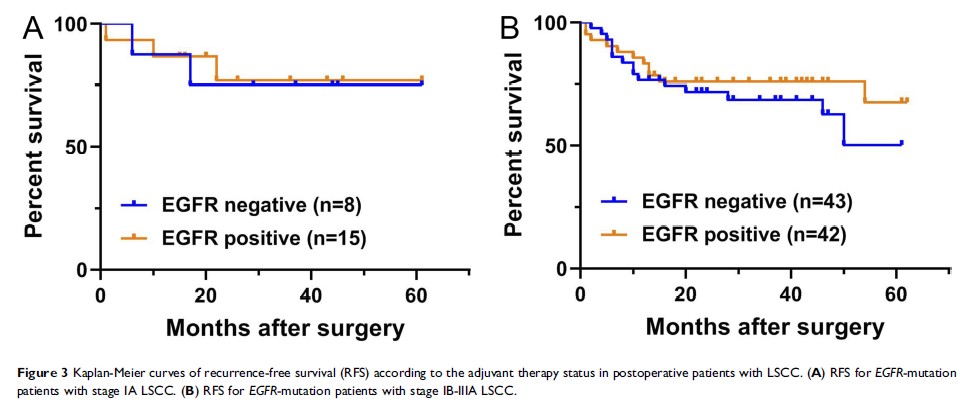
Results: EGFR mutations were found in 3.4% of patients with LSCC and predominantly in female and non-smoking patients. Tumor lesions in patients with EGFR -positive mutations were more irregularly shaped than those in patients with EGFR -negative mutations (P = 0.045). In non-smoking patients with LSCC, the proportion of marked spiculation was significantly higher in the EGFR -positive group than in the EGFR -negative group (P = 0.043). No significant difference in recurrence-free survival was noted between LSCC patients harboring EGFR -positive and those harboring EGFR -negative mutations. No difference in metastases was observed between the EGFR -positive and EGFR -negative cohorts.
Conclusion: Female gender, non-smoking habit, irregularly shaped tumor, and marked spiculation might predict the presence of EGFR mutations in LSCC. The administration of tyrosine kinase inhibitors to patients with LSCC after screening for EGFR mutations based on their clinical and imageological features would likely result in a population with a greater sensitivity to afatinib.
Keywords: EGFR mutation, lung squamous cell carcinoma, imageological feature, recurrence-free survival