115195
论文已发表
注册即可获取德孚的最新动态
IF 收录期刊
- 3.6 Breast Cancer (Dove Med Press)
- 4.3 Clin Epidemiol
- 2.6 Cancer Manag Res
- 3.2 Infect Drug Resist
- 4.1 Clin Interv Aging
- 6.1 Drug Des Dev Ther
- 4.1 Int J Chronic Obstr
- 8.7 Int J Nanomed
- 2.5 Int J Women's Health
- 3.2 Neuropsych Dis Treat
- 2.4 OncoTargets Ther
- 2.6 Patient Prefer Adher
- 2.6 Ther Clin Risk Manag
- 3.1 J Pain Res
- 3.5 Diabet Metab Synd Ob
- 4.5 Psychol Res Behav Ma
- 3.4 Nat Sci Sleep
- 2.4 Pharmgenomics Pers Med
- 2.6 Risk Manag Healthc Policy
- 4.6 J Inflamm Res
- 2.3 Int J Gen Med
- 3.9 J Hepatocell Carcinoma
- 3.3 J Asthma Allergy
- 2.5 Clin Cosmet Investig Dermatol
- 3.0 J Multidiscip Healthc

胆囊癌患者术前全身炎症生物标志物的预后价值及诺模图的建立
Authors Deng Y, Zhang F, Yu X, Huo CL, Sun ZG, Wang S
Received 3 June 2019
Accepted for publication 16 September 2019
Published 21 October 2019 Volume 2019:11 Pages 9025—9035
DOI https://doi.org/10.2147/CMAR.S218119
Checked for plagiarism Yes
Review by Single-blind
Peer reviewers approved by Dr Cristina Weinberg
Peer reviewer comments 3
Editor who approved publication: Dr Beicheng Sun
Background and aim: Preoperative systemic inflammatory biomarkers, including neutrophil to lymphocyte ratio (NLR), derived neutrophil to lymphocyte ratio (dNLR), platelet to lymphocyte ratio (PLR), and lymphocyte to monocyte ratio (LMR) have been developed to predict patient outcome in several types of carcinomas. The aim of this study was to investigate the potential prognostic value of NLR, dNLR, PLR, and LMR, and establish a prognostic nomogram in postoperative GBC patients who underwent radical cholecystectomy.
Methods: 169 GBC patients were retrospectively enrolled in the present study. ROC curve analysis was used to determine the optimal cut-off values of systemic inflammatory biomarkers. The prognostic value of those biomarkers was investigated according to the Kaplan-Meier method and Cox regression model. A relevant prognostic nomogram was established.
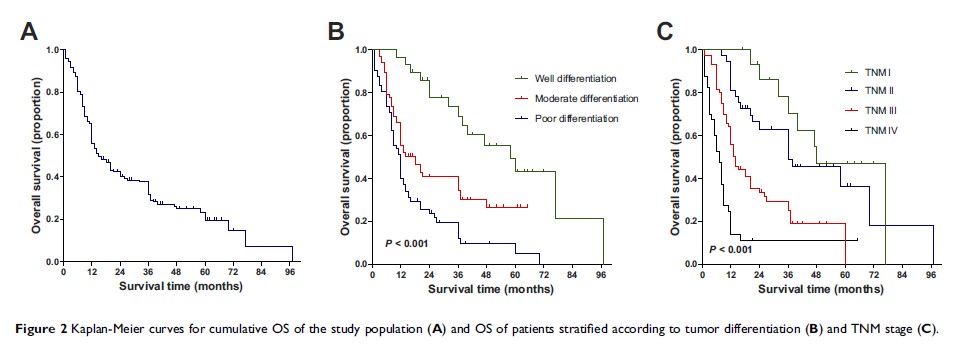
Results: Results showed that NLR, dNLR, PLR, and LMR were significantly associated with overall survival (OS); whereas, NLR and LMR were retained as independent indicators. Based on these independent predictors including tumor differentiation, T stage, N stage, CEA, NLR, and LMR, a nomogram was generated with an accuracy of 0.801.
Conclusion: Based on our findings, the predictive nomogram could accurately predict individualized survival probability of postoperative GBC patients, and might support clinicians in treatment optimization and clinical decision-making.
Keywords: gallbladder carcinoma, systemic inflammatory biomarker, prognosis, overall survival, nomogram