115195
论文已发表
注册即可获取德孚的最新动态
IF 收录期刊
- 3.6 Breast Cancer (Dove Med Press)
- 4.3 Clin Epidemiol
- 2.6 Cancer Manag Res
- 3.2 Infect Drug Resist
- 4.1 Clin Interv Aging
- 6.1 Drug Des Dev Ther
- 4.1 Int J Chronic Obstr
- 8.7 Int J Nanomed
- 2.5 Int J Women's Health
- 3.2 Neuropsych Dis Treat
- 2.4 OncoTargets Ther
- 2.6 Patient Prefer Adher
- 2.6 Ther Clin Risk Manag
- 3.1 J Pain Res
- 3.5 Diabet Metab Synd Ob
- 4.5 Psychol Res Behav Ma
- 3.4 Nat Sci Sleep
- 2.4 Pharmgenomics Pers Med
- 2.6 Risk Manag Healthc Policy
- 4.6 J Inflamm Res
- 2.3 Int J Gen Med
- 3.9 J Hepatocell Carcinoma
- 3.3 J Asthma Allergy
- 2.5 Clin Cosmet Investig Dermatol
- 3.0 J Multidiscip Healthc

青年乳腺癌患者术前血清 CEA 和 CA125 水平及诺模图的预后价值
Authors Li X, Dai D, Chen B, He S, Zhang J, Wen C, Wang B
Received 4 July 2019
Accepted for publication 8 September 2019
Published 24 October 2019 Volume 2019:12 Pages 8789—8800
DOI https://doi.org/10.2147/OTT.S221335
Checked for plagiarism Yes
Review by Single-blind
Peer reviewers approved by Ms Aruna Narula
Peer reviewer comments 2
Editor who approved publication: Dr Leo Jen-Liang Su
Background: Young breast cancer patients have poor prognosis compared to older patients in both overall survival (OS) and loco-regional failure-free survival. Carcinoembryonic antigen (CEA) and Cancer antigen 125 (CA125) have been widely used, but their prognostic value in young breast cancer patients remains unknown. The objectives of this study were to evaluate the prognostic value of preoperative CEA and CA125 serum levels and to build nomograms for better prognostic prediction of young Chinese breast cancer patients using both tumor markers.
Methods: We included 576 young breast cancer patients (≤40 years at diagnosis) and collected their preoperative information. The best cut-off values of the CEA and CA125 were identified with receiver operating characteristic (ROC) curves. Univariate and multivariate analyses were used to identify the relative risks of factors for the overall survival (OS), and disease-free survival (DFS), and nomograms were constructed based on these identified factors.
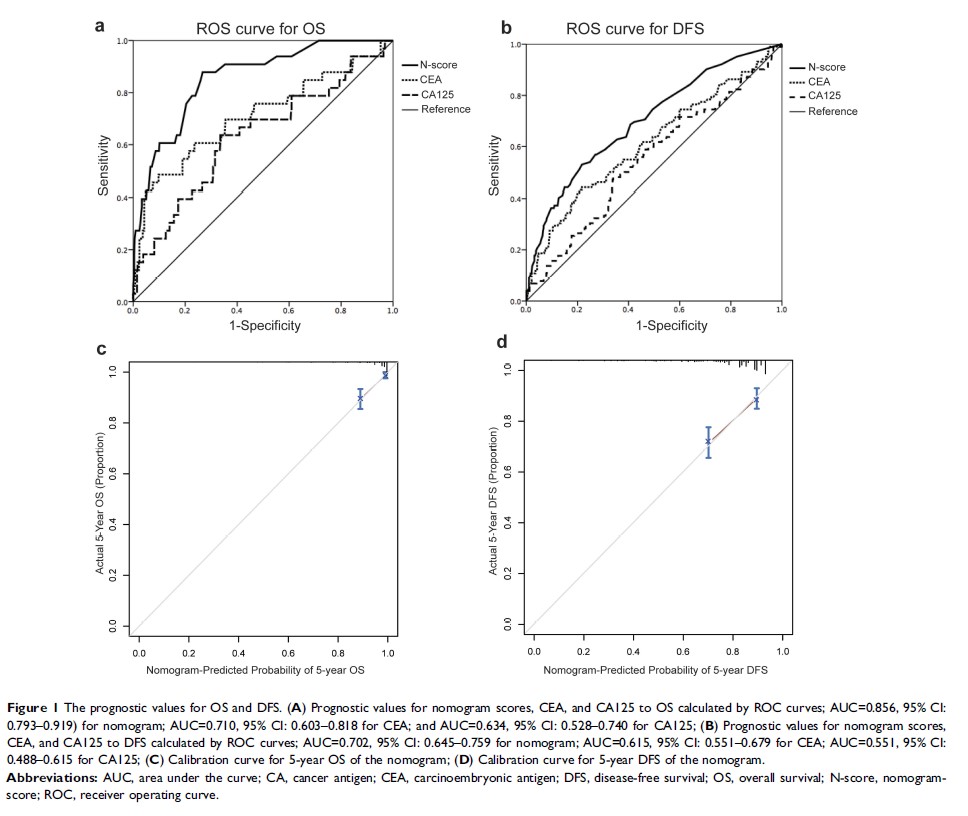
Results: The best cut-off values for CEA and CA125 in young breast cancer patients was 3.38 ng/mL and 19.38 U/mL, respectively. Kaplan-Meier analysis showed that young patients with low levels of CEA and/or CA125, had longer OS and DFS. Multivariate analysis suggested that both CEA and CA125 levels were independent predictive elements for OS. Nomograms were built and showed a better predictive ability for OS (AUC = 0.856) and DFS (AUC = 0.702) in young breast cancer patients.
Conclusion: Preoperative serum CEA and CA125 levels could be the independent prognostic factors for OS, and the nomograms including these two variables provide more personal forecasts information to help physicians optimize treatment for young breast cancer patients better.
Keywords: young breast cancer patient, carcinoembryonic antigen, cancer antigen 125, prognostic factors