115195
论文已发表
注册即可获取德孚的最新动态
IF 收录期刊
- 3.6 Breast Cancer (Dove Med Press)
- 4.3 Clin Epidemiol
- 2.6 Cancer Manag Res
- 3.2 Infect Drug Resist
- 4.1 Clin Interv Aging
- 6.1 Drug Des Dev Ther
- 4.1 Int J Chronic Obstr
- 8.7 Int J Nanomed
- 2.5 Int J Women's Health
- 3.2 Neuropsych Dis Treat
- 2.4 OncoTargets Ther
- 2.6 Patient Prefer Adher
- 2.6 Ther Clin Risk Manag
- 3.1 J Pain Res
- 3.5 Diabet Metab Synd Ob
- 4.5 Psychol Res Behav Ma
- 3.4 Nat Sci Sleep
- 2.4 Pharmgenomics Pers Med
- 2.6 Risk Manag Healthc Policy
- 4.6 J Inflamm Res
- 2.3 Int J Gen Med
- 3.9 J Hepatocell Carcinoma
- 3.3 J Asthma Allergy
- 2.5 Clin Cosmet Investig Dermatol
- 3.0 J Multidiscip Healthc

大便潜血试验用于检测近端与远端结肠直肠肿瘤形成的诊断准确性:系统评价和荟萃分析
Authors Lu M, Luo X, Li N, Chen H, Dai M
Received 27 April 2019
Accepted for publication 16 September 2019
Published 25 October 2019 Volume 2019:11 Pages 943—954
DOI https://doi.org/10.2147/CLEP.S213677
Checked for plagiarism Yes
Review by Single-blind
Peer reviewers approved by Dr Amy Norman
Peer reviewer comments 2
Editor who approved publication: Professor Eyal Cohen
Objective: We conducted a systematic review and meta-analysis aimed at evaluating the differences of diagnostic performance of fecal occult blood tests (FOBTs) in detecting advanced colorectal neoplasms located in the proximal versus distal colorectum.
Methods: PubMed, Embase, Cochrane Library, and Web of Science were searched for eligible articles published before August 17, 2018. Two independent reviewers conducted study assessment and data extraction. Diagnosis-related indicators of FOBT for detecting proximal and distal colorectal neoplasms were summarized, and further stratified by the type of FOBT (guaiac-based FOBT (gFOBT) and immunochemical FOBT (iFOBT)). Pooled sensitivities and specificities were calculated using a random effect model. Summary receiver operating characteristic curves were plotted and area under the curves were calculated.
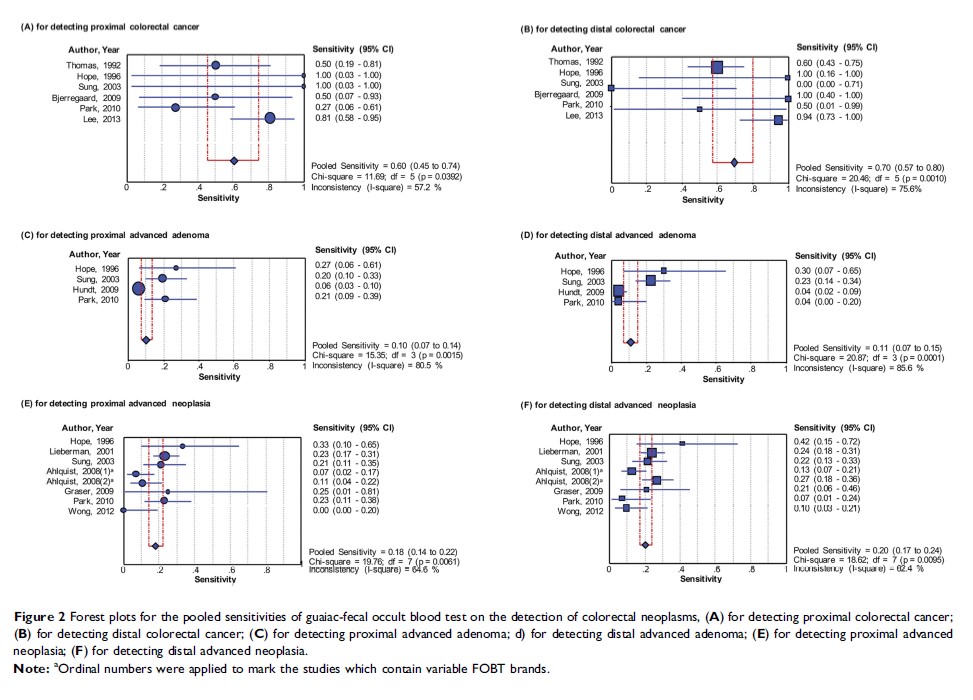
Results: Overall, 31 studies meeting the inclusion criteria were included in this review. For gFOBT, we found no site-specific difference (proximally vs distally located) of pooled sensitivities observed in the colorectal cancer (CRC), advanced adenomas, and advanced neoplasms groups. As for iFOBT, pooled sensitivities for detecting CRC located in the distal colon/rectum were comparable with that in the proximal colon (proximal vs distal, 0.67, 95% CI 0.62–0.72 vs 0.72, 95% CI 0.68–0.75), while higher pooled sensitivities for detecting advanced adenomas and advanced neoplasms located in the distal colon/rectum than for detecting those in the proximal colon were observed for iFOBT with the values of 0.24 (95% CI 0.22–0.25) vs 0.32 (95% CI 0.30–0.34) and 0.25 (95% CI 0.23–0.28) vs 0.38 (95% CI 0.36–0.40), respectively. Summary receiver operating characteristic curve analyses showed similar patterns for both types of FOBT regarding the diagnostic accuracy for detecting colorectal neoplasms according to the anatomical sites of the colorectum.
Conclusion: iFOBT had higher sensitivity for detecting advanced adenomas and advanced neoplasia located in the distal colon/rectum than that for those in the proximal colon.
Keywords: sensitivity, colorectal cancer, screening test