115195
论文已发表
注册即可获取德孚的最新动态
IF 收录期刊
- 3.6 Breast Cancer (Dove Med Press)
- 4.3 Clin Epidemiol
- 2.6 Cancer Manag Res
- 3.2 Infect Drug Resist
- 4.1 Clin Interv Aging
- 6.1 Drug Des Dev Ther
- 4.1 Int J Chronic Obstr
- 8.7 Int J Nanomed
- 2.5 Int J Women's Health
- 3.2 Neuropsych Dis Treat
- 2.4 OncoTargets Ther
- 2.6 Patient Prefer Adher
- 2.6 Ther Clin Risk Manag
- 3.1 J Pain Res
- 3.5 Diabet Metab Synd Ob
- 4.5 Psychol Res Behav Ma
- 3.4 Nat Sci Sleep
- 2.4 Pharmgenomics Pers Med
- 2.6 Risk Manag Healthc Policy
- 4.6 J Inflamm Res
- 2.3 Int J Gen Med
- 3.9 J Hepatocell Carcinoma
- 3.3 J Asthma Allergy
- 2.5 Clin Cosmet Investig Dermatol
- 3.0 J Multidiscip Healthc

基于多中心现实世界的数据,开发和验证新型诊断模型用于评估中国人群肺癌转移
Authors Yao Y, Yan C, Zhang W, Wu SG, Guan J, Zeng G, Du Q, Huang C, Zhang H, Wang H, Hou Y, Li Z, Wang L, Zheng Y, Li X
Received 1 June 2019
Accepted for publication 23 August 2019
Published 29 October 2019 Volume 2019:11 Pages 9213—9223
DOI https://doi.org/10.2147/CMAR.S217970
Checked for plagiarism Yes
Review by Single-blind
Peer reviewers approved by Dr Amy Norman
Peer reviewer comments 3
Editor who approved publication: Dr Eileen O'Reilly
Background: Accurate disease staging plays an important role in lung cancer’s clinical management. However, due to the limitation of the CT scan, it is still an unmet medical need in practice. In the present study, we attempted to develop diagnostic models based on biomarkers and clinical parameters for assessing lung cancer metastasis.
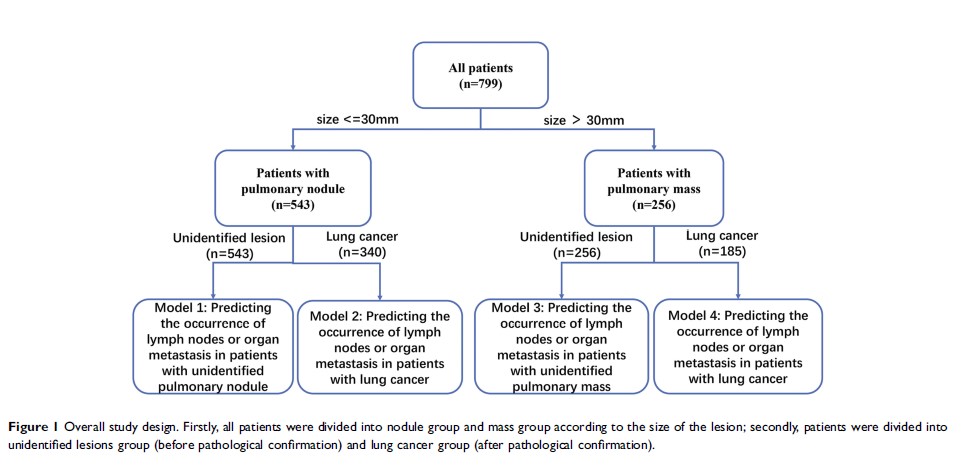
Methods: This study consisted of 799 patients with pulmonary lesions from three regional centers in China. It included 274 benign lesions patients, 326 primary lung cancer patients without metastasis, and 199 advanced lung cancer patients with lymph node or organ metastasis. The patients were divided into nodules group and masses group according to tumor size.
Results: Four nomogram models based on patient characteristics and tumor biomarkers were developed and evaluated for patients with nodules and masses, respectively. In patients with pulmonary nodules, the AUC to identify metastatic lung cancer from unidentified nodules (including benign nodules and lung cancer, model 1) reached 0.859 (0.827–0.887, 95% CI). Model 2 was used to predict metastasis in patients with lung cancer with AUC of 0.838 (0.795–0.876, 95% CI). In patients with pulmonary masses, the AUC to identify metastatic lung cancer from unidentified masses (model 3) reached 0.773 (0.717–0.823, 95% CI). Model 4 was used to predict metastasis in patients with lung cancer and AUC reached 0.731 (0.771–0.793, 95% CI). Decision curve analysis corroborated good clinical applicability of the nomograms in predicting metastasis.
Conclusion: All new models demonstrated promising discrimination, allowing for estimating the risk of lymph node or organ metastasis of lung cancer. Such integration of blood biomarker testing with CT imaging results will be an efficient and effective approach to benefit the accurate staging and treatment of lung cancer.
Keywords: CT imaging pulmonary lesions, biomarker, nomogram models, lung cancer metastasis, multicenter real-world