115195
论文已发表
注册即可获取德孚的最新动态
IF 收录期刊
- 3.6 Breast Cancer (Dove Med Press)
- 4.3 Clin Epidemiol
- 2.6 Cancer Manag Res
- 3.2 Infect Drug Resist
- 4.1 Clin Interv Aging
- 6.1 Drug Des Dev Ther
- 4.1 Int J Chronic Obstr
- 8.7 Int J Nanomed
- 2.5 Int J Women's Health
- 3.2 Neuropsych Dis Treat
- 2.4 OncoTargets Ther
- 2.6 Patient Prefer Adher
- 2.6 Ther Clin Risk Manag
- 3.1 J Pain Res
- 3.5 Diabet Metab Synd Ob
- 4.5 Psychol Res Behav Ma
- 3.4 Nat Sci Sleep
- 2.4 Pharmgenomics Pers Med
- 2.6 Risk Manag Healthc Policy
- 4.6 J Inflamm Res
- 2.3 Int J Gen Med
- 3.9 J Hepatocell Carcinoma
- 3.3 J Asthma Allergy
- 2.5 Clin Cosmet Investig Dermatol
- 3.0 J Multidiscip Healthc

2006-2016 年中国中部武汉市以人口为基础的胃肠道癌发病率、死亡率和生存率
Authors Cheng Y, Liu J, Liao Q, Hu X, Lv H, Ding P, Nie S, Tan L
Received 8 May 2019
Accepted for publication 28 September 2019
Published 29 October 2019 Volume 2019:11 Pages 9233—9241
DOI https://doi.org/10.2147/CMAR.S209925
Checked for plagiarism Yes
Review by Single-blind
Peer reviewers approved by Dr Nicola Ludin
Peer reviewer comments 2
Editor who approved publication: Dr Antonella D'Anneo
Objective: Incidence and mortality rates of malignant tumors in China are higher than global averages, especially for gastrointestinal (GI) cancers. To advance understanding of the epidemiology of GI cancers and to seek clues for cancer control, this study compared the incidence, mortality, and survival for GI cancers among residents of Wuhan (central China) and Chinese Americans.
Methods: A population-based study of cancer epidemiology was carried out on Wuhan residents and Chinese Americans. Data were collected from the Cancer Registry of Jiang’an District in Wuhan and the Surveillance, Epidemiology, and End Results (SEER) program. Joinpoint regression analyses were used to examine trends in the incidence and mortality of GI cancers in Wuhan. Furthermore, we estimated age-specific rates of incidence and mortality and survival rates of GI cancers in both populations.
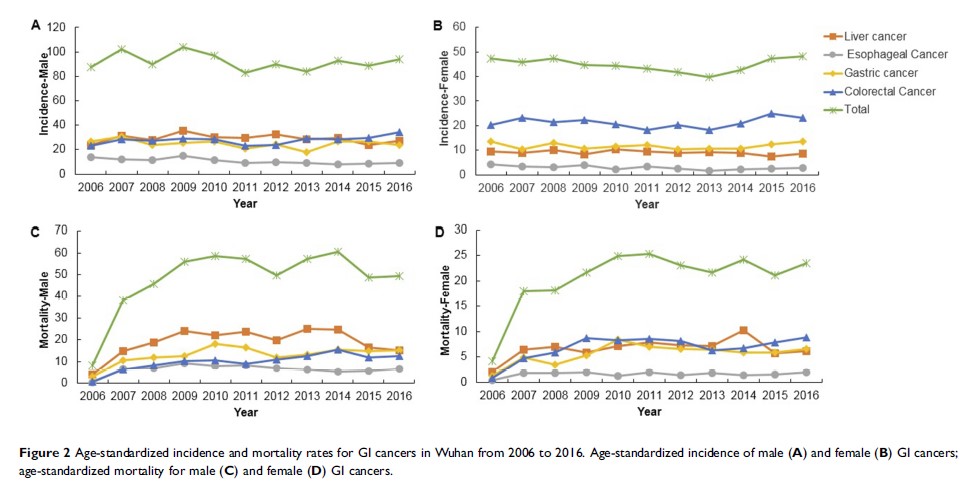
Results: Among male GI cancer patients, mortality rates exhibited a significant increasing trend during 2006–2016 in Wuhan, with an annual percentage change (APC) of 7.4% (95% CI 1.7%–13.3%). Among female patients, the incidence of GI cancers showed a declining trend (APC –2.3%, 95% CI –3.4% to –1.3%) during 2006–2013, then escalated with an APC of 6.2% (95% CI 2.3%–10.2%) during 2013–2016. Both male and female patients with esophageal cancer in Wuhan experienced better survival than Chinese Americans. However, survival rates for the other three GI cancers in Wuhan were relatively lower than Chinese Americans.
Conclusion: Escalating trends were observed in incidence among women and mortality among men with GI cancers. In addition, the survival rates of GI cancer patients in Wuhan were lower than Chinese Americans. As such, additional efforts are needed to control GI cancers in Wuhan, central China.
Keywords: mortality, incidence, population-based data, gastrointestinal cancer, China