115195
论文已发表
注册即可获取德孚的最新动态
IF 收录期刊
- 3.6 Breast Cancer (Dove Med Press)
- 4.3 Clin Epidemiol
- 2.6 Cancer Manag Res
- 3.2 Infect Drug Resist
- 4.1 Clin Interv Aging
- 6.1 Drug Des Dev Ther
- 4.1 Int J Chronic Obstr
- 8.7 Int J Nanomed
- 2.5 Int J Women's Health
- 3.2 Neuropsych Dis Treat
- 2.4 OncoTargets Ther
- 2.6 Patient Prefer Adher
- 2.6 Ther Clin Risk Manag
- 3.1 J Pain Res
- 3.5 Diabet Metab Synd Ob
- 4.5 Psychol Res Behav Ma
- 3.4 Nat Sci Sleep
- 2.4 Pharmgenomics Pers Med
- 2.6 Risk Manag Healthc Policy
- 4.6 J Inflamm Res
- 2.3 Int J Gen Med
- 3.9 J Hepatocell Carcinoma
- 3.3 J Asthma Allergy
- 2.5 Clin Cosmet Investig Dermatol
- 3.0 J Multidiscip Healthc

混合性肠球菌血流感染的临床特征和危险因素
Authors Zheng C, Cai J, Liu H, Zhang S, Zhong L, Xuan N, Zhou H, Zhang K, Wang Y, Zhang X, Tian B, Zhang Z, Wang C, Cui W, Zhang G
Received 31 May 2019
Accepted for publication 2 October 2019
Published 31 October 2019 Volume 2019:12 Pages 3397—3407
DOI https://doi.org/10.2147/IDR.S217905
Checked for plagiarism Yes
Review by Single-blind
Peer reviewers approved by Dr Cristina Weinberg
Peer reviewer comments 2
Editor who approved publication: Professor Suresh Antony
Purpose: Although the enterococcal bloodstream infections (EBSI) are often observed in clinic, the mixed-EBSI are few reported. The aim of this study was to investigate the clinical characteristics and risk factors of mixed-EBSI in comparison with monomicrobial EBSI (mono-EBSI).
Methods: A single-center retrospective observational study was performed between Jan 1, 2013 and Dec 31, 2018 in a tertiary hospital. All patients with EBSI were enrolled, and their data were collected by reviewing electronic medical records.
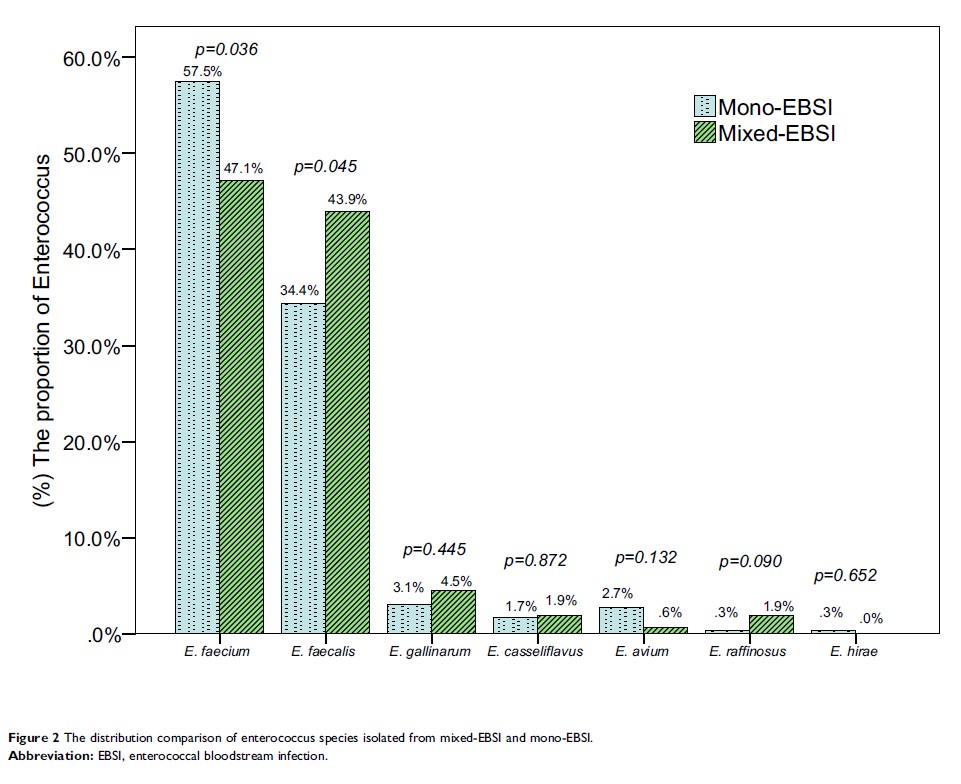
Results: A total of 451 patients with EBSI were enrolled including 157 cases (34.8%) with mixed-EBSI. The most common co-pathogens were Coagulase-negative Staphylococcus (26.86%), followed by Acinetobacter baumannii (23.43%) and Klebsiella pneumoniae (8.57%). In multivariable analysis, burn injury (adjusted odds ratio [aOR], 7.39; 95% confidence interval [CI], 2.69–20.28), and length of prior hospital stay (aOR, 1.01; 95% CI, 1.00–1.02) were associated with mixed-EBSI. Patients with mixed-EBSI developed with more proportion of septic shock (19% vs. 31.8%, p=0.002), prolonged length of intensive care unit (ICU) stay [9(0,25) vs. 15(2.5,36), p<0.001] and hospital stay [29(16,49) vs. 33(18.5,63), p=0.031]. The mortality was not significantly different between mixed-EBSI and mono-EBSI (p=0.219).
Conclusion: A high rate of mixed-EBSI is among EBSI, and Acinetobacter baumannii is the second predominant co-existed species, except for Coagulase-negative Staphylococcus . Burn injury and length of prior hospital stay are independent risk factors for mixed-EBSI. Although the mortality is not different, patients with mixed-EBSI might have poor outcomes in comparison with mono-EBSI, which merits more attention by physicians in the future.
Keywords: bloodstream infections, mixed-enterococcal bloodstream infections, monomicrobial enterococcal bloodstream infections, clinical characteristics, risk factors