115195
论文已发表
注册即可获取德孚的最新动态
IF 收录期刊
- 3.6 Breast Cancer (Dove Med Press)
- 4.3 Clin Epidemiol
- 2.6 Cancer Manag Res
- 3.2 Infect Drug Resist
- 4.1 Clin Interv Aging
- 6.1 Drug Des Dev Ther
- 4.1 Int J Chronic Obstr
- 8.7 Int J Nanomed
- 2.5 Int J Women's Health
- 3.2 Neuropsych Dis Treat
- 2.4 OncoTargets Ther
- 2.6 Patient Prefer Adher
- 2.6 Ther Clin Risk Manag
- 3.1 J Pain Res
- 3.5 Diabet Metab Synd Ob
- 4.5 Psychol Res Behav Ma
- 3.4 Nat Sci Sleep
- 2.4 Pharmgenomics Pers Med
- 2.6 Risk Manag Healthc Policy
- 4.6 J Inflamm Res
- 2.3 Int J Gen Med
- 3.9 J Hepatocell Carcinoma
- 3.3 J Asthma Allergy
- 2.5 Clin Cosmet Investig Dermatol
- 3.0 J Multidiscip Healthc

阿帕替尼在经导管动脉化疗栓塞术治疗难治性中晚期肝细胞癌中的疗效:倾向得分匹配分析
Authors Qiu Z, Shen L, Chen S, Qi H, Cao F, Xie L, Fan W
Received 15 July 2019
Accepted for publication 9 October 2019
Published 1 November 2019 Volume 2019:11 Pages 9321—9330
DOI https://doi.org/10.2147/CMAR.S223271
Checked for plagiarism Yes
Review by Single-blind
Peer reviewers approved by Dr Cristina Weinberg
Peer reviewer comments 4
Editor who approved publication: Dr Eileen O'Reilly
Purpose: This research aimed to compare the efficacy of combination treatment of transcatheter arterial chemoembolization (TACE) with apatinib versus TACE-alone for intermediate and advanced-stage hepatocellular carcinoma (HCC) cases refractory to TACE.
Patients and methods: A total of 125 patients with TACE refractory intermediate or advanced-stage HCC were enrolled and classified as TACE-apatinib group and TACE-alone group. One-to-one matched pairs between two groups were generated using propensity score matching (PSM). Associations of treatment modality with overall survival (OS) and progression-free survival (PFS) were determined by Cox regression. Adverse effects (AEs) were compared between two treatment groups to assess the safety of apatinib.
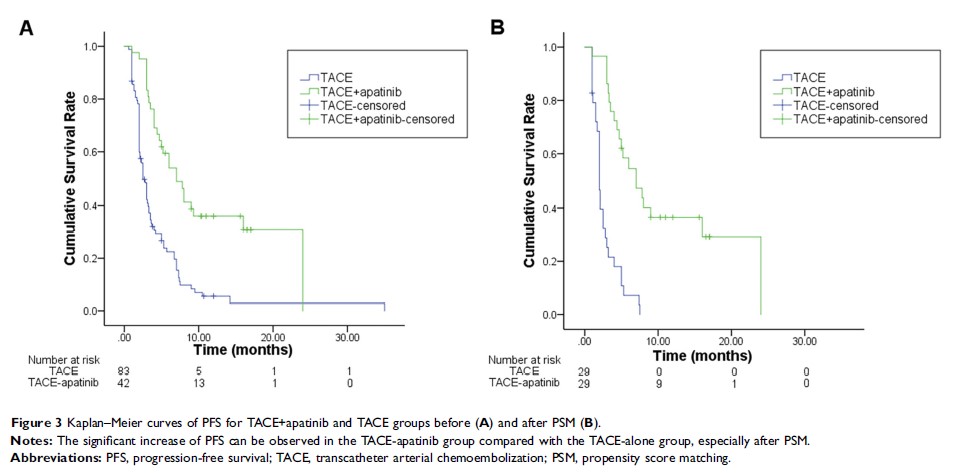
Results: Before PSM analysis, the median OS and PFS were 17.0 and 7.0 months in the TACE-apatinib group, while 8.5 and 2.5 months in the TACE-alone group (P <0.05). After PSM analysis, 29 pairs of patients were generated with no significant difference in baseline characteristics. The median OS and PFS were 17.0 and 7.0 months in the TACE-apatinib group, while 10.7 and 2.0 months in the TACE-alone group (P <0.001). Multivariate analyses showed that TACE-apatinib treatment was a positive prognostic factor of both OS (hazard ratio [HR]=0.280, 95% confidence interval [95% CI] =0.158–0.499; P <0.001) and PFS (HR=0.348, 95% CI=0.223–0.544; P <0.001). Tumor size≥5 cm (HR=1.732, 95% CI=1.086–2.760; P =0.021), presence of portal vein tumor thrombus (HR=2.297, 95% CI=1.379–3.827; P =0.001) and distant metastasis (HR=1.962, 95% CI=1.223–3.148; P =0.005) were independent hazard factors of OS. Three patients in TACE-apatinib group appeared grade 3/4 AEs while their symptoms could be alleviated by dosage reduction and symptomatic treatments.
Conclusion: TACE combined with apatinib demonstrated a superior therapeutic efficacy than TACE alone for improved OS and PFS toward the TACE refractory HCC. Apatinib could be recommended for HCC patients when TACE refractoriness occurs after further validation.
Keywords: hepatocellular carcinoma, transarterial chemoembolization, apatinib, prognosis