115195
论文已发表
注册即可获取德孚的最新动态
IF 收录期刊
- 3.6 Breast Cancer (Dove Med Press)
- 4.3 Clin Epidemiol
- 2.6 Cancer Manag Res
- 3.2 Infect Drug Resist
- 4.1 Clin Interv Aging
- 6.1 Drug Des Dev Ther
- 4.1 Int J Chronic Obstr
- 8.7 Int J Nanomed
- 2.5 Int J Women's Health
- 3.2 Neuropsych Dis Treat
- 2.4 OncoTargets Ther
- 2.6 Patient Prefer Adher
- 2.6 Ther Clin Risk Manag
- 3.1 J Pain Res
- 3.5 Diabet Metab Synd Ob
- 4.5 Psychol Res Behav Ma
- 3.4 Nat Sci Sleep
- 2.4 Pharmgenomics Pers Med
- 2.6 Risk Manag Healthc Policy
- 4.6 J Inflamm Res
- 2.3 Int J Gen Med
- 3.9 J Hepatocell Carcinoma
- 3.3 J Asthma Allergy
- 2.5 Clin Cosmet Investig Dermatol
- 3.0 J Multidiscip Healthc

FKBP14 通过靶向 IL-6/STAT3 信号通路促进结肠癌细胞的增殖和迁移
Authors Yang L, Zhang R, Yang J, Bi T, Zhou S
Received 9 July 2019
Accepted for publication 16 October 2019
Published 1 November 2019 Volume 2019:12 Pages 9069—9076
DOI https://doi.org/10.2147/OTT.S222555
Checked for plagiarism Yes
Review by Single-blind
Peer reviewers approved by Dr Sonali Singh
Peer reviewer comments 2
Editor who approved publication: Dr XuYu Yang
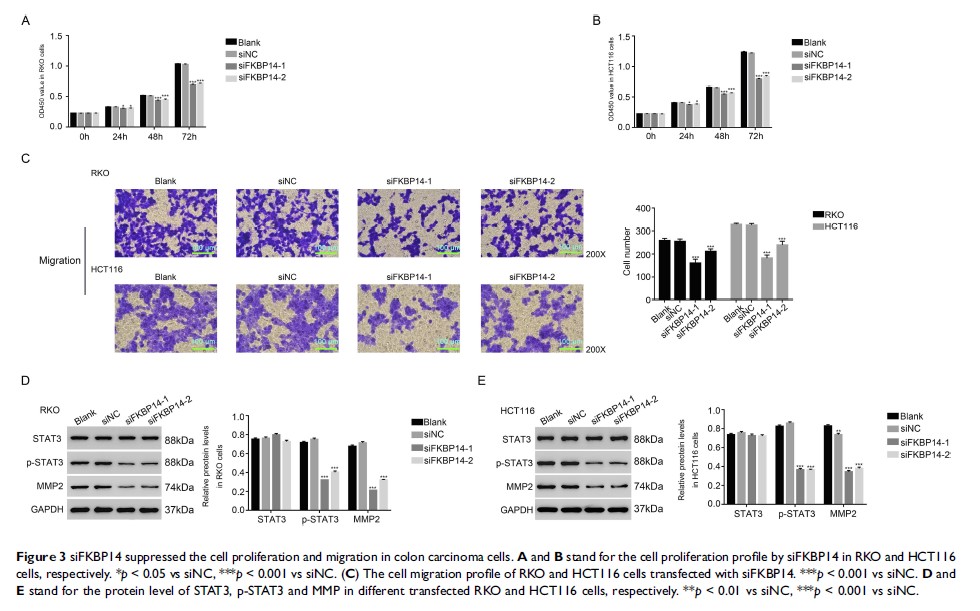
Purpose: FK506-binding proteins 14 (FKBP14), a highly conserved protein, is identified as an oncogene in certain human tumors. However, the detailed biological function of FKBP14 in colon carcinoma remains unclear. The purpose of the present research is to examine the role of FKBP14 in human colon carcinoma cells.
Methods: In the present study, FKBP14 induced silencing and overexpression in colon carcinoma cells by using RNA interference (RNAi) and lentiviral vector, respectively. A specific JAK/STAT inhibitor AG490 was used to explore the relationship between FKBP14 and STAT3 in colon carcinoma cells. Moreover, quantitative real-time polymerase chain reaction (qRT-PCR) and Western blot were used to examine the level of FKBP14 in colon carcinoma cells. Cell counting kit-8 (CCK-8) assay was used to determine the proliferation rate of colon carcinoma cells. Further, the migration rate of colon carcinoma cells was analyzed by performing a migration assay.
Results: Our results demonstrated that FKBP14 was upregulated in human colon carcinoma tissues. Moreover, high level of FKBP14 was associated with poor prognosis of colon carcinoma patients. Further, our findings firstly elucidated that FKBP14 was a pro-proliferation and migration factor in colon carcinoma cells. More importantly, FKBP14 might be a novel component in IL-6/JAK/STAT3 pathway and targeted STAT3 in colon carcinoma cells.
Conclusion: Our research not only indicated the potential signaling pathway of FKBP14 in colon carcinoma cells but also provided novel insight into the treatment for colon carcinoma.
Keywords: colon carcinoma, proliferation, migration, FKBP14, JAK/STAT, IL-6