115195
论文已发表
注册即可获取德孚的最新动态
IF 收录期刊
- 3.6 Breast Cancer (Dove Med Press)
- 4.3 Clin Epidemiol
- 2.6 Cancer Manag Res
- 3.2 Infect Drug Resist
- 4.1 Clin Interv Aging
- 6.1 Drug Des Dev Ther
- 4.1 Int J Chronic Obstr
- 8.7 Int J Nanomed
- 2.5 Int J Women's Health
- 3.2 Neuropsych Dis Treat
- 2.4 OncoTargets Ther
- 2.6 Patient Prefer Adher
- 2.6 Ther Clin Risk Manag
- 3.1 J Pain Res
- 3.5 Diabet Metab Synd Ob
- 4.5 Psychol Res Behav Ma
- 3.4 Nat Sci Sleep
- 2.4 Pharmgenomics Pers Med
- 2.6 Risk Manag Healthc Policy
- 4.6 J Inflamm Res
- 2.3 Int J Gen Med
- 3.9 J Hepatocell Carcinoma
- 3.3 J Asthma Allergy
- 2.5 Clin Cosmet Investig Dermatol
- 3.0 J Multidiscip Healthc

一种含有阿霉素的纳米药物和间充质干细胞衍生的外来体用于体外治疗骨肉瘤
Authors Wei H, Chen J, Wang S, Fu F, Zhu X, Wu C, Liu Z, Zhong G, Lin J
Received 10 June 2019
Accepted for publication 21 October 2019
Published 1 November 2019 Volume 2019:14 Pages 8603—8610
DOI https://doi.org/10.2147/IJN.S218988
Checked for plagiarism Yes
Review by Single-blind
Peer reviewers approved by Dr Colin Mak
Peer reviewer comments 3
Editor who approved publication: Dr Mian Wang
Purpose: The primary goal of the present study was to develop the nano-drug consisting of doxorubicin and exosome derived from mesenchymal stem cells, and to explore its effect on osteosarcoma in vitro.
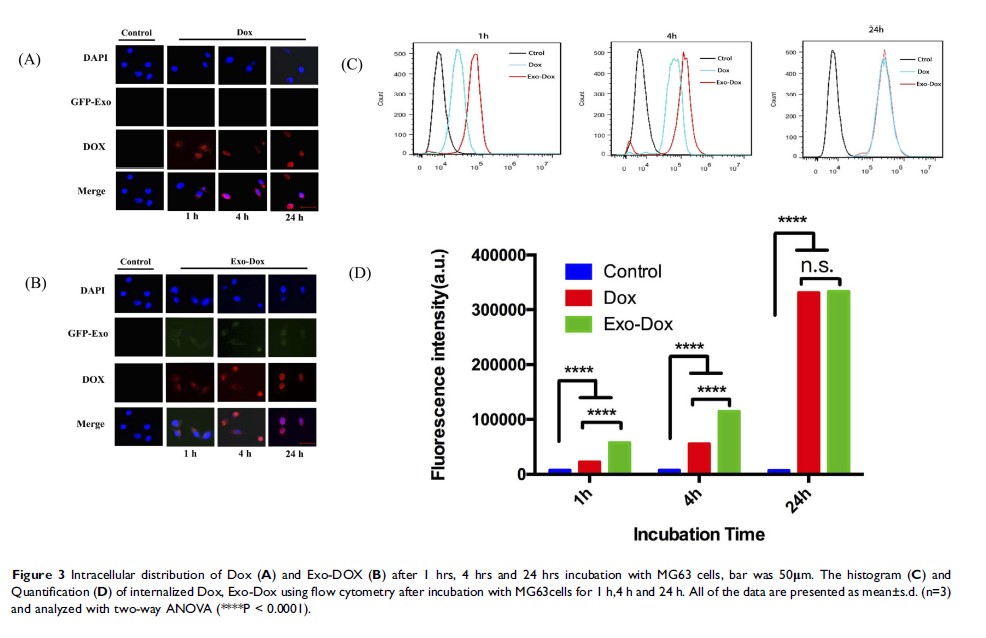
Methods: The exosomes were isolated from bone marrow MSCs (BM-MSCs) by an Exosome Isolation Kit. The exosome-loaded doxorubicin (Exo-Dox) was prepared by mixing exosome with Dox-HCl, desalinizing with triethylamine and then dialyzing against PBS overnight. The nanoparticle tracking analysis (NTA) and transmission electron microscope (TEM) were used to characterize of the exosome and Exo-Dox. The cytotoxicity of Exo-Dox was determined by CCK-8 assay. Further, the cellular uptake of different drugs was analyzed using inverted fluorescence microscope and flow cytometry.
Results: The typical exosome structures can be observed by TEM. After loading with doxorubicin, its size is larger than free exosome. Compared with the free Dox, the prepared Exo-Dox showed enhanced cellular uptake efficiency and anti-tumor effect in osteosarcoma MG63 cell line but low cytotoxicity in myocardial H9C2 cell line.
Conclusion: The prepared Exo-Dox could be used as an excellent chemotherapeutic drug for treatment of osteosarcoma in vitro. Considering the tumor-homing feature of BM-MSCs, the Exo-Dox may be a good candidate for targeted osteosarcoma treatment in future study.
Keywords: exosome, mesenchymal stem cells, doxorubicin, osteosarcoma