115195
论文已发表
注册即可获取德孚的最新动态
IF 收录期刊
- 3.6 Breast Cancer (Dove Med Press)
- 4.3 Clin Epidemiol
- 2.6 Cancer Manag Res
- 3.2 Infect Drug Resist
- 4.1 Clin Interv Aging
- 6.1 Drug Des Dev Ther
- 4.1 Int J Chronic Obstr
- 8.7 Int J Nanomed
- 2.5 Int J Women's Health
- 3.2 Neuropsych Dis Treat
- 2.4 OncoTargets Ther
- 2.6 Patient Prefer Adher
- 2.6 Ther Clin Risk Manag
- 3.1 J Pain Res
- 3.5 Diabet Metab Synd Ob
- 4.5 Psychol Res Behav Ma
- 3.4 Nat Sci Sleep
- 2.4 Pharmgenomics Pers Med
- 2.6 Risk Manag Healthc Policy
- 4.6 J Inflamm Res
- 2.3 Int J Gen Med
- 3.9 J Hepatocell Carcinoma
- 3.3 J Asthma Allergy
- 2.5 Clin Cosmet Investig Dermatol
- 3.0 J Multidiscip Healthc

高糖诱导的 PKCβ 和 PKCδ 高表达在啮齿动物心肌细胞 GLP-1 抗性中的重要作用
Authors Pan X, Chen J, Wang T, Zhang M, Wang H, Gao H
Received 15 May 2019
Accepted for publication 10 September 2019
Published 4 November 2019 Volume 2019:12 Pages 2289—2302
DOI https://doi.org/10.2147/DMSO.S215789
Checked for plagiarism Yes
Review by Single-blind
Peer reviewers approved by Dr Melinda Thomas
Peer reviewer comments 2
Editor who approved publication: Dr Antonio Brunetti
Purpose: Myocardia in diabetic patients exhibit increased vulnerability after ischemia/reperfusion injury (IRI). It has been demonstrated that glucagon-like peptide-1 (GLP-1) has a protective effect on cardiomyocytes. Protein kinase C (PKC) acts as a key regulator of many signaling pathways including oxidative stress and apoptosis. Our hypothesis is that increased vulnerability of myocardia in diabetic patients is partly due to GLP-1 resistance. The aim of this study was to explore the role of PKC in GLP-1 resistance in diabetic cardiomyocytes.
Methods: Cardiac function of diabetic or non-diabetic mice after myocardial IRI was detected with or without administration of GLP-1 analog exendin-4. Impacts of diabetes mellitus on GLP-1R expression in myocardia after IRI were accessed by Western blot. By transfecting PKC isoforms siRNA, in vitro study helped to identify the exact PKC isoforms which contributed to the downregulatio n of GLP-1R or impaired post-receptor signaling pathways in rodent cardiomyocytes (H9C2 cells) cultured by high glucose.
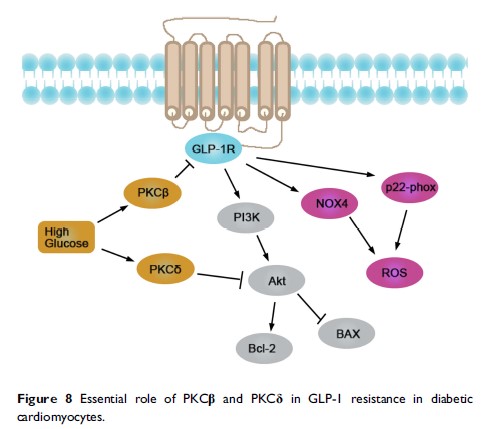
Results: The cardioprotective effects of endogenous GLP-1 were impaired in diabetic mice after myocardial IRI and administration of exendin-4 had no significant effects in restoring cardiac function. GLP-1 receptor (GLP-1R) expression decreased in H9C2 cells cultured by high glucose and knockdown of PKCβ partly restored GLP-1R expression. Overexpression of PKCδ induced by high glucose in H9C2 cells impaired GLP-1 post-receptor anti-apoptotic signaling pathways by inhibition of Akt phosphorylation. Knockdown of both PKCβ and PKCδ significantly restored cardioprotective effects of GLP-1 in H9C2 cells cultured by high glucose.
Conclusion: Our study found out a new mechanism of GLP-1 resistance that high glucose-induced overexpression of PKCβ and PKCδ impaired cardioprotective effects of GLP-1 by downregulation of GLP-1R and inhibition of GLP-1 post-receptor anti-apoptotic signaling pathways, thus provided a new perspective in treating myocardial IRI in diabetic patients.
Keywords: ischemia/reperfusion injury, protein kinase C, GLP-1 resistance, diabetic cardiomyocytes