115195
论文已发表
注册即可获取德孚的最新动态
IF 收录期刊
- 3.6 Breast Cancer (Dove Med Press)
- 4.3 Clin Epidemiol
- 2.6 Cancer Manag Res
- 3.2 Infect Drug Resist
- 4.1 Clin Interv Aging
- 6.1 Drug Des Dev Ther
- 4.1 Int J Chronic Obstr
- 8.7 Int J Nanomed
- 2.5 Int J Women's Health
- 3.2 Neuropsych Dis Treat
- 2.4 OncoTargets Ther
- 2.6 Patient Prefer Adher
- 2.6 Ther Clin Risk Manag
- 3.1 J Pain Res
- 3.5 Diabet Metab Synd Ob
- 4.5 Psychol Res Behav Ma
- 3.4 Nat Sci Sleep
- 2.4 Pharmgenomics Pers Med
- 2.6 Risk Manag Healthc Policy
- 4.6 J Inflamm Res
- 2.3 Int J Gen Med
- 3.9 J Hepatocell Carcinoma
- 3.3 J Asthma Allergy
- 2.5 Clin Cosmet Investig Dermatol
- 3.0 J Multidiscip Healthc

安徽省农村老年人抑郁症症状与生活质量的相关性,及抑郁症状的相关因素
Authors Rong J, Chen G, Wang X, Ge Y, Meng N, Xie T, Ding H
Received 29 July 2019
Accepted for publication 18 October 2019
Published 4 November 2019 Volume 2019:14 Pages 1901—1910
DOI https://doi.org/10.2147/CIA.S225141
Checked for plagiarism Yes
Review by Single-blind
Peer reviewers approved by Dr Nicola Ludin
Peer reviewer comments 2
Editor who approved publication: Dr Zhi-Ying Wu
Purpose: We aimed to assess the current status of depressive symptoms and quality of life (QoL) among rural elderly in central China (Anhui Province) and explore their correlation and associated factors for depressive symptoms.
Methods: A multi-stage random sampling method was used to obtain 3349 participants (aged ≥60): 1206 poor and 2143 non-poor. The 30-item Geriatric Depression Scale (GDS-30) and five-dimensional European quality of health scale (EQ-5D) were employed to evaluate depressive symptoms and QoL, respectively.
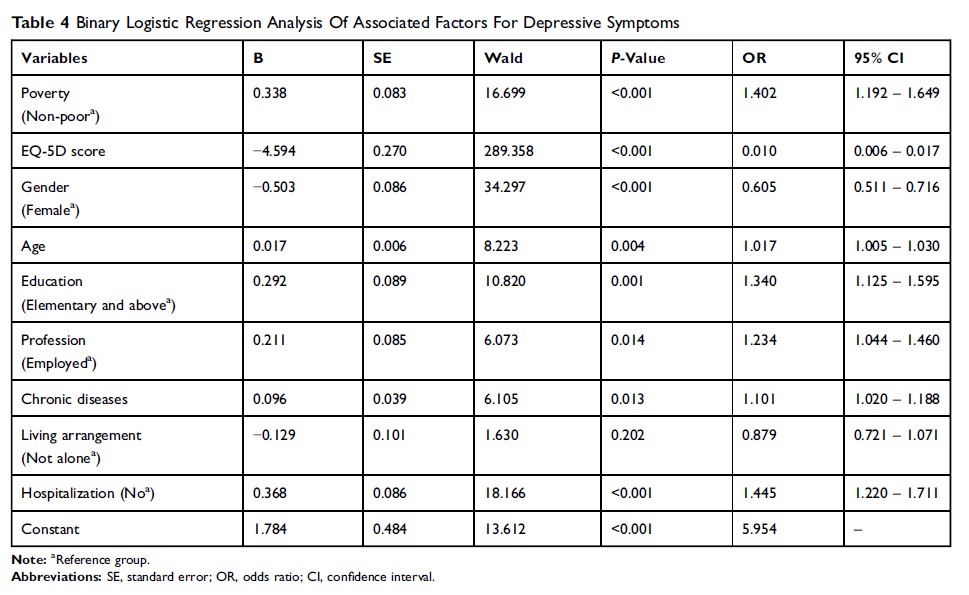
Results: The prevalence of depressive symptoms was 52.9%, and that in the poor group (62.3%) was significantly higher than the non-poor group (47.6%). The GDS-30 score was 12.40 ± 7.089, and the poor group scored significantly higher (14.045 ± 6.929) than the non-poor group (11.472 ± 7.011). The EQ-5D score was 0.713 ± 0.186, and the poor group (0.668 ± 0.192) scored significantly lower than the non-poor group (0.738 ± 0.178). There was a significant negative correlation between depressive symptoms and QoL (r = −0.400, P-value <0.05). The following factors were associated with depressive symptoms: poverty, low EQ-5D score, female gender, older age, illiteracy, unemployed, chronic diseases, and hospitalization in previous year.
Conclusion: Rural elderly in central China have a high prevalence of depressive symptoms and low QoL. Poverty was associated with a higher prevalence of depressive symptoms and lower QoL.
Keywords: depressive symptoms, quality of life, rural elderly, central China