115195
论文已发表
注册即可获取德孚的最新动态
IF 收录期刊
- 3.6 Breast Cancer (Dove Med Press)
- 4.3 Clin Epidemiol
- 2.6 Cancer Manag Res
- 3.2 Infect Drug Resist
- 4.1 Clin Interv Aging
- 6.1 Drug Des Dev Ther
- 4.1 Int J Chronic Obstr
- 8.7 Int J Nanomed
- 2.5 Int J Women's Health
- 3.2 Neuropsych Dis Treat
- 2.4 OncoTargets Ther
- 2.6 Patient Prefer Adher
- 2.6 Ther Clin Risk Manag
- 3.1 J Pain Res
- 3.5 Diabet Metab Synd Ob
- 4.5 Psychol Res Behav Ma
- 3.4 Nat Sci Sleep
- 2.4 Pharmgenomics Pers Med
- 2.6 Risk Manag Healthc Policy
- 4.6 J Inflamm Res
- 2.3 Int J Gen Med
- 3.9 J Hepatocell Carcinoma
- 3.3 J Asthma Allergy
- 2.5 Clin Cosmet Investig Dermatol
- 3.0 J Multidiscip Healthc

MST4 预测不良预后并通过推动胃癌的上皮-间质转化来并促进转移
Authors Li T, Deng L, He X, Jiang G, Hu F, Ye S, You Y, Duanmu J, Dai H, Huang G, Tang C, Lei X
Received 17 June 2019
Accepted for publication 27 September 2019
Published 5 November 2019 Volume 2019:11 Pages 9353—9369
DOI https://doi.org/10.2147/CMAR.S219689
Checked for plagiarism Yes
Review by Single-blind
Peer reviewers approved by Dr Nicola Ludin
Peer reviewer comments 2
Editor who approved publication: Professor Bilikere Dwarakanath
Background: Metastasis is the main cause for gastric cancer (GC)-related deaths. Better understanding of GC metastatic mechanism would provide novel diagnostic markers and therapeutic targets. Though it has been reported that mammalian sterile-20-like kinase 4 (MST4) exerts the oncogenic role in other tumors, the prognostic value and biological role of MST4 in GC are still unknown.
Methods: The expression level of MST4 in GC was analyzed by using TCGA database. Then, Western blot and polymerase chain reaction (PCR) were used to determine the MST4 expression in GC tissues and cell lines. Immunohistochemistry was performed to investigate the expression of proteins in human GC tissues, and its correlation with clinicopathologic parameters as well as the prognosis for patients with GC was analyzed. In addition, the biological function and its molecular mechanism of MST4 in GC were investigated by in vitro and in vivo assays.
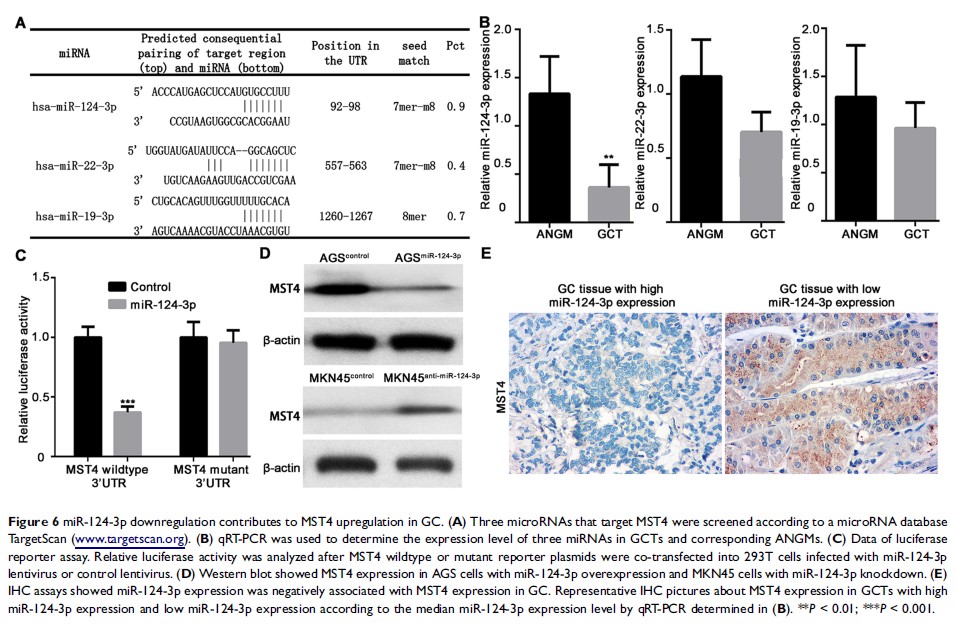
Results: It demonstrated that MST4 expression was significantly upregulated in GC tissues and cell lines. High expression of MST4 was correlated with aggressive clinicopathological parameters such as lymph node metastasis, lymphovascular invasion (all P < 0.05). GC patients with high MST4 expression had both shorter overall survival (OS) and disease-free survival (DFS) than those with low MST4 expression (all P < 0.05). MST4 expression was an independent and significant risk factor for OS and DFS of GC patients (all P < 0.05). Results of functional experiments showed that MST4 could promote GC cells migration, invasion in vitro and metastasis in vivo. In terms of mechanism, MST4 promoted metastasis by facilitating epithelial–mesenchymal transition (EMT) through activating Ezrin pathway in GC. Further studies indicate that down-regulated miR-124-3p expression contributes to upregulated MST4 expression in GC.
Conclusion: Our data showed that MST4 predicts poor prognosis and promotes metastasis by facilitating epithelial–mesenchymal transition in GC. Therefore, our study suggests that MST4 can be used as a valuable prognostic biomarker and a potential therapeutic target in GC.
Keywords: MST4, gastric cancer, prognosis, epithelial-mesenchymal transition, metastasis