115195
论文已发表
注册即可获取德孚的最新动态
IF 收录期刊
- 3.6 Breast Cancer (Dove Med Press)
- 4.3 Clin Epidemiol
- 2.6 Cancer Manag Res
- 3.2 Infect Drug Resist
- 4.1 Clin Interv Aging
- 6.1 Drug Des Dev Ther
- 4.1 Int J Chronic Obstr
- 8.7 Int J Nanomed
- 2.5 Int J Women's Health
- 3.2 Neuropsych Dis Treat
- 2.4 OncoTargets Ther
- 2.6 Patient Prefer Adher
- 2.6 Ther Clin Risk Manag
- 3.1 J Pain Res
- 3.5 Diabet Metab Synd Ob
- 4.5 Psychol Res Behav Ma
- 3.4 Nat Sci Sleep
- 2.4 Pharmgenomics Pers Med
- 2.6 Risk Manag Healthc Policy
- 4.6 J Inflamm Res
- 2.3 Int J Gen Med
- 3.9 J Hepatocell Carcinoma
- 3.3 J Asthma Allergy
- 2.5 Clin Cosmet Investig Dermatol
- 3.0 J Multidiscip Healthc

抑制脊髓角质中单羧酸盐转运蛋白 1 可显著逆转慢性炎症性疼痛
Authors He J, Yu L, Wang Z, Wang Q, Cao JL, Gu L
Received 17 June 2019
Accepted for publication 19 October 2019
Published 5 November 2019 Volume 2019:12 Pages 2981—2990
DOI https://doi.org/10.2147/JPR.S219359
Checked for plagiarism Yes
Review by Single-blind
Peer reviewers approved by Dr Melinda Thomas
Peer reviewer comments 2
Editor who approved publication: Dr Katherine Hanlon
Purpose: Chronic inflammatory pain is a common condition in the clinic, and the underlying mechanism is not being completely understood. Various studies have demonstrated that central and peripheral sensitization and synaptic plasticity could play crucial functions in chronic inflammatory pain. Moreover, families of monocarboxylate transporters (MCTs) are closely related to cellular metabolism and synaptic plasticity, and it is also reported that MCTs participate in chronic inflammatory pain. Nevertheless, there is a probability of the engaging role of MCT 1 is in chronic inflammatory pain, but its specific cellular level mechanism is yet to be investigated. In our study, we hypothesized that MCT 1 in the spinal dorsal horn plays an important part in chronic inflammatory pain.
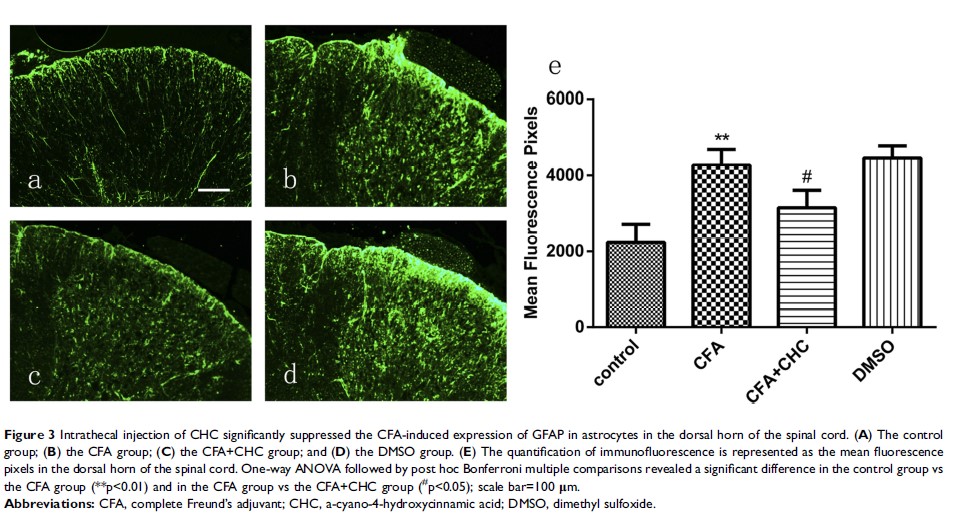
Methods: In experiment A, rats were gone through nociceptive behavioral testing at 1 d day before and 1 d, 3 d, and 7 d after completing complete Freund’s adjuvant (CFA) injection. The specimens collected for detecting MCT 1 by Western blotting. In experiment B, rats were randomly divided into four groups. Intrathecal injection of MCT 1 inhibitor and nociceptive behavioral tests were performed 1 d day before and 1 d, 3 d, 7 d, 14 d, and 21 d after CFA injection. MCT 1 and p-ERK levels in spinal dorsal horn were measured by Western blotting, and GFAP in spinal dorsal horn was detected by immunofluorescence.
Results: The expression of MCT 1 in the spinal dorsal horn was increased during chronic inflammatory pain in rats. The intrathecal injection of an MCT 1 inhibitor evidently diminished the expression of MCT 1 and GFAP in the spinal dorsal horn, and the behavioral nociceptive responses were also attenuated. Meanwhile, the expression of p-ERK was also decreased by the intrathecal injection of an MCT 1 inhibitor.
Conclusion: Our results indicate that MCT 1 very likely play a critical role in regulating chronic inflammatory pain and may influence the regulation of synaptic plasticity via ERK in the spinal dorsal horn of rats.
Keywords: chronic inflammatory pain, monocarboxylate transporter 1, spinal dorsal horn, astrocyte, synaptic plasticity