115195
论文已发表
注册即可获取德孚的最新动态
IF 收录期刊
- 3.6 Breast Cancer (Dove Med Press)
- 4.3 Clin Epidemiol
- 2.6 Cancer Manag Res
- 3.2 Infect Drug Resist
- 4.1 Clin Interv Aging
- 6.1 Drug Des Dev Ther
- 4.1 Int J Chronic Obstr
- 8.7 Int J Nanomed
- 2.5 Int J Women's Health
- 3.2 Neuropsych Dis Treat
- 2.4 OncoTargets Ther
- 2.6 Patient Prefer Adher
- 2.6 Ther Clin Risk Manag
- 3.1 J Pain Res
- 3.5 Diabet Metab Synd Ob
- 4.5 Psychol Res Behav Ma
- 3.4 Nat Sci Sleep
- 2.4 Pharmgenomics Pers Med
- 2.6 Risk Manag Healthc Policy
- 4.6 J Inflamm Res
- 2.3 Int J Gen Med
- 3.9 J Hepatocell Carcinoma
- 3.3 J Asthma Allergy
- 2.5 Clin Cosmet Investig Dermatol
- 3.0 J Multidiscip Healthc

外部肛门和尿道括约肌肌电图对帕金森叠加综合征多系统萎缩的鉴别诊断
Authors Qiu F, Wang K, Li T, Song D, Wang Z, Zhang H, Liu J, Ren M, Qi X
Received 2 June 2019
Accepted for publication 2 October 2019
Published 5 November 2019 Volume 2019:15 Pages 3061—3067
DOI https://doi.org/10.2147/NDT.S218073
Checked for plagiarism Yes
Review by Single-blind
Peer reviewers approved by Dr Cristina Weinberg
Peer reviewer comments 2
Editor who approved publication: Professor Jun Chen
Background: The differential diagnosis of Parkinson’s disease (PD) with multiple-system atrophy (MSA) is difficult because of their similarity in symptoms and signs. The objective of this study was to investigate the value of external anal-sphincter electromyography (EAS-EMG) and urethral-sphincter electromyography (US-EMG) in differentiating MSA from PD.
Methods: A total of 201 patients, — 101 MSA and 100 PD — were recruited in this study. Average duration and amplitude of motor unit potentials (MUPs), percentage of polyphasic MUPs, amplitude during strong contractions, and recruitment patterns during maximal voluntary contractions were recorded and analyzed to assess diagnostic efficiency of EAS-EMG and US-EMG for MSA.
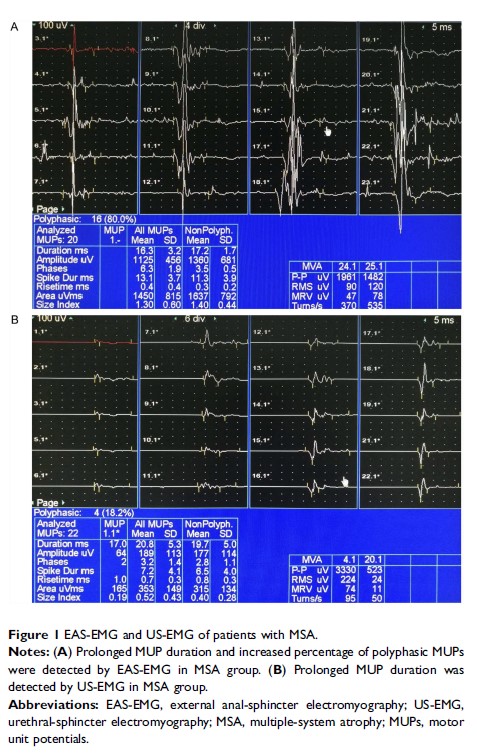
Results: Significant differences in average MUP duration and recruitment patterns during maximal voluntary contractions were found between patients with MSA and patients with PD using both EAS-EMG (P <0.001, P <0.001) and US-EMG (P <0.001, P <0.001). The percentage of polyphasic MUPs and amplitude during strong contractions showed significant differences in MSA and PD using only EAS-EMG (P <0.001, P =0.005). Cutoff points for average MUP duration in EAS-EMG and US-EMG for differential diagnosis of MSA with PD were 10.9 and 11.1 milliseconds, respectively. With average MUP duration of EAS-EMG and US-EMG being applied jointly, sensitivity and specificity in distinguishing MSA from PD were 83.2% and 71.8%, respectively.
Conclusion: EAS-EMG and US-EMG were sensitive and specific methods for the diagnosis and differential diagnosis of MSA, and the combination of both would improve the diagnostic rate of MSA compared to only one method being used.
Keywords: differential diagnosis, MSA, PD, EAS-EMG, US-EMG