115195
论文已发表
注册即可获取德孚的最新动态
IF 收录期刊
- 3.6 Breast Cancer (Dove Med Press)
- 4.3 Clin Epidemiol
- 2.6 Cancer Manag Res
- 3.2 Infect Drug Resist
- 4.1 Clin Interv Aging
- 6.1 Drug Des Dev Ther
- 4.1 Int J Chronic Obstr
- 8.7 Int J Nanomed
- 2.5 Int J Women's Health
- 3.2 Neuropsych Dis Treat
- 2.4 OncoTargets Ther
- 2.6 Patient Prefer Adher
- 2.6 Ther Clin Risk Manag
- 3.1 J Pain Res
- 3.5 Diabet Metab Synd Ob
- 4.5 Psychol Res Behav Ma
- 3.4 Nat Sci Sleep
- 2.4 Pharmgenomics Pers Med
- 2.6 Risk Manag Healthc Policy
- 4.6 J Inflamm Res
- 2.3 Int J Gen Med
- 3.9 J Hepatocell Carcinoma
- 3.3 J Asthma Allergy
- 2.5 Clin Cosmet Investig Dermatol
- 3.0 J Multidiscip Healthc

胰腺癌患者血清衍生的外泌体可促进转移:基于 iTRAQ 的蛋白质组学分析
Authors Tang P, Tao L, Yuan C, Zhang L, Xiu D
Received 1 September 2019
Accepted for publication 17 October 2019
Published 6 November 2019 Volume 2019:12 Pages 9329—9339
DOI https://doi.org/10.2147/OTT.S229494
Checked for plagiarism Yes
Review by Single-blind
Peer reviewers approved by Ms Rachel Predeepa
Peer reviewer comments 2
Editor who approved publication: Dr Federico Perche
Background: Pancreatic cancer (PC) is one of the most aggressive malignancies and has a poor prognosis despite being extensively researched. The role of serum-derived exosomes in tumorigenesis and the development of PC is still unclear.
Method: The present study employed iTRAQ-based proteomic analysis to search for differences between the serum exosomes of PC patients and those from control patients. Then, bioinformatics methods were used to analyze the functions of the identified proteins, and the possible functions were verified through cell culture experiments.
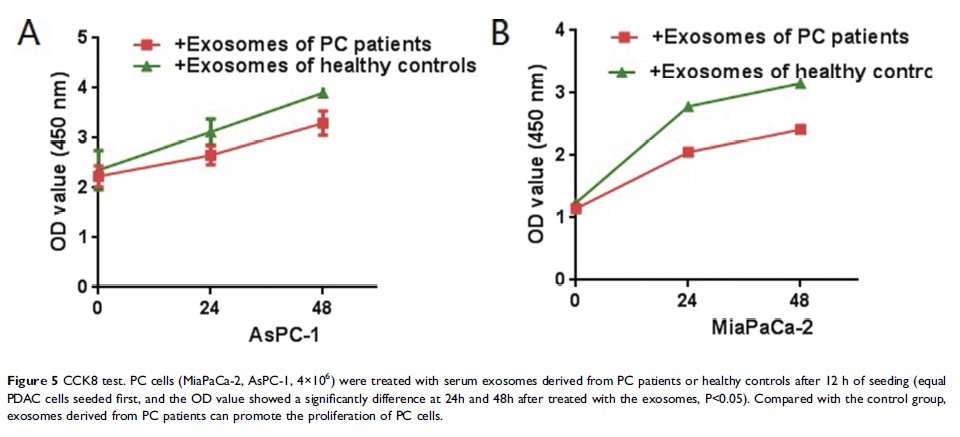
Results: A total of 611 proteins were identified from exosomes, and 141 proteins were differentially expressed, with 91 up- and 50 down regulated proteins in PC cancer compared to healthy controls. Further analysis indicated that APOE serves as an important hub in the network. In addition, CRP, VWF, APOA2, NIN, and GSK3B potentially interact with many other proteins. We then tested the effect of patient serum-derived exosomes on pancreatic cancer cells and found that patient serum-derived exosomes, but not those from healthy controls, induced cell proliferation, migration, and EMT, supporting the role of exosomes in metastasis.
Conclusion: Our data suggest that exosomes derived from PC patients may promote PC metastasis.
Keywords: proteomic analysis, pancreatic cancer, serum exosome, metastasis