115195
论文已发表
注册即可获取德孚的最新动态
IF 收录期刊
- 3.6 Breast Cancer (Dove Med Press)
- 4.3 Clin Epidemiol
- 2.6 Cancer Manag Res
- 3.2 Infect Drug Resist
- 4.1 Clin Interv Aging
- 6.1 Drug Des Dev Ther
- 4.1 Int J Chronic Obstr
- 8.7 Int J Nanomed
- 2.5 Int J Women's Health
- 3.2 Neuropsych Dis Treat
- 2.4 OncoTargets Ther
- 2.6 Patient Prefer Adher
- 2.6 Ther Clin Risk Manag
- 3.1 J Pain Res
- 3.5 Diabet Metab Synd Ob
- 4.5 Psychol Res Behav Ma
- 3.4 Nat Sci Sleep
- 2.4 Pharmgenomics Pers Med
- 2.6 Risk Manag Healthc Policy
- 4.6 J Inflamm Res
- 2.3 Int J Gen Med
- 3.9 J Hepatocell Carcinoma
- 3.3 J Asthma Allergy
- 2.5 Clin Cosmet Investig Dermatol
- 3.0 J Multidiscip Healthc

中国青少年身体活动和与屏幕相关的久坐行为的混合模式及其与抑郁、焦虑和自残行为的关系
Authors Liu M, Zhang J, Hu E, Yang H, Cheng C, Yao S
Received 19 June 2019
Accepted for publication 25 October 2019
Published 11 November 2019 Volume 2019:12 Pages 1041—1050
DOI https://doi.org/10.2147/PRBM.S220075
Checked for plagiarism Yes
Review by Single-blind
Peer reviewers approved by Dr Justinn Cochran
Peer reviewer comments 2
Editor who approved publication: Professor Mei-chun Cheung
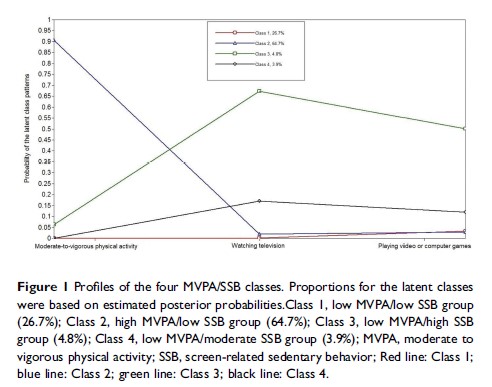
Background and purpose: There are increasing concern about independent associations between physical activity, screen-based sedentary behavior (SSB), and psychological problems, but only a few studies have attempted to explore combined patterns of physical activity and SSB in adolescents and their correlations with psychological problems. This study was aimed at identifying combined patterns of moderate-to-vigorous physical activity (MVPA) and SSB and examining the prevalence of different combined patterns and their correlations with depression, anxiety, and self-injurious behavior among Chinese adolescents.
Methods: Junior and senior high school students (N = 13,659; mean age 15.18±1.89) were recruited. Latent class analysis was conducted to identify combined patterns of MVPA and SSB. Associations between subgroups of MVPA and SSB and socio-demographic characteristics were assessed by logistic regression. Their correlation with depression, anxiety, and self-injurious behaviors was assessed by analysis of variance with analysis stratified by gender.
Results: Four latent classes were identified: high MVPA/low SSB group (64.7%), low MVPA/low SSB (26.7%), low MVPA/high SSB (4.8%), and low MVPA/moderate SSB (3.9%). Generally, the high MVPA/low SSB class was a relatively healthy group. The low MVPA/high SSB class was at risk of enduring depression, anxiety, and self-injurious behavior, with boys being more at risk than girls.
Conclusion: Four latent subgroups of MVPA and SSB were identified in Chinese adolescents. The findings highlight the potential role of concurrent MVPA and SSB, with gender-specific characteristics in the primary prevention of adolescent depression, anxiety, and self-injurious behaviors.
Keywords: exercise, internet, media use, subgroups, mental health, suicide