115195
论文已发表
注册即可获取德孚的最新动态
IF 收录期刊
- 3.6 Breast Cancer (Dove Med Press)
- 4.3 Clin Epidemiol
- 2.6 Cancer Manag Res
- 3.2 Infect Drug Resist
- 4.1 Clin Interv Aging
- 6.1 Drug Des Dev Ther
- 4.1 Int J Chronic Obstr
- 8.7 Int J Nanomed
- 2.5 Int J Women's Health
- 3.2 Neuropsych Dis Treat
- 2.4 OncoTargets Ther
- 2.6 Patient Prefer Adher
- 2.6 Ther Clin Risk Manag
- 3.1 J Pain Res
- 3.5 Diabet Metab Synd Ob
- 4.5 Psychol Res Behav Ma
- 3.4 Nat Sci Sleep
- 2.4 Pharmgenomics Pers Med
- 2.6 Risk Manag Healthc Policy
- 4.6 J Inflamm Res
- 2.3 Int J Gen Med
- 3.9 J Hepatocell Carcinoma
- 3.3 J Asthma Allergy
- 2.5 Clin Cosmet Investig Dermatol
- 3.0 J Multidiscip Healthc

反映血脑屏障破坏的生物标志物在预测中枢神经系统淋巴瘤的风险方面具有重要价值
Authors Yu W, Si M, Li L, He P, Fan Z, Zhang Q, Jiao X
Received 9 July 2019
Accepted for publication 25 September 2019
Published 11 November 2019 Volume 2019:12 Pages 9505—9512
DOI https://doi.org/10.2147/OTT.S222432
Checked for plagiarism Yes
Review by Single-blind
Peer reviewers approved by Ms Rachel Predeepa
Peer reviewer comments 2
Editor who approved publication: Dr Sanjeev Srivastava
Objective: We aimed to identify the biomarkers in cerebrospinal fluid (CSF) that facilitate the diagnosis of lymphomas with central nervous system (CNS) involvement.
Methods: Four cases of non-Hodgkin’s lymphoma (NHL) patients with/without CNS involvement were enrolled respectively, and non-CNS tumor patients (n=3) were selected to be the controls. Lab biomarkers, cytokines, and tight junction proteins (TJs) in CSF and serum were measured.
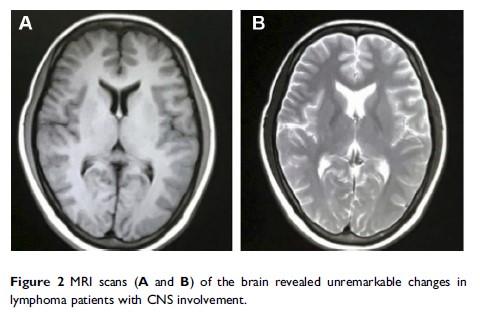
Results: When comparing the CNS to non-CNS group, cytokine including MMP-9 (15.24 vs 0.36 ng/mL), CCL-2 (1922.04 vs 490.68 pg/mL), and sVCAM-1 (61.36 vs 9.00 pg/mL), TJs including OCLN (6.68 vs 2.59 pg/mL), and ZO-1 (710.04 vs 182.98 pg/mL) in CSF were significantly higher in lymphomas patients with CNS involvement than those without CNS involvement. However, serum biomarkers were not significantly elevated. Contrary to the major findings, all conventional biomarkers and MRI results showed no significant change.
Conclusion: CSF biomarkers affecting BBB disruption are valuable in mirroring the risk of lymphoma CNS metastasis. Further study with a larger sample size is needed to verify these biomarkers in predicting lymphoma CNS involvement.
Keywords: lymphoma, CNS metastasis, cytokines, tight junction protein