115195
论文已发表
注册即可获取德孚的最新动态
IF 收录期刊
- 3.6 Breast Cancer (Dove Med Press)
- 4.3 Clin Epidemiol
- 2.6 Cancer Manag Res
- 3.2 Infect Drug Resist
- 4.1 Clin Interv Aging
- 6.1 Drug Des Dev Ther
- 4.1 Int J Chronic Obstr
- 8.7 Int J Nanomed
- 2.5 Int J Women's Health
- 3.2 Neuropsych Dis Treat
- 2.4 OncoTargets Ther
- 2.6 Patient Prefer Adher
- 2.6 Ther Clin Risk Manag
- 3.1 J Pain Res
- 3.5 Diabet Metab Synd Ob
- 4.5 Psychol Res Behav Ma
- 3.4 Nat Sci Sleep
- 2.4 Pharmgenomics Pers Med
- 2.6 Risk Manag Healthc Policy
- 4.6 J Inflamm Res
- 2.3 Int J Gen Med
- 3.9 J Hepatocell Carcinoma
- 3.3 J Asthma Allergy
- 2.5 Clin Cosmet Investig Dermatol
- 3.0 J Multidiscip Healthc

高危型人乳头瘤病毒 E7 通过 APH1B 来实现宫颈癌干细胞样细胞的干性维持
Authors Yang S, Chen T, Huang L, Xu S, Cao Z, Zhang S, Xu J, Li Y, Yue Y, Lu W, Cheng X, Xie X
Received 19 November 2018
Accepted for publication 30 September 2019
Published 12 November 2019 Volume 2019:11 Pages 9541—9552
DOI https://doi.org/10.2147/CMAR.S194239
Checked for plagiarism Yes
Review by Single-blind
Peer reviewers approved by Dr Andrew Yee
Peer reviewer comments 2
Editor who approved publication: Dr Rituraj Purohit
Purpose: To determine whether early proteins from high-risk human papillomavirus (HPV) have the capacity to maintain cellular stemness.
Patients and methods: First, we isolated cancer stem cell like cells from two cervical cancer cell lines, SiHa and CaSki, using non-adhesive culture with serum-free medium. Second, we knocked down HPV16 E7 in SiHa sphere cells and overexpressed HPV16 E7 in U2OS sphere cells. Third, we used RNA-seq analysis and Western blotting to screen and identify the expression of differentially expressed genes in SiHa cells with HPV16 E7 knockdown.
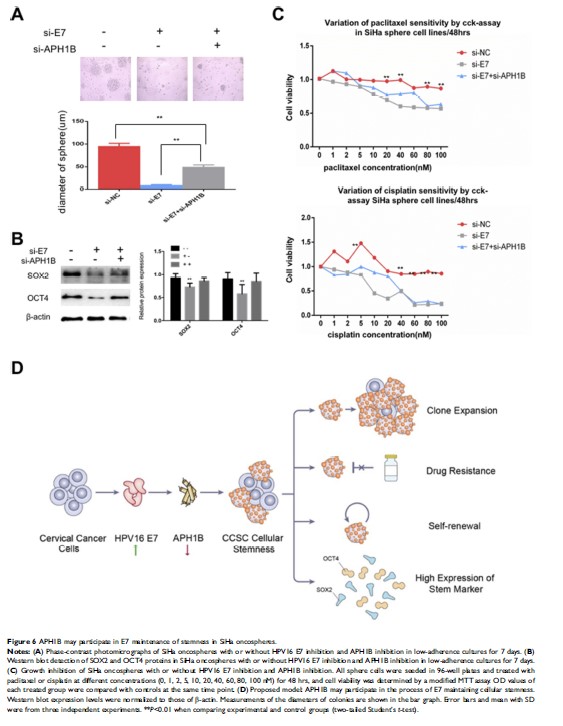
Results: We found that both SiHa and CaSki cells grew as cell spheres (oncospheres) and shared the properties of cancer stem cells, including high expression of stem cell marker OCT4 and SOX2, self-renew, and resistance to chemotherapeutic drugs. The stem-like properties were deprived when HPV16 E7 was knocked down in SiHa sphere cells and maintained when HPV16 E7 was over-expressed in U2OS sphere cells. APH1B was up-regulated, among differential expression genes, in SiHa cells with HPV16 E7 knockdown and modulated cellular stemness and SiHa sphere cells with APH1B knockdown regained the stem-like properties deprived by E7 inhibition.
Conclusion: HPV16 E7 possesses the capacity to maintain cellular stemness and APH1B may participate in this process in cervical cancer sphere cells.
Keywords: cervical cancer, HPV, cancer stem cell, APH1B