115195
论文已发表
注册即可获取德孚的最新动态
IF 收录期刊
- 3.6 Breast Cancer (Dove Med Press)
- 4.3 Clin Epidemiol
- 2.6 Cancer Manag Res
- 3.2 Infect Drug Resist
- 4.1 Clin Interv Aging
- 6.1 Drug Des Dev Ther
- 4.1 Int J Chronic Obstr
- 8.7 Int J Nanomed
- 2.5 Int J Women's Health
- 3.2 Neuropsych Dis Treat
- 2.4 OncoTargets Ther
- 2.6 Patient Prefer Adher
- 2.6 Ther Clin Risk Manag
- 3.1 J Pain Res
- 3.5 Diabet Metab Synd Ob
- 4.5 Psychol Res Behav Ma
- 3.4 Nat Sci Sleep
- 2.4 Pharmgenomics Pers Med
- 2.6 Risk Manag Healthc Policy
- 4.6 J Inflamm Res
- 2.3 Int J Gen Med
- 3.9 J Hepatocell Carcinoma
- 3.3 J Asthma Allergy
- 2.5 Clin Cosmet Investig Dermatol
- 3.0 J Multidiscip Healthc

阿帕替尼在难治性晚期宫颈癌患者的挽救性治疗中的临床价值
Authors Su M, Gao Y, Ye X, Zhou Q, Zhao L, Cai X, Chen D, Su H, Zhang X, Xie C
Received 9 September 2019
Accepted for publication 30 October 2019
Published 14 November 2019 Volume 2019:12 Pages 9707—9713
DOI https://doi.org/10.2147/OTT.S230406
Checked for plagiarism Yes
Review by Single-blind
Peer reviewers approved by Dr Shashank Kaushik (PT)
Peer reviewer comments 2
Editor who approved publication: Dr Arseniy Yuzhalin
Purpose: Apatinib is effective and safe for several advanced or metastatic cancers, but its therapeutic value in cervical cancer is still unknown. The aim of the study was to assess the therapeutic value of apatinib in patients with chemo-refractory advanced cervical cancer.
Patients and methods: This was a retrospective study of patients with advanced cervical cancer treated with apatinib between April 2015 and December 2018 at the First Affiliated Hospital of Wenzhou Medical University, Wenzhou, China. Patients had to have failed at least 2 lines of chemotherapy prior to receiving apatinib. The clinical tumor response was evaluated after 4 weeks of apatinib treatment, and then every 8 weeks (two cycles). Progression-free survival (PFS), overall survival (OS), objective response rate (ORR), disease control rate (DCR), and adverse events were evaluated.
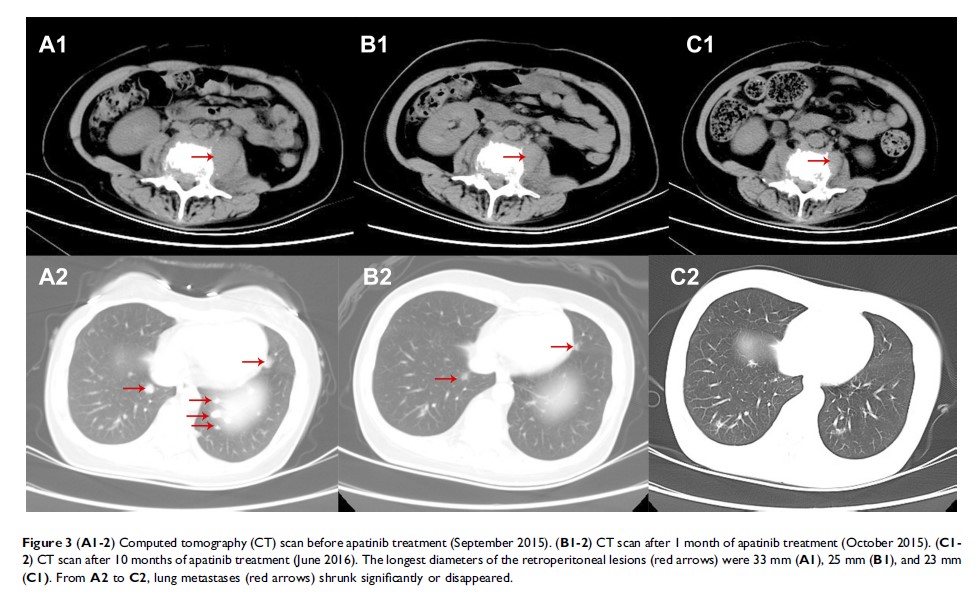
Results: Twenty-five patients were included in this study. The median PFS was 5.8 months (95% CI, 4.65–6.95), and the median OS was 12.2 months (95% CI, 8.99–15.41). ORR was 48% and DCR was 96%. Complete response was not observed. The most common adverse events in this study (all grades) were hand-foot syndrome (48%), hypertension (20%), and mouth mucositis (20%).
Conclusion: Apatinib monotherapy showed good therapeutic value with tolerable adverse events for patients with chemo-refractory advanced cervical cancer.
Keywords: cervix carcinoma, YN968D1, antiangiogenesis drug, efficacy, safety