115195
论文已发表
注册即可获取德孚的最新动态
IF 收录期刊
- 3.6 Breast Cancer (Dove Med Press)
- 4.3 Clin Epidemiol
- 2.6 Cancer Manag Res
- 3.2 Infect Drug Resist
- 4.1 Clin Interv Aging
- 6.1 Drug Des Dev Ther
- 4.1 Int J Chronic Obstr
- 8.7 Int J Nanomed
- 2.5 Int J Women's Health
- 3.2 Neuropsych Dis Treat
- 2.4 OncoTargets Ther
- 2.6 Patient Prefer Adher
- 2.6 Ther Clin Risk Manag
- 3.1 J Pain Res
- 3.5 Diabet Metab Synd Ob
- 4.5 Psychol Res Behav Ma
- 3.4 Nat Sci Sleep
- 2.4 Pharmgenomics Pers Med
- 2.6 Risk Manag Healthc Policy
- 4.6 J Inflamm Res
- 2.3 Int J Gen Med
- 3.9 J Hepatocell Carcinoma
- 3.3 J Asthma Allergy
- 2.5 Clin Cosmet Investig Dermatol
- 3.0 J Multidiscip Healthc

药物干预对一家中国医院使用碳青霉烯类药物的影响:一项前期研究
Authors Xin C, Xia Z, Li G
Received 28 August 2019
Accepted for publication 10 October 2019
Published 15 November 2019 Volume 2019:12 Pages 3567—3573
DOI https://doi.org/10.2147/IDR.S229009
Checked for plagiarism Yes
Review by Single-blind
Peer reviewers approved by Dr Colin Mak
Peer reviewer comments 2
Editor who approved publication: Dr Joachim Wink
Background: The challenge of drug resistance to carbapenems is of international concern with leading to increased hospital lengths of stay, costs, and mortality rates. How to get rid of the vicious cycle of drug resistance, new drugs, and re-resistance, and even the emergence of all-drug-resistant bacteria that humans cannot cope with, are the major challenges we face. To date, data about pharmaceutical interventions on the use of carbapenems are currently limited.
Patients and methods: A retrospective cohort study was conducted to compare pre- and post-intervention in Tongde Hospital of Zhejiang Province. Pharmaceutical interventions were performed in the post-intervention group, including real time monitoring of medication orders, educative group activities, and making interventions to physicians. Intervention acceptance and outcomes, including the length of hospital stay, readmission rates, 30-day mortality, and utilization of carbapenems, which was evaluated by the daily defined doses (DDDs), the days of therapy (DOTs), and the cost of carbapenems, were reviewed.
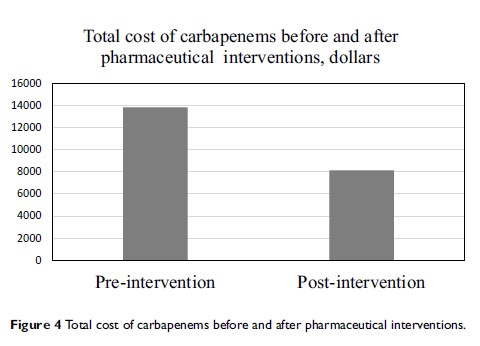
Results: During the study, 593 interventions were provided by clinical pharmacists with an average acceptance rate of 82.79%. Compared with the pre-intervention group, prescriptions of carbapenems for pathogen-directed therapy were improved significantly in the post-intervention group (59.27% vs 21.74%, p =0.022). The DDDs decreased from 281.96 to 174.28 and DOTs decreased from 9.19 to 5.18 after pharmaceutical intervention, and the pharmaceutical interventions had significantly lower mean total cost of carbapenems ($13,828.8 vs $8137.1, p =0.004) and length of hospital stay (9.3±1.5 vs 15.9±2.2, p =0.014). There was a significant reduction in 30-day mortality in the post-intervention group (9.46% vs 17.86%, p =0.013) while there were no differences found in the 30-day readmission (20.19% vs 20.66%, p =0.99).
Conclusion: Implementation of pharmaceutical interventions in our hospital successfully improved the appropriateness of carbapenem prescribing overall, and reduced the DDDs, DOTs, length of hospital day, and cost of carbapenems.
Keywords: carbapenems, pharmaceutical interventions, readmission rates, daily defined doses, days of therapy