115195
论文已发表
注册即可获取德孚的最新动态
IF 收录期刊
- 3.6 Breast Cancer (Dove Med Press)
- 4.3 Clin Epidemiol
- 2.6 Cancer Manag Res
- 3.2 Infect Drug Resist
- 4.1 Clin Interv Aging
- 6.1 Drug Des Dev Ther
- 4.1 Int J Chronic Obstr
- 8.7 Int J Nanomed
- 2.5 Int J Women's Health
- 3.2 Neuropsych Dis Treat
- 2.4 OncoTargets Ther
- 2.6 Patient Prefer Adher
- 2.6 Ther Clin Risk Manag
- 3.1 J Pain Res
- 3.5 Diabet Metab Synd Ob
- 4.5 Psychol Res Behav Ma
- 3.4 Nat Sci Sleep
- 2.4 Pharmgenomics Pers Med
- 2.6 Risk Manag Healthc Policy
- 4.6 J Inflamm Res
- 2.3 Int J Gen Med
- 3.9 J Hepatocell Carcinoma
- 3.3 J Asthma Allergy
- 2.5 Clin Cosmet Investig Dermatol
- 3.0 J Multidiscip Healthc

miR138 的过表达通过小鼠的抗炎反应可缓解坐骨神经损伤引起的轻微神经痛
Authors Zhu B, Gao J, Ouyang Y, Hu Z, Chen X
Received 15 June 2019
Accepted for publication 3 October 2019
Published 18 November 2019 Volume 2019:12 Pages 3135—3145
DOI https://doi.org/10.2147/JPR.S219462
Checked for plagiarism Yes
Review by Single-blind
Peer reviewers approved by Dr Cristina Weinberg
Peer reviewer comments 2
Editor who approved publication: Dr Katherine Hanlon
Background: The emerging role of inflammation in the initiation and maintenance of neuropathic pain has been confirmed. Previous studies have reported that miR138 has neuroprotective and anti-inflammatory effects in animal models of spinal cord injury and in human coronary artery endothelial cell injury, while its effect on neuropathic pain is still not known. As the mechanism of neuropathic pain remains unclear, we investigated whether miR138 is involved in the development of neuropathic pain and the role of miR138 in the modulation of inflammation in the spinal cord in a mouse model of neuropathic pain induced by spared sciatic nerve injury (SNI).
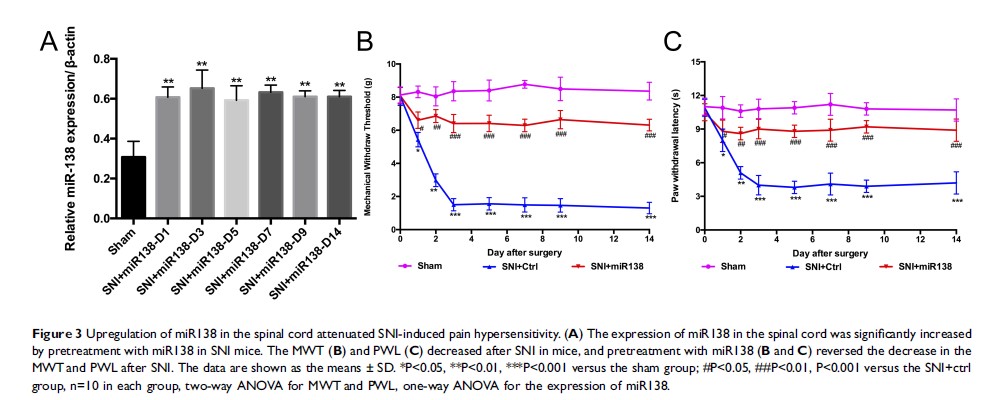
Materials and methods: Firstly, the expression of miR138 in spinal cord was evaluated on days 1, 3, 5, 7, 9 and 14 after SNI. And then, LV-miR-control and LV-miR138 were intrathecally injected 1 week before the surgery followed by investigation of the expression of miR138, mechanical allodynia and thermal hyperalgesia on day 1, 3, 5, 7, 9, 14 after SNI. Ipsilateral L4-L6 spinal cord tissue was harvested on day 14 post-SNI and detected by Western blotting, enzyme-linked immunosorbent assay or immunohischemistry.
Results: We observed decreased expression of miR138 and increased expression of proinflammatory cytokines, along with activated microglia, astrocytes and nuclear factor-κВ (NF-κВ), in the spinal cord dorsal horn after SNI. Moreover, the intrathecal upregulation of miR138 significantly alleviated SNI-induced mechanical allodynia and thermal hyperalgesia, downregulated the production of proinflammatory cytokines, and deactivated microglia, astrocytes and NF-κВ.
Conclusion: The results indicate that miR138 contributes to the development of neuropathic pain and that the overexpression of miR138 alleviates pain hypersensitivity by inhibiting proinflammatory cytokine production and glial activation, which suggests a novel target for reducing neuropathic pain.
Keywords: neuropathic pain, miR138, spared sciatic nerve injury, NF-κВ