115195
论文已发表
注册即可获取德孚的最新动态
IF 收录期刊
- 3.6 Breast Cancer (Dove Med Press)
- 4.3 Clin Epidemiol
- 2.6 Cancer Manag Res
- 3.2 Infect Drug Resist
- 4.1 Clin Interv Aging
- 6.1 Drug Des Dev Ther
- 4.1 Int J Chronic Obstr
- 8.7 Int J Nanomed
- 2.5 Int J Women's Health
- 3.2 Neuropsych Dis Treat
- 2.4 OncoTargets Ther
- 2.6 Patient Prefer Adher
- 2.6 Ther Clin Risk Manag
- 3.1 J Pain Res
- 3.5 Diabet Metab Synd Ob
- 4.5 Psychol Res Behav Ma
- 3.4 Nat Sci Sleep
- 2.4 Pharmgenomics Pers Med
- 2.6 Risk Manag Healthc Policy
- 4.6 J Inflamm Res
- 2.3 Int J Gen Med
- 3.9 J Hepatocell Carcinoma
- 3.3 J Asthma Allergy
- 2.5 Clin Cosmet Investig Dermatol
- 3.0 J Multidiscip Healthc

每天吃绿色蔬菜与轻度认知障碍之间的关联:上海以社区为本的横断面调查
Authors Li W, Sun L, Yue L, Li G, Xiao S
Received 27 June 2019
Accepted for publication 28 October 2019
Published 18 November 2019 Volume 2019:15 Pages 3213—3218
DOI https://doi.org/10.2147/NDT.S221074
Checked for plagiarism Yes
Review by Single-blind
Peer reviewers approved by Dr Cristina Weinberg
Peer reviewer comments 2
Editor who approved publication: Dr Yuping Ning
Background: Emerging evidence has suggested that green vegetables may prevent cognitive decline.
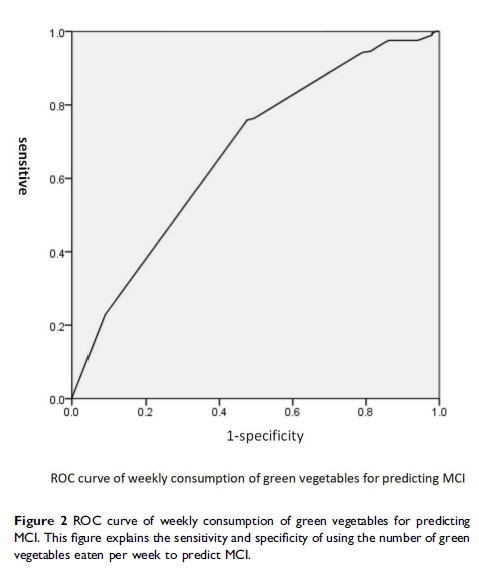
Methods: We examined the cross-sectional association between green vegetables intake and mild cognitive impairment (MCI) using data from 525 participants aged 55 years and above from the China Longitudinal Aging Study (CLAS) in Shanghai.
Results: Compared with participants who did not eat green vegetables every day, those who had consumed green vegetables every day had a significantly lower risk of mild cognitive impairment (MCI) (OR = 0.218, 95% CI, 0.116–0.411, p < 0.001), and this association was independent of age, education, having hobbies, surfing the Internet, sleep time per night (youth), long-term residency and consumption of specific red food, such as meat, bread, bean curd, and ginger.
Conclusion: In summary, using community-based data in Shanghai, we found out that subjects who eat green vegetables every day have significantly lower odds of MCI than those who do not eat every day. Based on current evidence, we propose that eating green vegetables every day might be a potential preventive measure to slow cognitive decline and neurodegeneration in the elderly.
Keywords: elderly, Chinese, dietetic association, green vegetables, cognitive impairment